



A Mount Toubkal trek ends at 4,167 metres, on the highest summit in Morocco and in the whole Atlas range, yet it begins in a village about an hour and a half by road from Marrakech airport. In summer conditions the normal route needs no ropes and no climbing technique. What it does need is stamina for one very long day, enough time to adjust to the altitude and a clear idea of the season you are walking in.
This guide covers how many days to plan, how the route from Imlil unfolds, how hard climbing Toubkal really is, the best time to go and what to pack. Distances, walking times and height gains come from the itineraries we walk with our groups.
Mount Toubkal at a glance
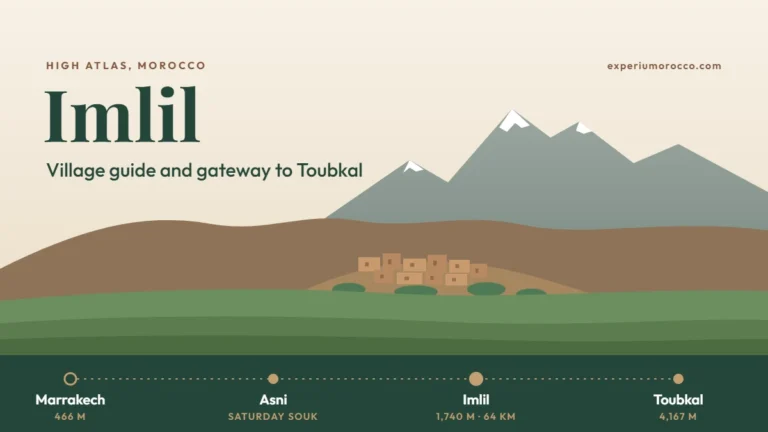
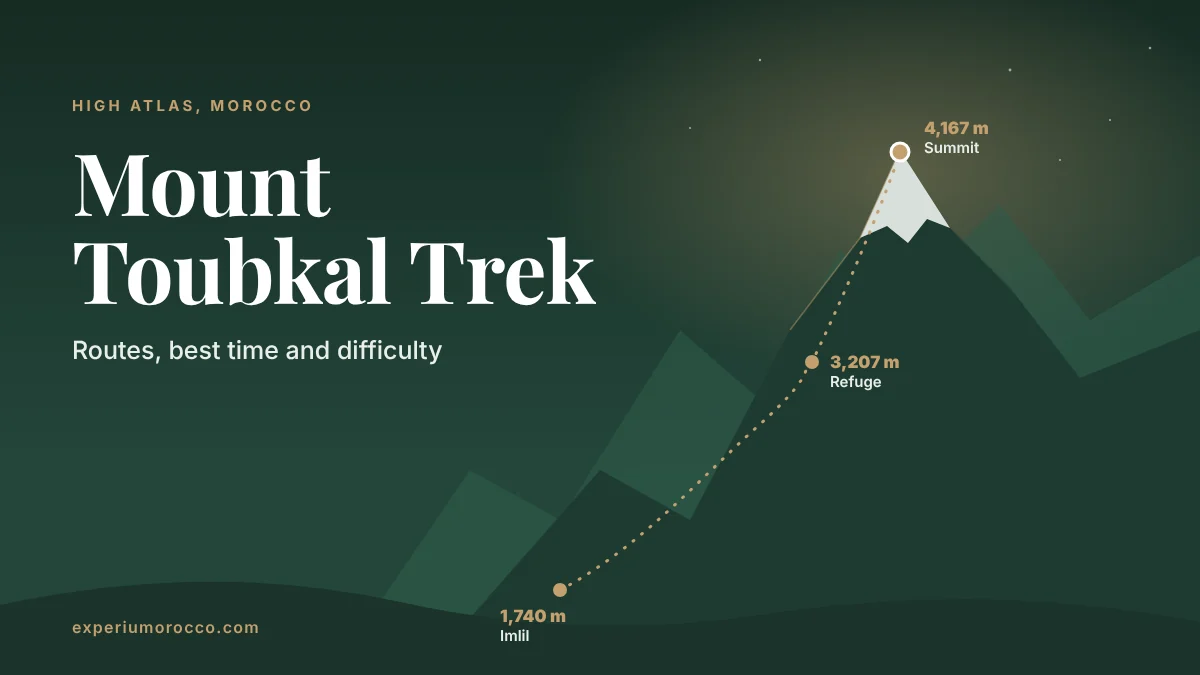
The height of Mount Toubkal is 4,167 m. It is the highest peak in Morocco, in the Atlas Mountains and in North Africa, and it rises inside Toubkal National Park, south of Marrakech. Most walkers start from Imlil, a mountain village 64 km from the city by road.
Between the village and the top lie 2,427 metres of ascent. The classic plan splits them in two: a long walk up to the refuge, then a pre-dawn start for the summit the next morning.

How many days do you need?
Plan at least two walking days from Imlil, which means four days for a Mount Toubkal trek starting and ending at Marrakech airport. The real decision is how much time you give your body before summit day, and whether you want other peaks along the way. Four formats make sense, from a short walk below the mountain to a six-day circuit.
One-day visit to the national park (no summit)
With a single free day you will not reach the top, but you can still walk inside the park. The road climbs from Marrakech through Asni, known for its Saturday souk, to Imlil. From there a local guide leads a walk of about an hour and a half to Aremd, a village inside the park with Toubkal on the skyline. A mule can carry you on that stretch if you prefer. Count roughly eight hours for the whole outing. The Toubkal National Park and Imlil day trip from Marrakech follows exactly this route, and it is a fair way to see the terrain before committing to the climb.
4-day trek with summit
- Day 1Arrival in Marrakech, free afternoon in the medina
- Day 2Imlil to the Toubkal refuge (3,207 m) by the classic path12 km · about 6 h · +1,460 m / −20 m
- Day 3 · Summit daySummit (4,167 m), back to the refuge, then down to Imlil or Tamatert21 km · 9 to 11 h · +980 m / −2,440 m
- Day 4Transfer from Imlil to Marrakech airportAbout 1 h 30 by road
This is the shortest Mount Toubkal trek that still reaches the top, and the hardest on the body: your first night in the mountains is already at 3,207 m, and summit day includes 2,440 m of descent. It suits people who hike in the mountains regularly and are short on time. The stage details are on the 4-day Toubkal trek with summit climb page.
5-day trek with summit
Same summit, gentler approach. Instead of heading straight up the main valley, you spend the first mountain night at the Tamsoult refuge (2,250 m), on a quieter path.
- Day 1Arrival in Marrakech, free time in the city
- Day 2Imlil, the Tizi Oudite pass and the Azzadene valley to the Tamsoult refuge12 km · 5 to 6 h · +950 m / −350 m
- Day 3The “path of a hundred bends” to the Aguelzim pass (3,520 m), then down to the Toubkal refuge14 km · 7 to 8 h · +1,420 m / −430 m
- Day 4 · Summit daySummit in about 3 to 4 hours, descent over Tibheirine (3,887 m), then down to Imlil19 km · 9 to 10 h · +980 m / −2,320 m
- Day 5Short morning walk out of Imlil and drive back to Marrakech
That extra night below 3,000 m is the main difference. If you have never slept at altitude, it is the format we would point you to first, and the 5-day Toubkal trek from Marrakech follows this route.
6-day Toubkal circuit
For walkers who want more than one 4,000. This circuit takes the same quiet approach through Tamsoult, spends two nights at the Toubkal refuge and adds Ras Ouanoukrim and Timesguida the day after the summit.
- Day 1Arrival in Marrakech, free time in the city
- Day 2Imlil (1,740 m) over the Tizi Mzik pass to the Tamsoult refuge (2,250 m)12 km · 5 to 6 h · +950 m / −350 m
- Day 3Irhoulidene waterfall and the Aguelzim pass to the Toubkal refuge14 km · 7 to 8 h · +1,420 m / −430 m
- Day 4 · Summit dayToubkal summit as a round trip from the refuge, by the Toubkal pass (3,950 m)9 km · 7 to 8 h · +1,030 m / −1,030 m
- Day 5 · Two more summitsRas Ouanoukrim (4,083 m) and Timesguida (4,088 m), with a few easy scrambling passages, then down to Imlil21 km · 10 to 11 h · +990 m / −2,320 m
- Day 6Transfer from Imlil to Marrakech airportAbout 1 h 30 by road
The full stages are on the 6-day Toubkal circuit with Ras Ouanoukrim and Timesguida.
The standard route from Imlil
The normal route follows the valley above Imlil to the refuge at 3,207 m on the first day, then climbs from the refuge to the summit and back down on the second.
Imlil to the refuge
The classic path climbs steadily up the valley from Imlil. Along the way, small stalls sell juice, dried fruit and local snacks, and the trail passes right by the shrine of Sidi Chamharouch. Mules carry the main bags, so you walk with a daypack of 15 to 20 litres.
The Refuge du Toubkal sits at 3,207 m. Rooms are shared and beds are bunks. Everyone heading for the summit gathers here, so expect walkers from many countries and an early night.
Summit day and descent
You leave before dawn with a headlamp. The path is steep but, outside snow conditions, it has no technical difficulty. Plan on three to four hours from the refuge to the top, with short stops to drink and eat. From the summit the view takes in the Atlas chain and the Siroua massif.
The part most people underestimate is the way down. On the 4-day format you lose 2,440 metres in a single day, first back to the refuge for a meal, then all the way to Imlil. Telescopic poles make a real difference to your knees here.

How hard is Toubkal?
Toubkal is not a technical climb in summer conditions, but it is a demanding trek. The ground is high-mountain terrain: paths, uneven ground and scree. On the shortest format, summit day lasts 9 to 11 hours and includes more than 2,000 metres of descent. The main hazards of the summer ascent are scree, slippery slopes and altitude sickness, which matches what we see on the mountain.
Fitness and previous experience
Climbing Toubkal is realistic for people who exercise regularly or who are used to full-day walks with large height gains. A previous multi-day trek and some time in high mountains help a lot. A simple check: if you have not walked 9 or 10 hours in a day recently, build up to it in the weeks before, or choose a format with an extra night.
Altitude and acclimatisation
According to the NHS, altitude sickness usually appears above 2,500 m, often 6 to 10 hours after arrival. Typical signs are headache, nausea, dizziness, tiredness, loss of appetite and poor sleep. The NHS advises going up slowly, spending time below 2,500 m before climbing higher, drinking enough water and avoiding big height gains in a single day.
The Toubkal refuge, at 3,207 m, is already above that threshold. On the 4-day format it is your first mountain night. On the 5 and 6-day formats you sleep first at Tamsoult, 2,250 m, which follows that advice more closely. Whatever the itinerary, tell your guide as soon as a headache starts: it is far easier to act early than at 4,000 m.
Best time to climb Toubkal
The best time to climb Toubkal on foot, without winter equipment, is the window from April to October. That is the period we recommend for our treks. Climbs still take place outside it, but the route then depends on snow and weather, and may change on the day.
- J
- F
- M
- A
- M
- J
- J
- A
- S
- O
- N
- D
Spring and autumn
Spring can still hold snow high up. Wikipedia’s Toubkal entry notes that crampons are needed for late-winter and spring ascents, and that an ice axe may still be useful on the last snowfields in early summer. For an April or May date, check current conditions with your guide before you travel.
October closes the recommended window at the other end of the year.
Summer heat
From May, the normal route is free of technical difficulty, which makes summer the simplest season underfoot. The challenge is heat lower down: Marrakech, where most trips start and end, averages daily highs of about 37 °C in July and August. Start walking early, carry at least one litre of water and keep sunglasses, sun cream and a cap at hand.
Winter: snow, crampons and why a guide matters
Mount Toubkal in winter is a different climb. The mountain is covered in snow and ice and can be exposed to avalanches, and crampons stop being optional.
This is where an experienced guide matters most: choosing the line on hard snow, reading the weather and deciding when to turn back. A winter ascent should always be planned around the conditions of the day, not around a fixed timetable.
Do you need a guide?
A guide is strongly advised. The UK government’s travel advice for Morocco recommends hiring a professional guide for hikes in the Atlas Mountains. Local access rules can change, so check the current requirement shortly before your trip.
On the treks we organise, a local mountain guide walks with the group, a cook prepares the meals and mules carry the bags. In practice the guide sets the pace, manages water and food, handles the refuge logistics and makes the turnaround call if the weather or someone’s condition requires it. On a mountain this size, that last decision is the one that counts.
What to pack for Toubkal
Your kit has to cover a warm walk-in and a cold pre-dawn start on summit day. This is the kit list we use for our Toubkal treks, grouped by use.
- BagsA 40 to 45 litre backpack or duffel for the mules, and a 15 to 20 litre daypack you carry yourself.
- LayersThree technical T-shirts and two thermal base layers, a fleece or light down jacket, and a waterproof shell (Gore-Tex type). Long hiking trousers, shorts and a spare pair of trousers.
- Feet and handsMid or high-cut hiking boots, three pairs of socks, telescopic poles, thin gloves plus thick gloves for summit day, and sandals or Crocs for the refuge.
- Night and summit morningA three-season sleeping bag (comfort +5 °C), a headlamp with spare batteries, a beanie and a neck gaiter.
- Sun and waterSunglasses, sun cream, lip balm, a cap and a bottle of at least one litre.
- Papers and extrasValid passport, personal medication, an emergency blanket, chargers, optional earplugs for the refuge and cash for drinks and tips (around €50 to €80, indicative).
Insurance. On our treks you need either a federation licence with mountain cover valid in Morocco or accident insurance that covers the activity. Travel insurance is not included in trek prices, and neither are extra costs caused by bad weather, cancellations or altitude sickness, so read your policy before you go.
Getting from Marrakech to Imlil
Imlil lies 64 km from Marrakech. The road passes Asni, then follows a green valley where Berber villages are built in terraces above the fields. On our treks the transfer to Imlil and back is included, so the first day of walking starts from the village.
Allow for the return when you book your flight home. The drive from Imlil to Marrakech airport takes about an hour and a half, which is why we ask for flights leaving at 12:00 or later on the last morning.

FAQ
What is the height of Mount Toubkal?
4,167 metres, the highest point in Morocco and in the Atlas Mountains. The usual base, the Refuge du Toubkal, stands at 3,207 m, and the trailhead village of Imlil at 1,740 m.
How hard is Toubkal for a first-timer?
The normal route is not technical outside snow conditions, but summit day is long and ends with a big descent. It suits people who exercise regularly and are used to full-day walks. For a first high-altitude trek, a format with a night at Tamsoult (2,250 m) gives your body more time to adjust.
What is the best time to climb Toubkal?
April to October. Snow can linger high up in spring, and July and August are the hottest months in Marrakech. Outside that window, expect winter conditions and an itinerary that depends on the snow.
Can you climb Mount Toubkal in winter?
Yes, but it becomes a winter mountain ascent. The slopes are covered in snow and ice, avalanches are possible and crampons are required, so go with an experienced guide and a flexible plan.
How many days do you need for a Mount Toubkal trek?
Two walking days from Imlil is the minimum, which makes a 4-day trip from Marrakech airport. A 5-day format adds an acclimatisation night, and a 6-day circuit adds two more 4,000 m peaks.
What insurance do you need for a Toubkal trek?
On our treks, a federation licence with mountain cover valid in Morocco or accident insurance covering the activity is mandatory. Check that your policy also covers mountain rescue and delays caused by weather.