

Toubkal is only the beginning of trekking in the Atlas Mountains. East of it, the central High Atlas has a second 4,000 m summit, deep gorges and the green Aït Bouguemez valley. To the south, the dry Jbel Saghro is the place to walk in winter. These are the treks we guide beyond Toubkal, and how to choose between them.
For a second 4,000 m peak, trek M’Goun in the central High Atlas, between April and November. For dramatic cliffs and some exposed scrambling, choose the Taghia cirque and the Happy Valley. For winter trekking, go south to the volcanic Jbel Saghro, from September to April. All these treks last 7 to 9 days from Marrakech, with mules carrying the luggage.
The best treks in Morocco beyond Toubkal, at a glance
Six multi-day treks, three in the central High Atlas and three further south or west. The table compares their length, high point, season and the kind of walking to expect.
| Trek | Region | Trip length | High point | Season | Terrain |
|---|---|---|---|---|---|
| M’Goun and the Happy Valley | Central High Atlas | 7 days | M’Goun summit | April to November | Long ridge, no technical difficulty |
| M’Goun and the Achabou gorges | Central High Atlas | 9 days | M’Goun summit | June to September | Summit, then wading through a canyon |
| Taghia and the Happy Valley | Central High Atlas | 7 days | 3,253 m | On request | Easy but exposed scrambling on day 2 |
| Jbel Saghro | South of the High Atlas | 9 days | Kouaouch, 2,600 m | September to April | Rocky paths, canyons, one steep descent |
| Draa Valley desert trek | Lower Draa Valley | 9 days | Low desert | October to April | Palm groves, hamada and dunes |
| Atlantic coast to Essaouira | Coast south of Essaouira | 8 days | Coastal hills | February to December | Cliff paths and beaches |
Trip length counts every day from arrival in Marrakech to departure. Source: our own itineraries.
Why trek beyond Toubkal?
Toubkal, at 4,167 m, is the highest summit in North Africa, with a well-trodden route from Imlil. If that is your goal, our guide to climbing Mount Toubkal covers it. The treks below are a different kind of Atlas Mountains trekking: a week of walking from valley to valley, village to village, with a summit or a gorge along the way rather than as the whole point.
Three things set them apart:
- Fewer trekkers. The central High Atlas and the Saghro see far fewer walkers than the Toubkal area.
- Longer journeys. You walk for five or six days, sleeping in camps, shepherd huts and village guesthouses.
- Different landscapes. Tall cliffs, high plateaus, volcanic rock, desert and ocean, depending on the trek.
M’Goun: Morocco’s other 4,000 m peak
Ighil M’Goun rises to 4,071 m in the central High Atlas, the third highest peak of the Atlas Mountains after Toubkal and Ouanoukrim. The area around it is a UNESCO Global Geopark. Despite the altitude, the normal route to the top is not technical: it follows a long, broad ridge that can hold snow, and the view from the summit reaches far across the range.
- Summit4,071 m
- StartAït Bouguemez valley
- Drive from MarrakechAbout 5 hours
- Highest passOver 3,300 m
Summit height and ranking: Wikipedia.
Both of our M’Goun treks start the same way. After a drive of about five hours from Marrakech to the Aït Bouguemez valley, you walk an hour to the first camp at Ikkis. The next day climbs gently through box and juniper to a high pass, with the whole M’Goun ridge in view, then drops to the Tarkeddit plateau, near the springs of the Tessaout, at around 2,900 m. Summit day follows the ridge to the top and comes down by the Tizi n’Oumsoud pass, at 2,970 m. After that, the two treks go different ways.
Back to the Happy Valley, in 7 days
The shorter version returns north to the Aït Bouguemez valley, the “Happy Valley”, for a last night in a village guesthouse before driving back to Marrakech by the Ouzoud waterfalls. It runs from April to November. If you do not feel like the summit on the day, there is a muleteers’ route that passes below it and reaches the same camp in the Oulilimt valley. All of this is our M’Goun trek with the Happy Valley.
Down the Achabou gorges, in 9 days
The longer version keeps going south, about 100 km on foot in six days. Below the summit, you follow the M’Goun river down past villages such as El Mrabitine, with its fortified house, and Taghreft. Then comes the Achabou narrows, where the canyon walls rise more than 1,200 m above you and the passage is only a few metres wide. There is no path left: you walk in the river, with water up to your calves.
The trek ends in the Boutaghrar valley, and the drive back to Marrakech stops at Aït Ben Haddou. It runs from June to September. Details are on our M’Goun summit and Achabou gorges trek page.
- Bring warm clothes for summit day and for the two nights around 3,000 m, even in summer.
- Pack shoes you can wade in for the Achabou gorges.
Taghia cirque and the Happy Valley
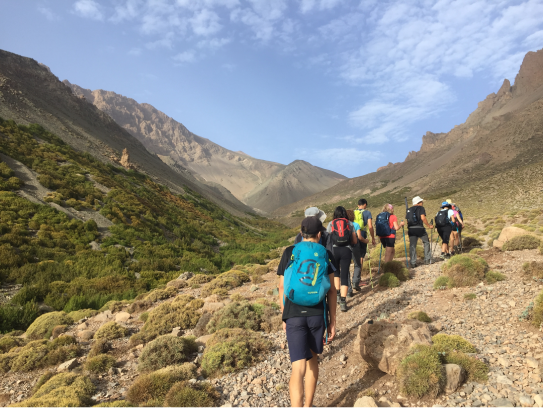
This is the most dramatic trek of the central High Atlas, and the only one here with exposed ground. It starts near Zaouiat Ahansal and walks up a gorge to the cirque of Taghia, closed by rock walls more than 800 m high. Then it climbs out of the cirque and crosses high, empty country before coming down into the Happy Valley.
- Agoudim to Taghia. From the end of the track, at 1,600 m, up the gorge into the cirque, at 1,880 m.
- Taghia to Mdint Jdid. The key day: a steep climb, a passage through an underground corridor called Inifif, “the funnel”, then airy ledges with short, easy but exposed scrambling. The mules take another way.
- The Ifrilzem ridge. A long, bare ridge close to or above 3,000 m, reaching 3,253 m, then down to the Izourar lake, often dry.
- Down to the Happy Valley. On the herding paths of the Aït Atta nomads, through holm oak, ancient juniper and box.
- Through the valley to Agouti. Dinosaur footprints, the Sidi Moussa granary on its hill, and a night in a village guesthouse.
The drive back to Marrakech stops at the Ouzoud waterfalls. Day 2 is the reason to think twice: you need to be sure-footed and comfortable with heights. If that is you, this is our Taghia cirque and Happy Valley trek.

Jbel Saghro: trekking in winter
When the High Atlas is under snow, walk in the Jbel Saghro. This range of dark rock lies south of the High Atlas, between the Dades Valley and the Sahara. Its highest point is Amalou n’Mansour, at 2,712 m, and it is the driest mountain area of the whole Atlas system. That is exactly what makes it good from September to April and very hot from June.
- The Saghro is the traditional home of the Aït Atta, a Berber people who still move with their herds. In summer, many go up to the cooler pastures of the Aït Bouguemez valley, where the M’Goun treks start.
Our trek walks for six days, 4 to 8 hours and 12 to 20 km a day, from the village of Tagdilt south of Kelaat M’Gouna. The best day climbs Kouaouch, at 2,600 m, with views over the Saghro and the pre-Saharan mountains, then drops steeply to the Igli oasis. Later come the Afourar gorges, with a few simple canyoning moves, a camp at Tiblah, the rock towers of Bab n’Ali and a night by the Tazlout waterfall.
- Winter nights are cold: at the Almou n’Ouarg camp, at 2,300 m, the temperature drops below 0 °C.
- Water is very scarce on the first day: carry enough from Tagdilt.
You will find the full programme on our Jbel Saghro trek page.
Highest point, climate and Aït Atta: Wikipedia.

Beyond the mountains: desert and coast treks
Two of the best treks in Morocco are not in the mountains at all. They follow the same idea, walking from camp to camp with a team, but in the desert and along the ocean.
The Draa Valley on foot
In the lower Draa Valley, you walk between palm groves, stony hamada and dunes, with camels carrying the water, food and bags. Days are 5 to 7 hours and 14 to 18 km, from October to April, with nights in bivouacs among the dunes of Tidri, Erg Sahel and Ras Errich. It is our Draa Valley desert trek from Marrakech, and our guide to desert trips from Marrakech shows how it compares with the classic desert tours.
The Atlantic coast to Essaouira
South of Essaouira, there is no coast road for a long stretch: just cliffs, coves, dunes and long, almost empty beaches. This trek follows them north for five days, 5 to 7 hours a day, crossing the argan-covered Igzoulne hills and sleeping on the beach or in the Iftan dunes. Camels carry the bags. You walk into Sidi Kaouki along the sand and finish in Essaouira. It runs from February to December, and the programme is on our Atlantic coast trek to Essaouira page.
- The beaches are almost deserted: swim only when the sea allows it, and with great care.
Which trek for which season?
Trek the high mountains from spring to autumn, and the south in winter. Between them, these treks cover the whole year.
Source: the season set for each of our treks.
The overlap is in spring and autumn. In April, October and November, you can choose between the M’Goun, the Saghro, the Draa Valley and the coast. In July and August, choose the M’Goun or the coast: the Saghro is very hot from June.
How hard are these treks?
You do not need to be an experienced mountaineer, but you do need to be fit enough to walk five to seven hours a day for several days in a row. Most of these treks are rated moderate effort and easy technical difficulty. A few points make the difference:
- You only carry a day pack. Mules carry the bags in the mountains, and camels in the desert and on the coast.
- Altitude is real on the M’Goun. You sleep around 2,900 m before the summit, and the climb to that plateau is the most demanding stage.
- Taghia asks for a head for heights. The scrambling on day 2 is easy but exposed.
- Heat is the main effort in the Saghro. The stage after the Tazlout waterfall is demanding because of the heat and the climbing.
What to pack for a multi-day trek
Pack for big temperature changes between day and night, and in a soft bag the animals can carry.
- A sleeping bag. Camping gear is provided, but sleeping bags are not included on the Saghro, Draa Valley, Atlantic coast and Achabou treks.
- A soft travel bag rather than a suitcase, for the mules or camels.
- A small day pack for water, a camera and your passport.
- Broken-in walking boots. Wear them on the plane, in case your luggage goes missing.
- Warm layers for cold nights in the mountains and in the desert in winter.
- Sun protection: hat, sunglasses and sun cream.
- A personal first-aid kit.
FAQ
What is the best trek in the Atlas Mountains apart from Toubkal?
For a summit, the M’Goun, a 4,071 m peak with no technical difficulty on its normal route. For scenery, the Taghia cirque and the Happy Valley. For winter, the Jbel Saghro, south of the High Atlas.
How high is M’Goun, and is it hard to climb?
Ighil M’Goun is 4,071 m high, the third highest peak of the Atlas Mountains. The ascent follows a long, broad ridge without technical difficulty, but you need to be fit and ready for cold and altitude.
Where is the Happy Valley in Morocco?
The Happy Valley is the Aït Bouguemez valley, in the central High Atlas, about five hours’ drive from Marrakech. It is the starting point of the M’Goun treks and the end of the Taghia trek.
When is the best time for hiking in the Atlas Mountains?
For the high mountains, from late spring to autumn: our M’Goun treks run from April to November, or June to September for the Achabou gorges. For the Jbel Saghro and the desert, from September or October to April.
Can you trek in Morocco in winter?
Yes. The Jbel Saghro, the Draa Valley and the Atlantic coast are all good winter treks. Expect cold nights in the Saghro, below 0 °C at the highest camp.
Do I carry my own luggage?
No. On all these treks, mules or camels carry the bags and camping gear. You only carry a day pack.