

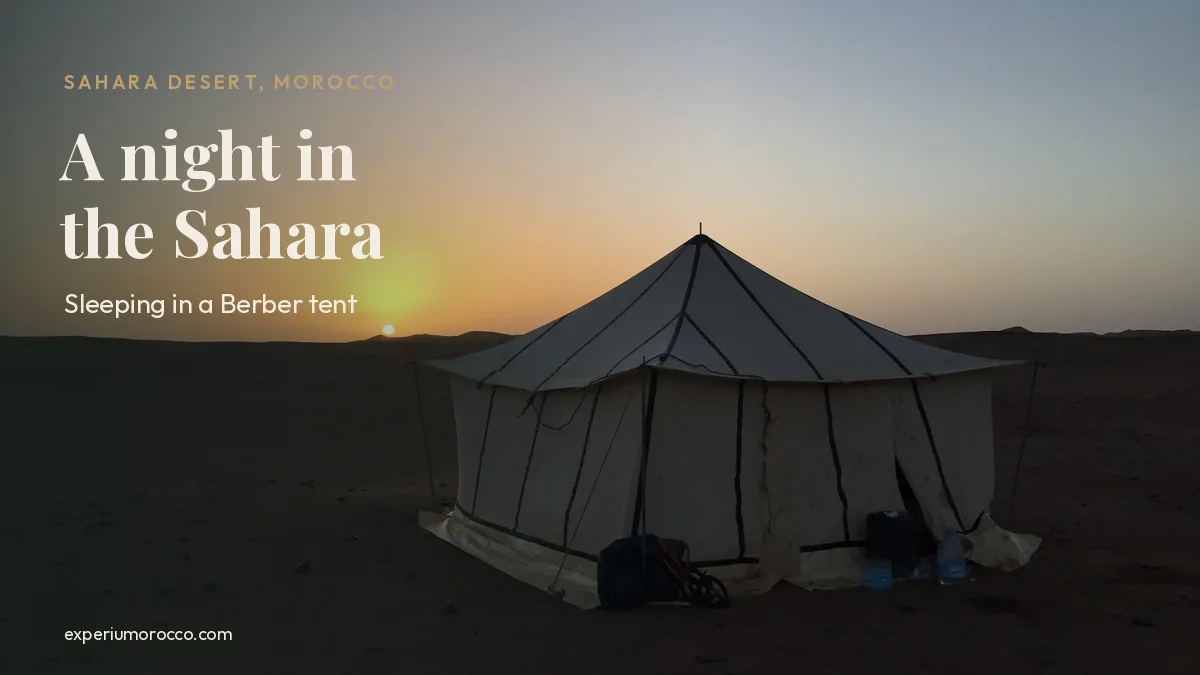
A night in the Sahara desert is what many travellers remember most from southern Morocco: reaching camp on a camel as the sun goes down, drinking tea by the fire and sleeping in a Berber tent surrounded by dunes. This guide explains what these tents really are, how a night in a Morocco desert camp unfolds, how cold it gets and what to pack, with photos taken on our own routes.
The traditional tent of North Africa’s nomads is called a khaima, and travellers usually call it a Berber tent. In desert camps you sleep in fixed tents, some with a private bathroom and shower; on treks you sleep in tents pitched every evening. The night starts at sunset with tea, dinner, a fire and music, and ends with sunrise over the dunes. From October to April the days are pleasant, but the nights are cold.
What is a Berber tent?
In Morocco the word is khaima, sometimes written haima: the tent of the nomadic peoples of North Africa. In English it is usually called a Berber tent, and that is the name you will find in most desert tour descriptions.
Nomad tents are not a thing of the past. In the south, on the lands of the Aït Atta, one of the last nomadic tribes in Morocco, shepherd families still live in large goat-hair tents and move with their flocks. You may come across them on our walking routes, especially in winter.
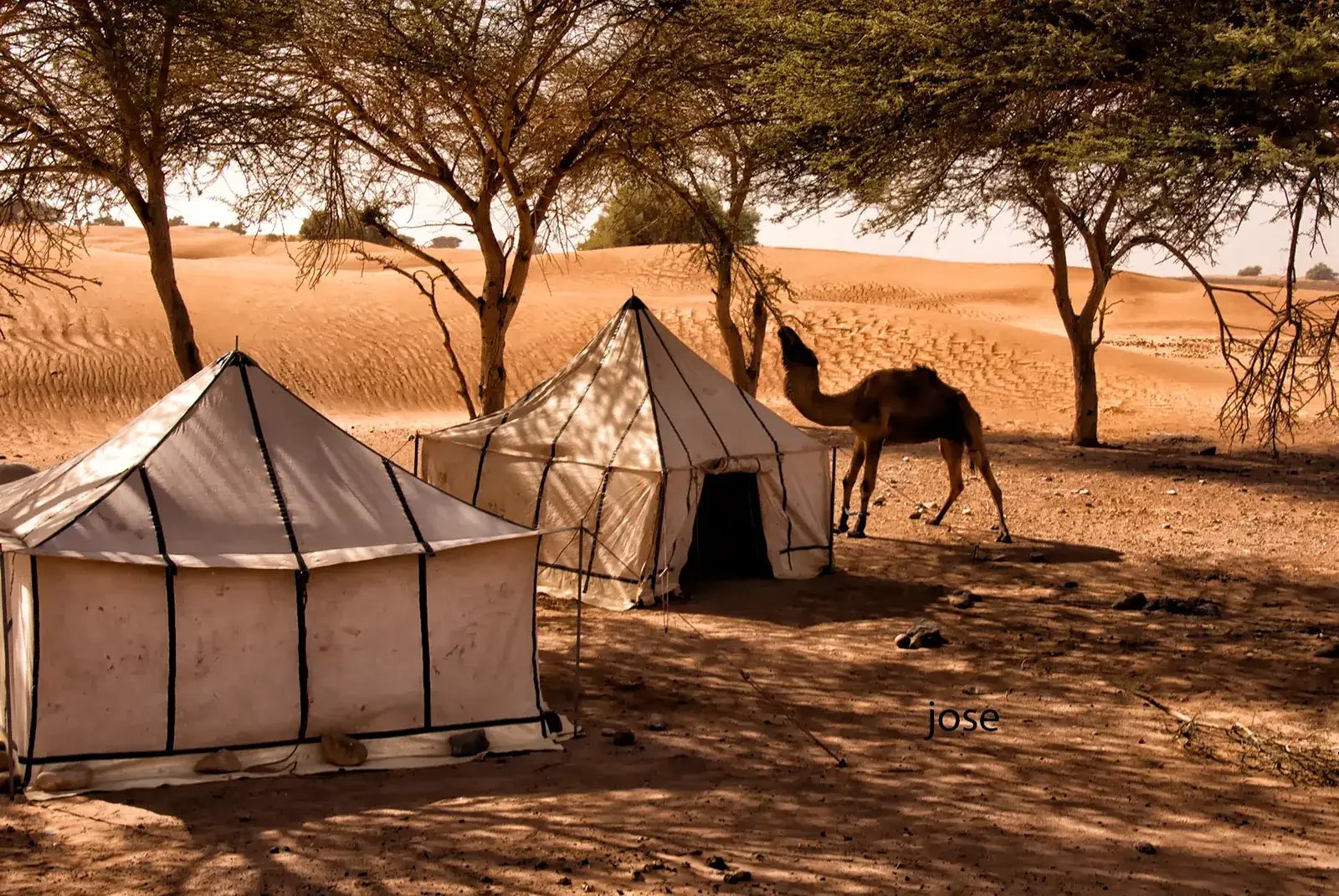
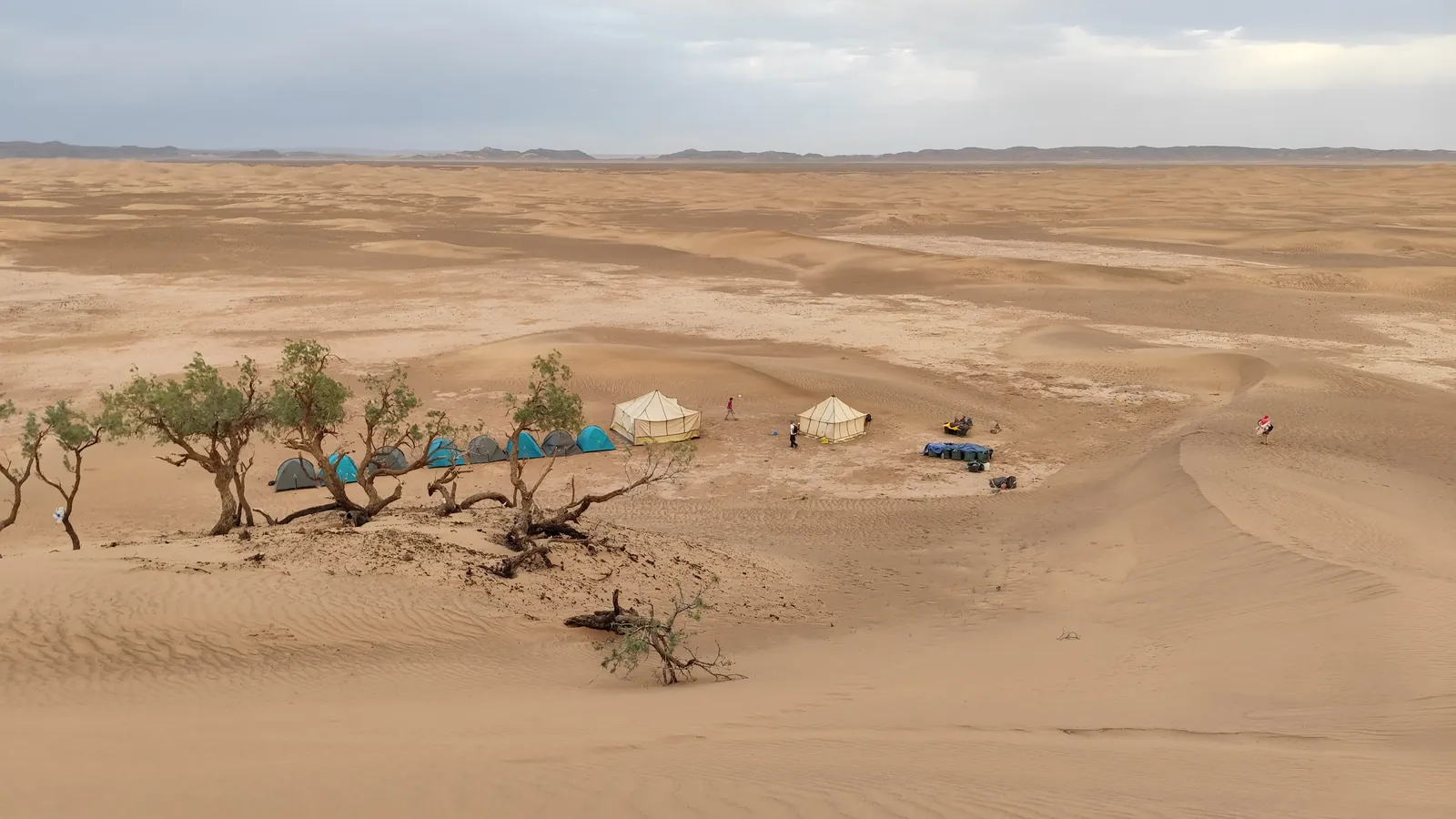
The tent you sleep in as a traveller is something else: a large canvas tent, like the ones in the photo, pitched in a camp. Inside, they vary a lot from one camp to another, from simple tents to superior ones with a private bathroom and shower.
Berber tent, trekking tent or open sky: four ways to sleep in the desert
When people ask us about a night in the Sahara desert, they usually picture a Berber tent. In practice there are several ways to spend the night, and the difference lies less in the tent than in the kind of trip. These are the four we offer, from the most comfortable to the most adventurous.
- Superior Berber tentPrivate tent with bathroom and shower at a camp among the Erg Chebbi dunes, in Merzouga.
- Tuareg tent at a campA full-board night at a camp near Zagora, reached by camel.
- Trekking tentOn walking routes, camp is pitched in a new spot every evening and tents are shared.
- Under the starsAt Erg Chigaga you can choose to sleep outside the tent, in the open.
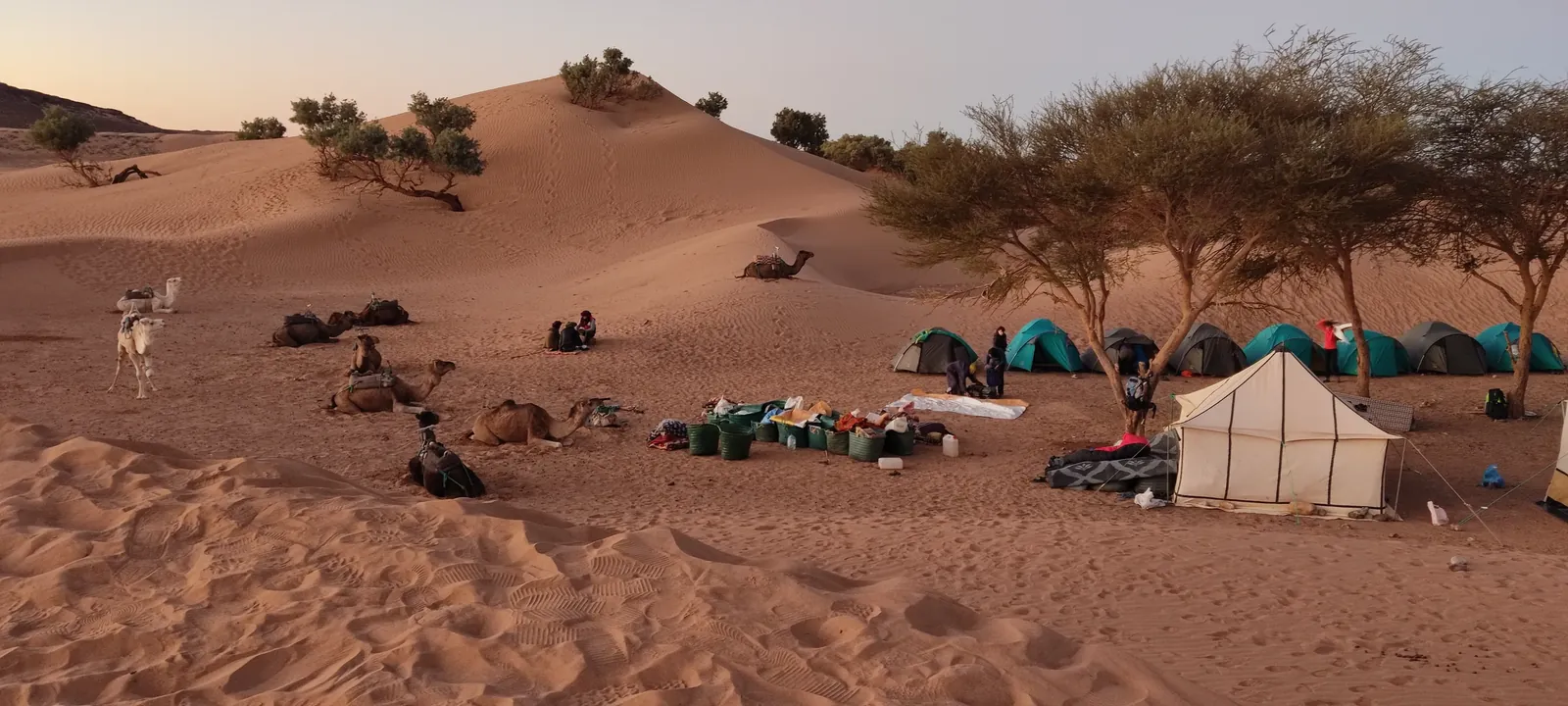
With the first two, camp is already set up when you arrive and someone takes care of everything. With the third, the camp travels with you: camels carry the water, food and luggage, and the cameleers pitch it at the end of each stage. It is the way of sleeping in the desert closest to nomadic life, and the one used on our walking routes.
How a night in a desert camp unfolds
Every camp has its own rhythm, but a night in the desert follows much the same script. This is how we spend it with our travellers, from sunset to sunrise.
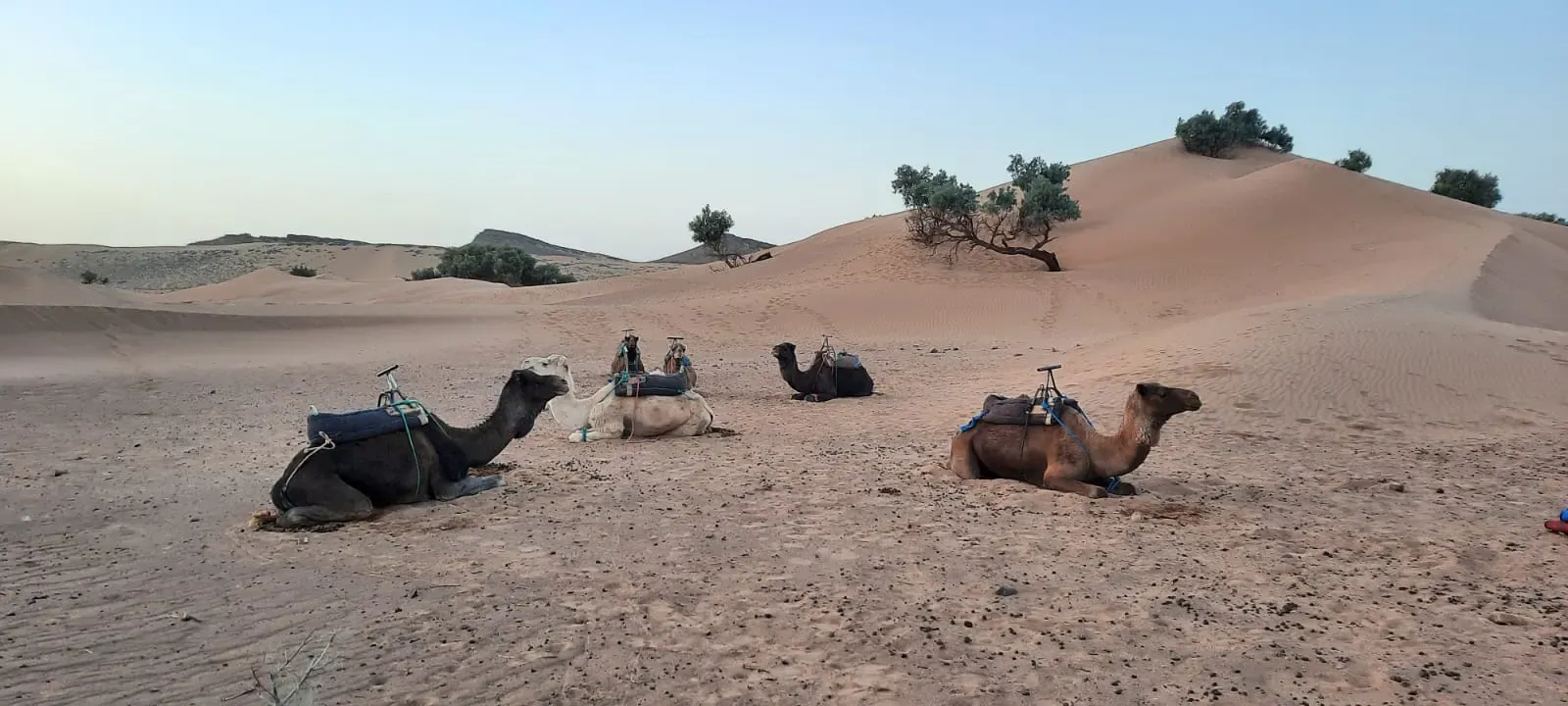
- SunsetArrival by camel. At Merzouga the ride to camp takes about an hour and a half, with a stop on top of the dunes to watch the sun go down. The camp team carries your luggage to the tent.
- On arrivalYou are welcomed with tea. Time to drop your things, explore the camp and rest for a while.
- DinnerIn fixed camps, dinner is served in the camp restaurant. On treks it is eaten at the bivouac itself, after a day of five to seven hours on foot.
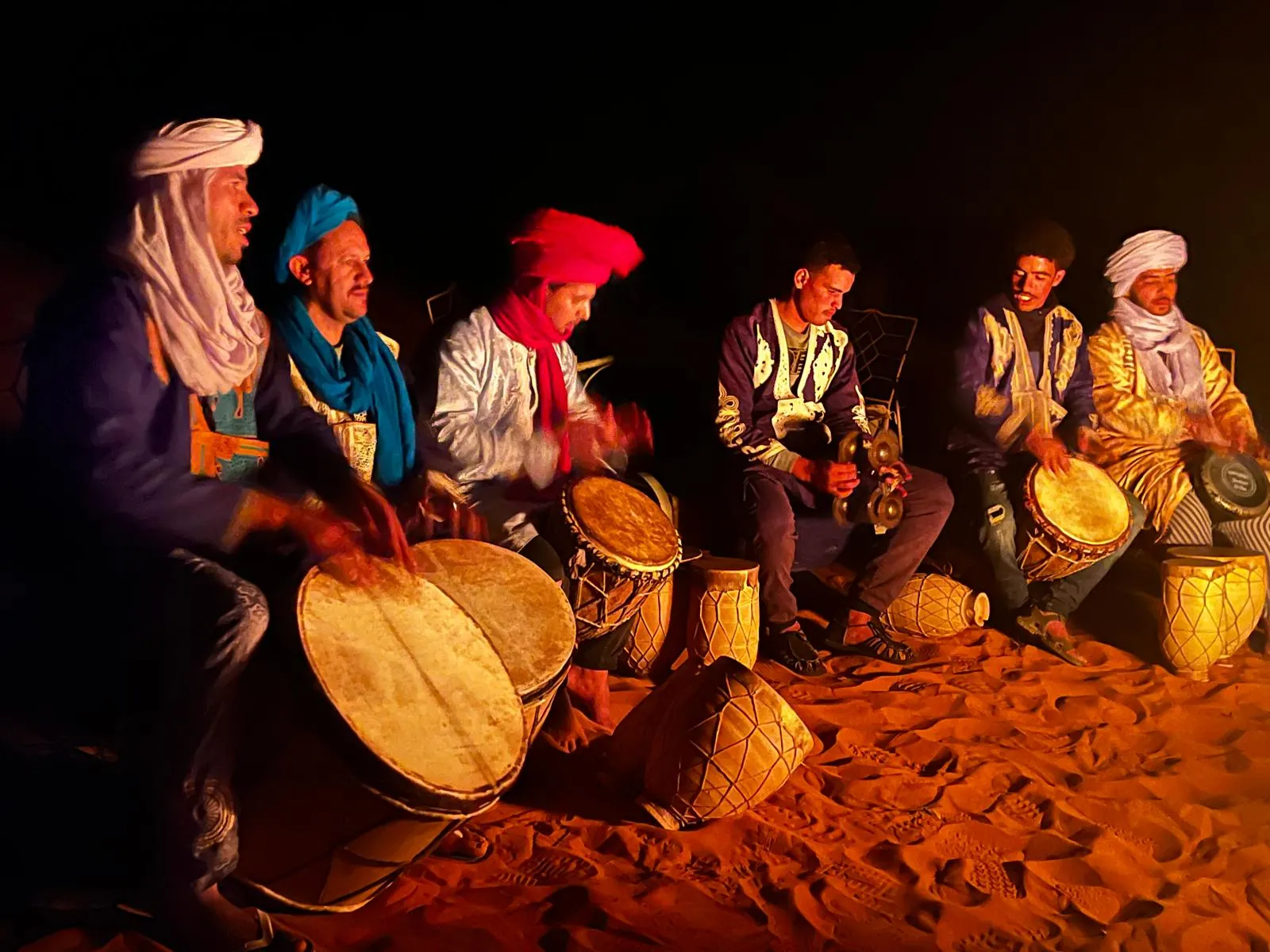
- After dinnerThe fire is lit, then come the drums and the Berber songs. Nobody is in a hurry to go to bed.
- NightFar from any town, the sky fills with stars. It is worth stepping out of the tent for a while before you sleep.
- SunriseGet up early: watching the sun rise over the dunes is the other half of the experience.
Tagoula, the bread baked under the sand
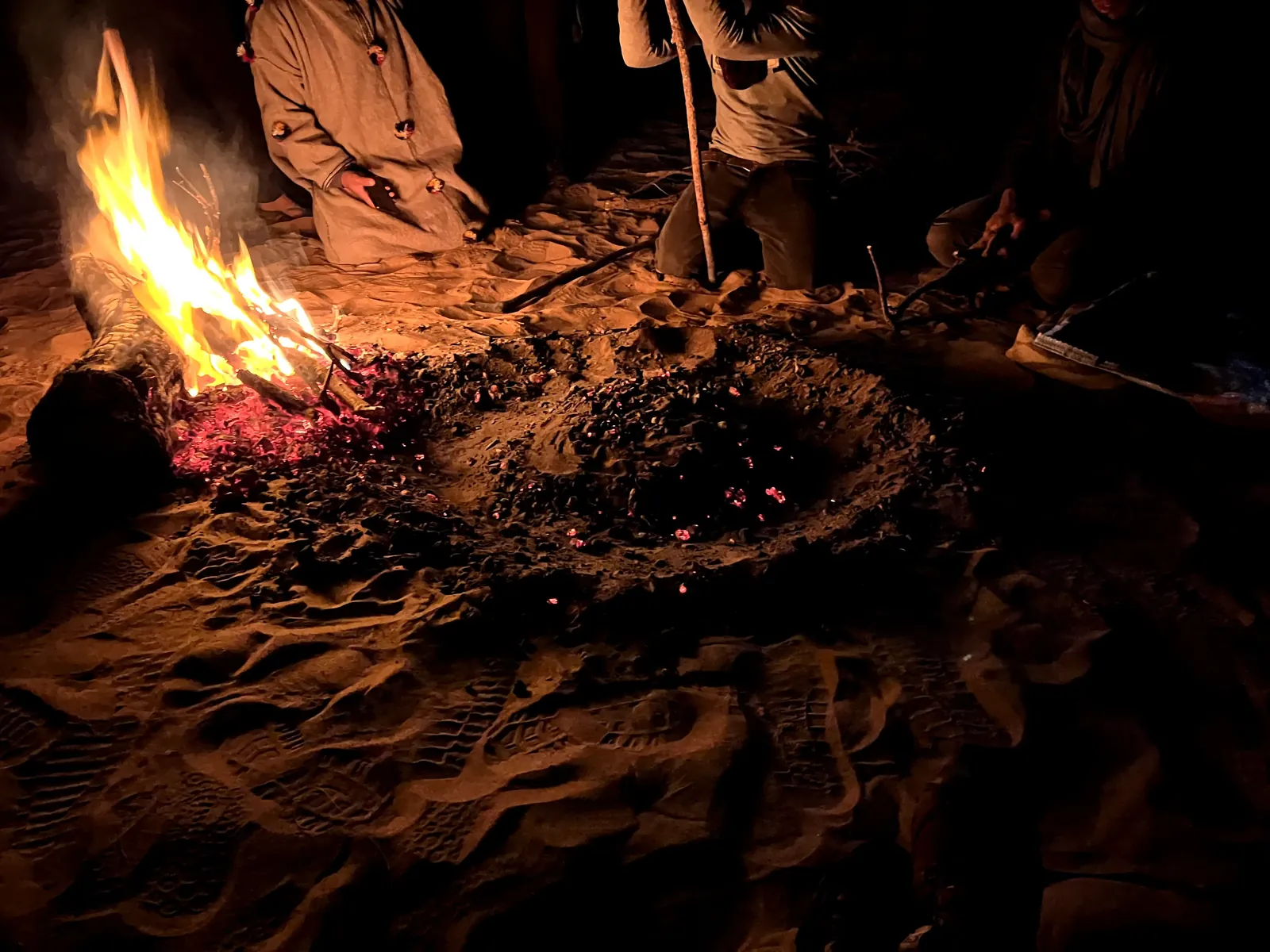
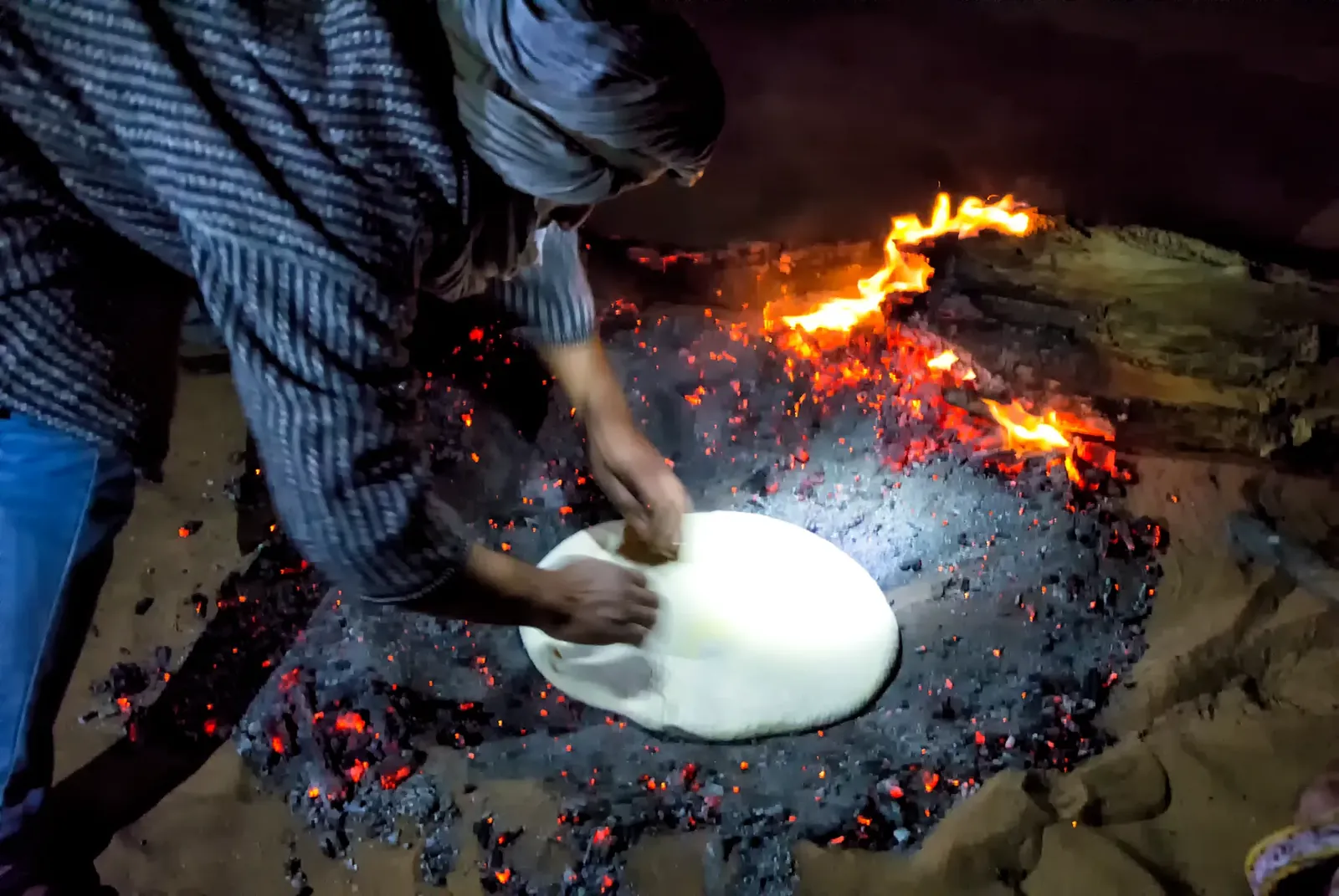
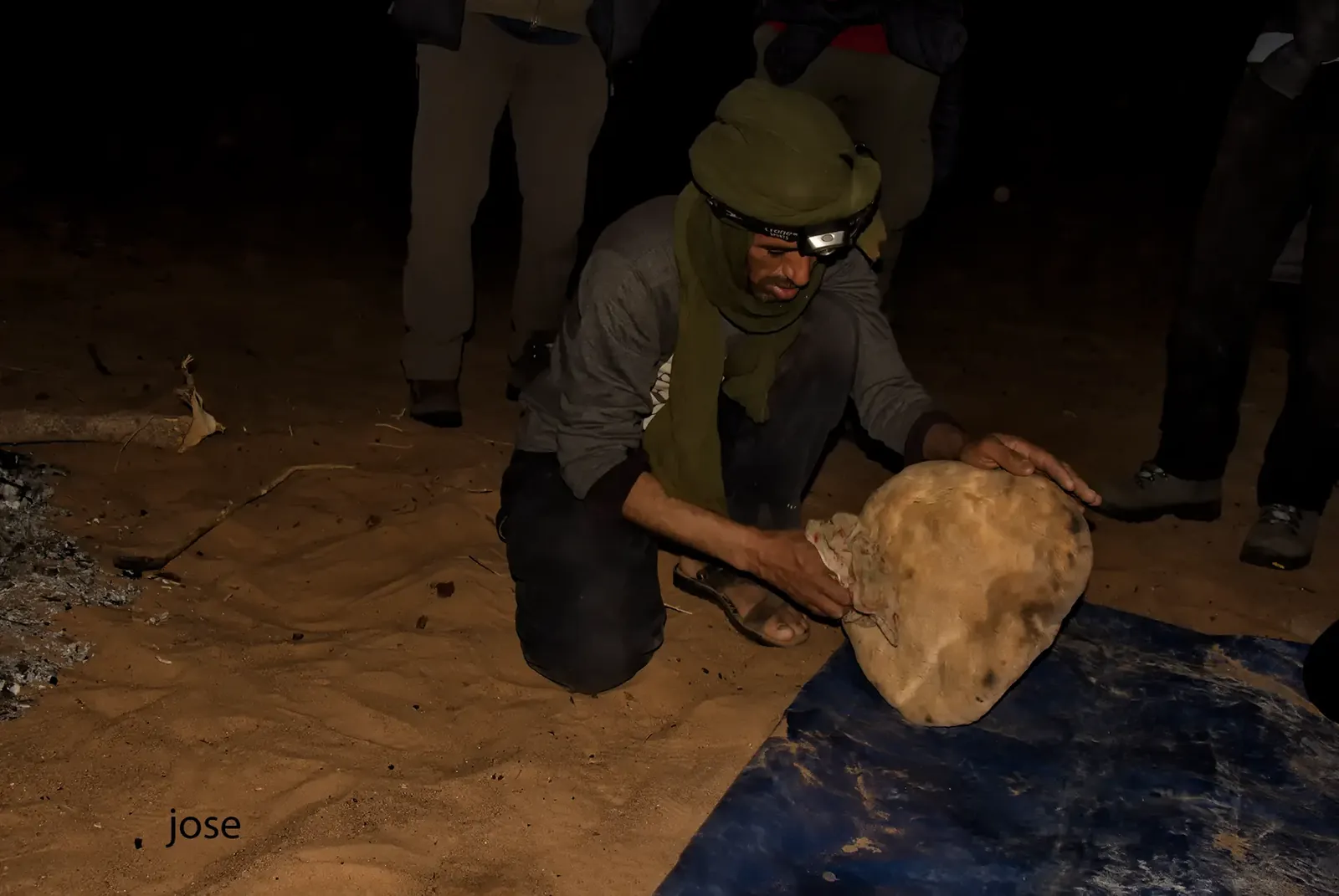
On our Draa Valley desert trek there is one dinner nobody forgets. On the last night in the dunes, at the foot of Jebel Bani, the team makes tagoula, a bread baked directly in the hot sand under the embers of the campfire.
First the fire is left to burn down to a good bed of embers. The dough, round and flattened by hand, is laid on that bed and covered with sand and embers. Once it is baked, the ash is pushed aside with a stick, the bread is lifted out and brushed clean of sand before it is broken. It is eaten hot, around the same fire it was baked in.
How cold is a night in the Sahara desert?
Colder than most people expect. As soon as the sun sets, the desert loses its heat fast. Official data for Errachidia, the closest town to Merzouga with figures published by the World Meteorological Organization, make the point: in January the average high is about 16 °C (61 °F) and the average low drops to 2 °C (36 °F). Out in the dunes, away from any town, the small hours feel colder still.
- Jan
- Feb
- Mar
- Apr
- May
- Jun
- Jul
- Aug
- Sep
- Oct
- Nov
- Dec
Source: Morocco’s national meteorological service (Direction de la Météorologie Nationale), via the WMO World Weather Information Service. Rounded values. Ouarzazate, the gateway to the Draa Valley, has very similar figures (WMO data).
That is why our desert routes run from October to April, when the days are mild and good for walking. The price is a cold night, especially from December to February. Summer is the opposite: in July and August average highs pass 38 °C (100 °F), too hot to walk or sleep comfortably in the desert.
If you are trekking, the sleeping bag is the only piece of camping gear you bring yourself. Choose one rated for temperatures close to 0 °C (32 °F), and keep your warm layers out of the suitcase: you will want them as soon as the sun goes down.
Where to sleep in a desert camp in Morocco
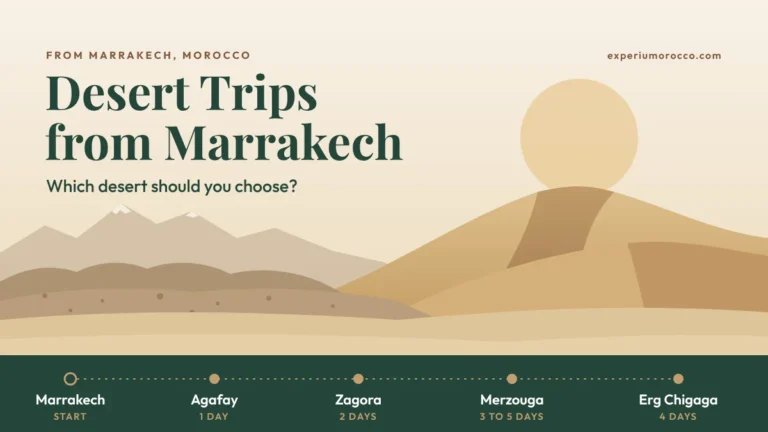
These are the options from Marrakech, depending on how much time you have and the experience you are after. If you are still choosing between deserts, our comparison of desert trips from Marrakech covers distances and landscapes in more detail.
Merzouga and Erg Chebbi
The classic picture of the Sahara, with the highest dunes. On our 3-day Merzouga desert tour from Marrakech you ride a camel for about an hour and a half to camp and sleep in a private superior tent with bathroom and shower. For a gentler pace, the 4-day version adds a night in Ouarzazate. Both include sandboarding on the dunes.
Zagora and the Draa Valley
The shortest way to spend a night in the desert from Marrakech. On our 2-day Draa Valley and Zagora desert trip you reach camp by camel (the ride there and back adds up to one hour) and sleep in a Tuareg tent on full board. Bear in mind that around the camp there is more stone than sand.
Erg Chigaga
More remote and quieter: the last two hours are a 4×4 track from M’Hamid. On the 4-day Erg Chigaga desert tour you sleep in a private tent at a camp among the dunes or, if you feel like it, under the open sky.
On foot, from bivouac to bivouac
For those who want to walk. Our Draa Valley desert trek has four nights of bivouac among the Tidri dunes, Erg Sahel and Ras Errich, and it is the tagoula route. If you prefer the sea, the Atlantic coast trek to Essaouira also includes bivouac nights in the dunes and on the beach.
Agafay, if you only have a day
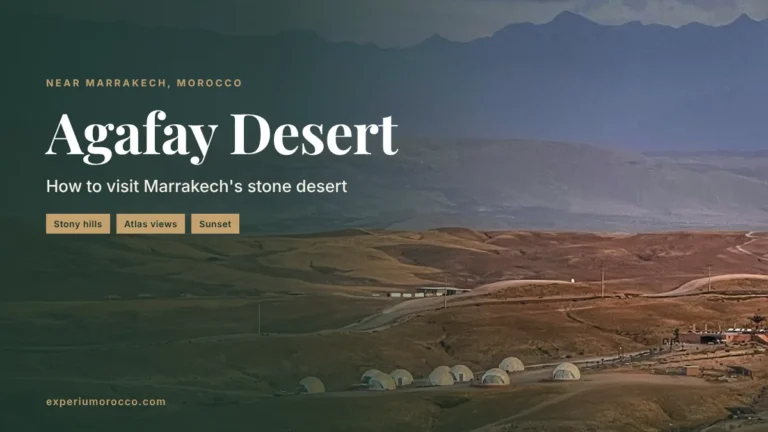
Agafay is a stony desert on the edge of Marrakech, with no dunes. Our Agafay desert day trip does not include a night, but you can add dinner in a Berber tent at sunset. Our Agafay Desert guide explains what to expect.
What to pack for a night in the desert
You do not need much, but a few things make the difference between a cold night and one you will remember fondly.
- A sleeping bag if you are on a trek: the rest of the camping gear is included.
- Warm layers for the night: a fleece or a light down jacket, a hat and dry socks to sleep in.
- A head torch, to find your way around camp without relying on other people’s light.
- A cheche, the desert scarf worn as a turban, which protects you from sun and blowing sand. If you do not have one, you can buy one on the way to Merzouga.
- Sunglasses, sun cream and a hat: the daytime sun is as strong as the night is cold.
- Comfortable shoes and sportswear for the camel ride and the dunes.
For everything else, from booking to payment, see our frequently asked questions.
FAQ about a night in the desert
What is a Berber tent?
It is the tent of the nomadic peoples of North Africa, called khaima in Morocco. In Moroccan desert camps, travellers sleep in large canvas tents; nomad families use goat-hair tents.
Do desert camp tents have a bathroom?
It depends on the camp. On our 3-day Merzouga tour the tent is private and superior, with its own bathroom and shower. On treks you sleep in bivouac tents, without a private bathroom.
How cold does it get at night in the Sahara desert?
Cold. In Errachidia, near Merzouga, the average January low is about 2 °C (36 °F), and in the dunes the early morning feels even colder. Bring warm layers and, on a trek, a good sleeping bag.
Can you sleep under the stars instead of in a tent?
Yes, at some camps. On our 4-day Erg Chigaga tour you can choose to spend the night in the open, among the dunes.
When is the best time for a night in the Sahara desert?
From October to April, when the days are mild. Summer is very hot: in July the average high in Errachidia is around 40 °C (104 °F).
Can you spend a night in the desert on a day trip from Marrakech?
Not on our day trips. The Agafay trip, to a stony desert without dunes on the edge of Marrakech, does not include a night, although you can add dinner in a Berber tent. The shortest option with a night in the desert is Zagora, in two days.