


Jbel Saghro trek in southern Morocco
From €640 per person
 1 / 13


- Duration
- 9 days / 8 nights
- Tour type
- Treks
- Languages
- English, French, Spanish
- Difficulty
- Moderate effort, technically easy
Overview
Six days on foot across Jbel Saghro, a volcanic massif south of the High Atlas, through canyons, oases and Ait Atta nomad camps.
Tour highlights
- Climb to Kouaouch (2,600 m), the second-highest summit in the Saghro
- Afourar gorges, with a few short canyoning passages
- Camp at Tiblah, one of the most striking spots in the Saghro
- The towers of Bab n'Ali, where part of the film Babel was shot
- A night beside the Tazlout waterfall
- Meetings with Ait Atta nomad families
Route at a glance
9 days / 8 nights
- Marrakech airport Starting point
- Marrakech
- Ouarzazate
- Dades Valley
- Jebel Saghro
- Marrakech airport Ending point
About this tour
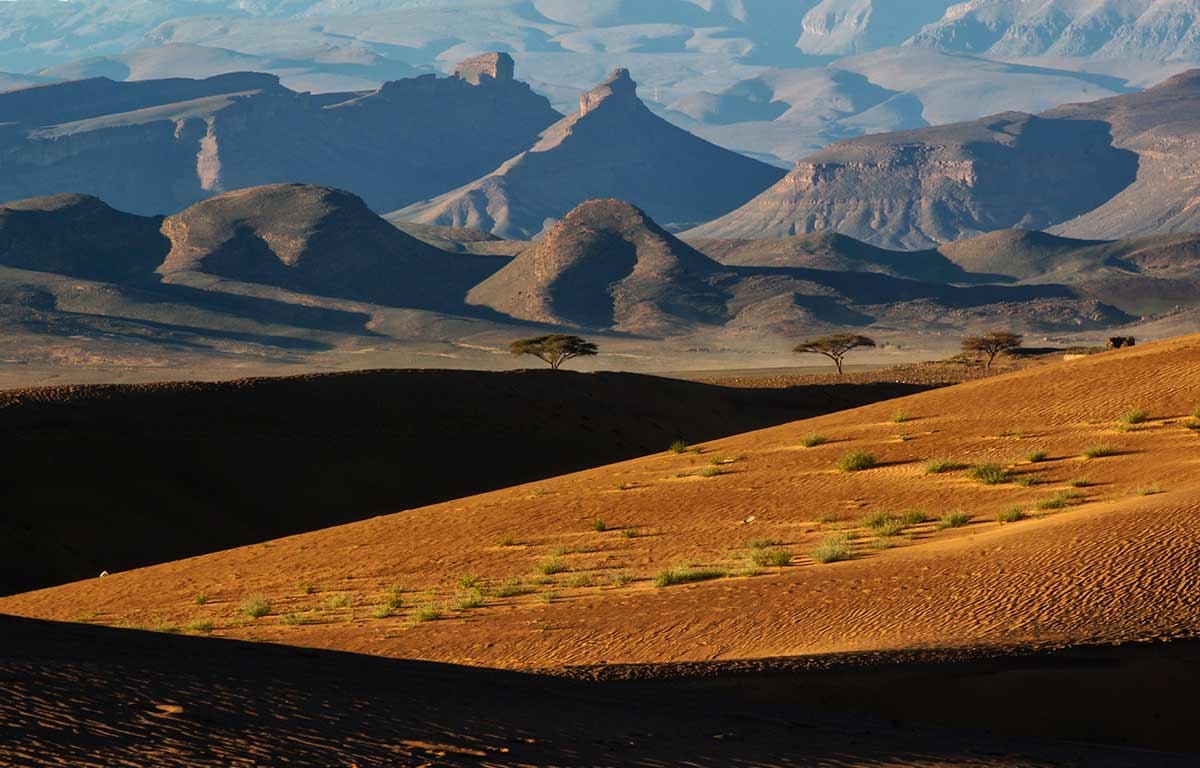
Not quite desert and not quite mountain, Jbel Saghro is a massif of bare rock lying north of the Sahara, south of the High Atlas and east of Ouarzazate. Its highest point is Amalou n'Mansour (2,712 m). Few travellers know it: it is a land of gorges, plains of dark volcanic rock, small oases and villages where the Berber people keep a strong tradition of hospitality.
It is sometimes called the Moroccan Hoggar. The Amazigh tribes of the Ait Atta and the Ait Sedrat live here. The massif forms a long ridge running parallel to the High Atlas and drops sharply to the north towards the Dades plain, home to Kelaat M'Gouna and the Dades and Todra valleys. The terrain is complex, with flat-topped plateaus known as tadaout, canyons and conglomerate cliffs shaped by erosion. The area is part of the UNESCO biosphere reserve of the oases of southern Morocco.
The Ait Atta, a confederation of tribes already recorded in the 15th century, held out against French occupation during the protectorate until the battle of Bougafer. Most of them are still transhumant herders: they move across the Saghro in search of grazing, and in summer they climb to the cooler pastures of the High Atlas, because from June the massif turns into an oven.
The trek covers valleys, canyons and summits over six days of walking, with mules carrying the loads and nights spent in a gîte and in camp.
Day by day itinerary
Print this itinerary-
Day 01
Day 1 of 9
Arrival in Marrakech
We meet you at the airport together with your mountain guide and take you to your riad in the medina.
-
Day 02
Day 2 of 9
Marrakech - Ouarzazate - Kelaat M'Gouna - Tagdilt
An early start and, after breakfast, we head south by road. We cross the High Atlas over the Tizi n'Tichka pass (2,260 m), often snowbound in winter, go through Ouarzazate and follow the Valley of a Thousand Kasbahs, the Valley of Roses and the Dades Valley.
At Kelaat M'Gouna we turn south and, after about 20 km of dirt track across a desert plateau, reach the village of Tagdilt (1,600 m), where we spend the night in a gîte. If time allows, we stop before Ouarzazate to visit the kasbah of Ait Ben Haddou, a UNESCO World Heritage Site.
- Meals
- Breakfast
-
Day 03
Day 3 of 9
Tagdilt - Tizi n'Ouarg - Almou n'Ouarg
We meet the muleteer team, load the bags and start walking across a plateau, passing Tislit n'Ouarzarzam. There is very little water in this area, so make sure you leave Tagdilt with enough.
We pass close to Ait Atta nomad families and cross the Tizi n'Ouarg pass (2,450 m), with views over the Saghro range and the snowy peaks of the central High Atlas, especially M'Goun (4,068 m). We stop for lunch nearby and walk down easily to the camp at Almou n'Ouarg (2,300 m), as the nomads call it. It is the coldest night of the week: in winter the temperature drops below 0 °C.
- Meals
- Breakfast, lunch and dinner
-
Day 04
Day 4 of 9
Almou n'Ouarg - Kouaouch - Igli
This is the finest and most spectacular day of the trek. We start by climbing the highest summit of the route, Kouaouch (2,600 m), the second-highest peak in the Saghro. We then descend towards Tassigdelt (2,200 m) and have lunch with wide views over the Saghro and the pre-Saharan mountains.
In the afternoon a very steep descent takes us to camp in the oasis of Igli (1,700 m).
- Meals
- Breakfast, lunch and dinner
-
Day 05
Day 5 of 9
Igli - Afourar gorges - Tiblah
We begin with a climb to a small pass and enter the Afourar gorges, with a few easy canyoning passages. We go through the village of the same name and keep heading down the canyon, stopping for lunch near the hamlet of Cebar.
We then follow a side canyon west to Tiblah (1,300 m), the most striking campsite in the Saghro.
- Meals
- Breakfast, lunch and dinner
-
Day 06
Day 6 of 9
Tiblah - Bab n'Ali - Tazlout waterfall
We leave Tiblah on a nomad path to the village of Anguis and carry on to the twin towers of Bab n'Ali, where part of the film Babel was shot. We have lunch at the foot of the towers.
We spend the night beside the Tazlout waterfall (1,100 m), the lowest point of the trek, where you can already feel the heat of the Sahara, not far away.
- Meals
- Breakfast, lunch and dinner
-
Day 07
Day 7 of 9
Tazlout waterfall - Aqqa n'Tifarnine
A tough stage because of the heat and the height gain. After breakfast we pass close to a hat-shaped mountain, Tichichit or Tazlout (1,871 m), in a little-known part of Jbel Saghro. This is where the battle of Bougafer was fought between the French and the Ait Atta warriors.
In the afternoon we reach Aqqa n'Tifarnine (1,900 m), an area of nomad camps, where we spend the night.
- Meals
- Breakfast, lunch and dinner
-
Day 08
Day 8 of 9
Aqqa n'Tifarnine - Tizi n'Tazazert - Marrakech
The last day of trekking, well away from the classic routes. We walk along the slopes of Amalou n'Mansour (2,700 m), the highest point in the Saghro, cross the dry bed of the Tifarnine and climb an old path, with views over much of the volcanic massif, to the Tazazert pass.
There we say goodbye to the muleteers and the vehicle drives us back to Marrakech, crossing the valleys and mountains of the High Atlas once more. Night in a riad, with a shower and a proper bed.
-
Day 09
Day 9 of 9
Marrakech - airport
After breakfast you have time to wander through the souks and streets of the medina. Transfer to the airport in good time for your flight.
- Meals
- Breakfast
What's included
Included
- mountain guide
- Accommodation in Marrakech in a double room with breakfast
- Accommodation and full board on the trekking days
- Muleteers, support staff and camping equipment, except sleeping bags
- All transfers during the trip by tourist vehicle
- Bottled water during the trek
Not included
- Travel, accident or cancellation insurance
- Personal first aid kit
- Tips (in Morocco it is customary to tip people who provide a service)
- Unforeseen costs due to circumstances beyond our control, such as flight cancellations or delays
- Meals on the transfer days between Marrakech and the start or end of the trek
- Drinks of any kind
What to bring
- Sleeping bag
Good to know
Trek facts
- Format: group trek with a guide
- Walking time: 4 to 8 hours a day
- Distance: 12 to 20 km a day
- Trip length: 9 days, including 6 days of walking
- Accommodation: hotel or riad, gîte and tent
- Transport: private bus
- Season: September to April
Guide
You are accompanied by a professional mountain guide certified by the Mountain Tourism Training Centre (CFAMM).
Weather
In winter the Tizi n'Tichka pass is often under snow and the night at Almou n'Ouarg drops below 0 °C. From June the Saghro is very hot.


