

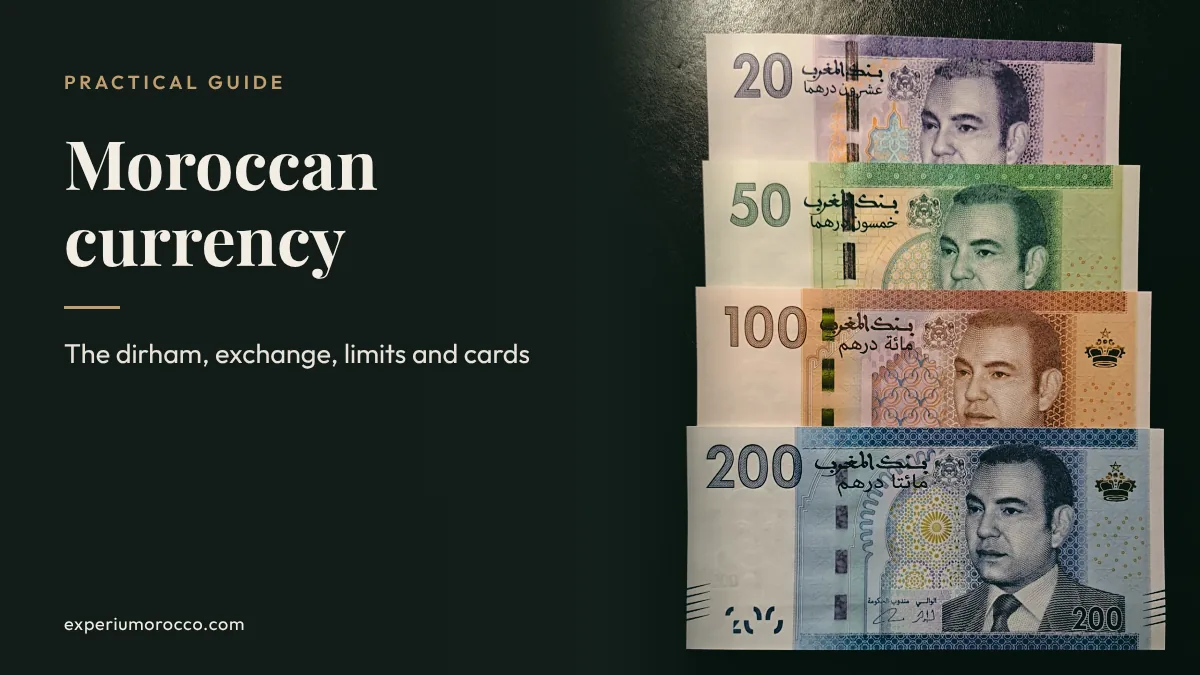
Before you land in Morocco, it helps to know a few things about money: what the currency is, why your bank at home probably cannot sell it to you, how much cash you can carry and what the notes you will be handed look like. This guide sums up what official sources say about the Moroccan dirham, with photos of the notes in circulation, where to change money, how to pay by card, and a few practical details that will save you some confusion in the souks.
Morocco’s currency is the dirham (MAD or DH), divided into 100 centimes. It is a closed currency, so you change money once you arrive: at banks, bureaux de change, the airport or authorised hotels. You can take up to 2,000 dirhams in cash into or out of the country, and you must declare foreign currency worth 100,000 dirhams or more at customs. Notes from the 2012 series and the new 2023-2024 series circulate side by side, while some much older notes stopped being legal tender on 1 January 2026. As a rough guide, the UK government puts 100,000 dirhams at around £8,000.
What currency is used in Morocco?
The Moroccan currency is the dirham. You will see it written as MAD at banks and as DH or dh on shop labels. It is divided into 100 centimes and issued by Bank Al-Maghrib, the country’s central bank.
The key point for travellers is in the UK government’s travel advice: the Moroccan dirham is a closed, non-convertible currency. In practice, that means you usually cannot order dirhams before you travel the way you would euros or dollars. Most visitors bring pounds, euros or a card and change money once they are in Morocco.
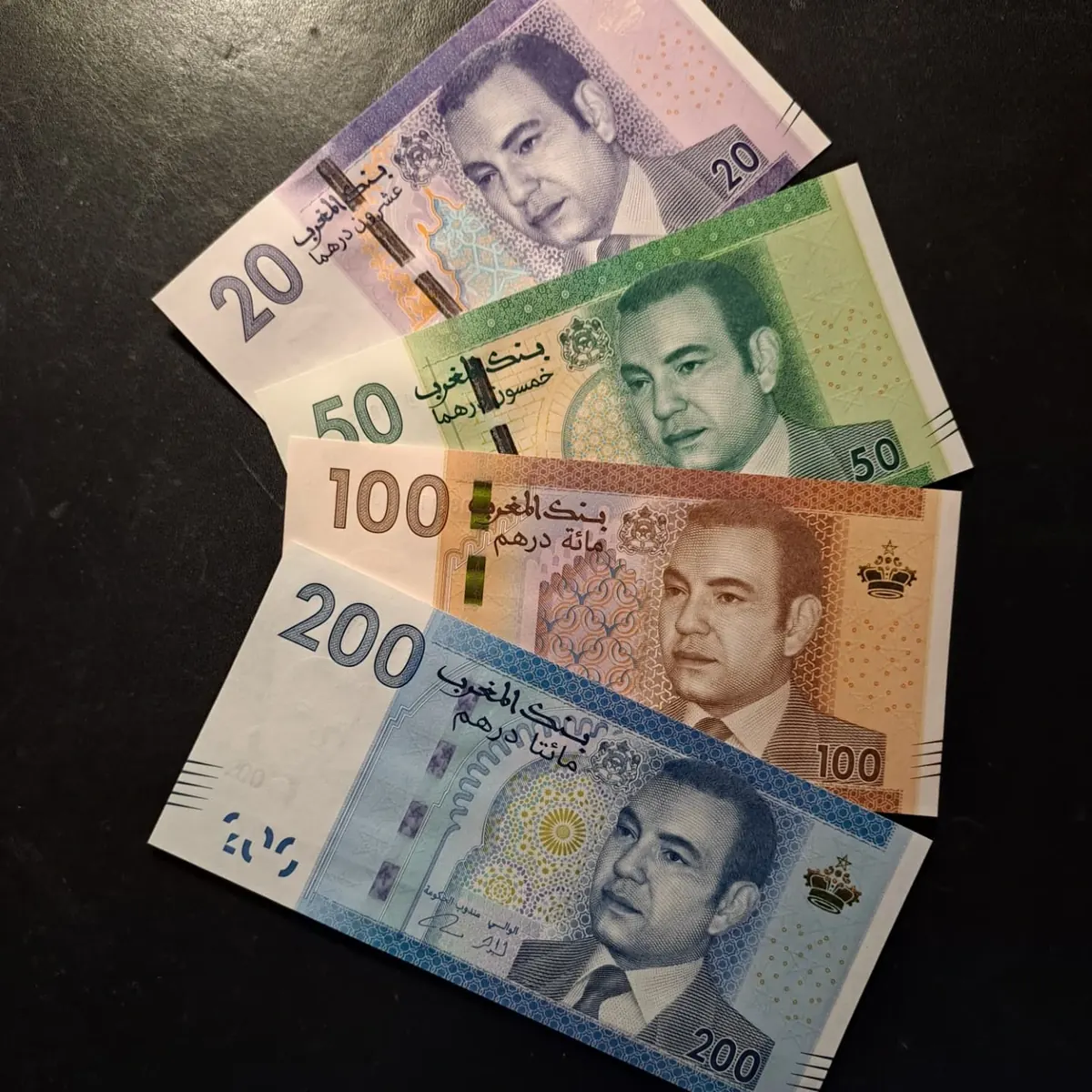
Moroccan dirham notes and coins
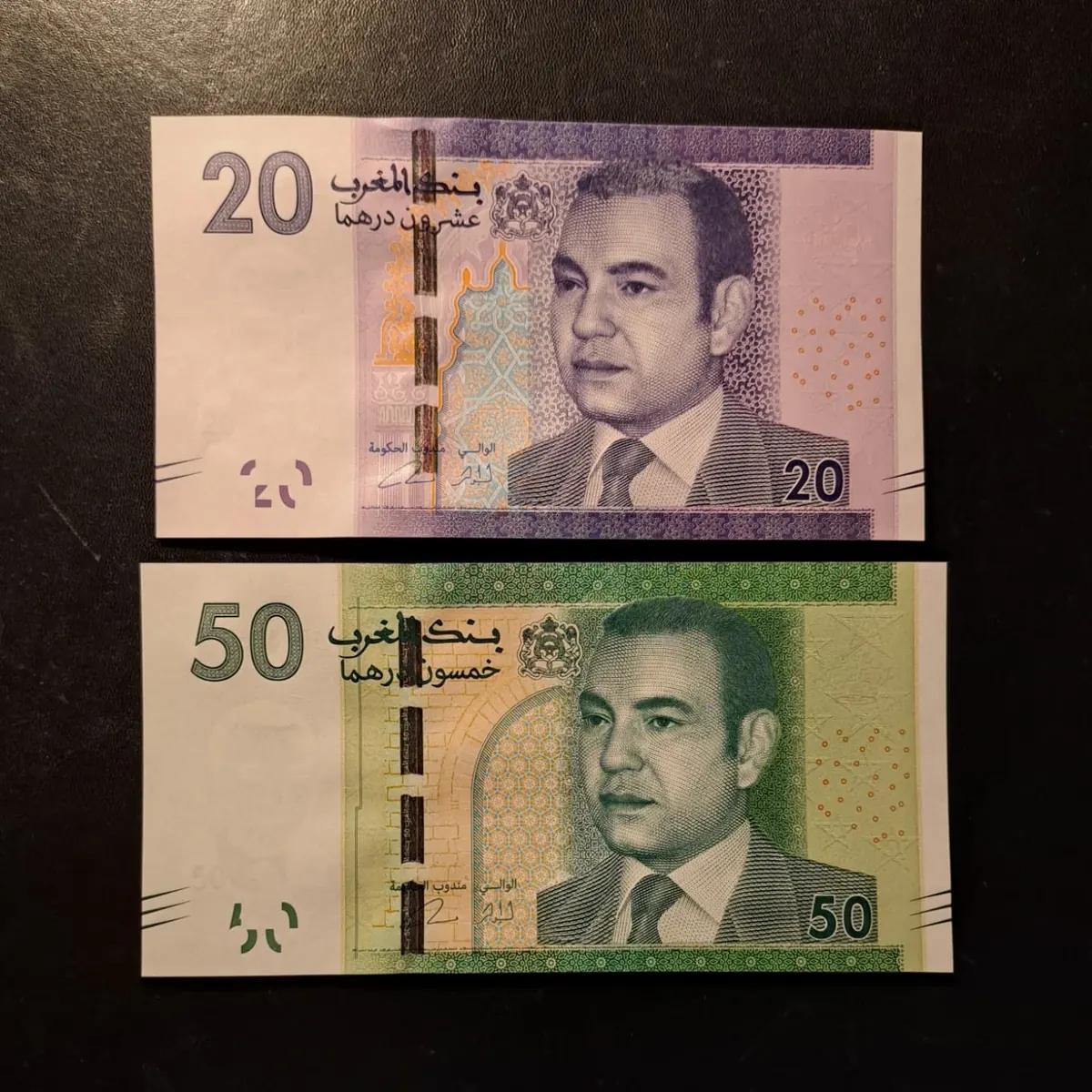
Banknotes come in 20, 50, 100 and 200 dirhams. Each value keeps the same colour from one series to the next, which is the quickest way to tell them apart: purple for 20, green for 50, orange-brown for 100 and blue for 200.
- 20DH
- 50DH
- 100DH
- 200DH
Colour key for each note: it does not reproduce the real banknote designs.
Two main series are in use today: the 2012 series, which Bank Al-Maghrib began issuing in 2013, and a new series released between November 2023 and August 2024. Both show King Mohammed VI on the front and both are legal tender, so it is normal to get old and new designs in the same handful of change.
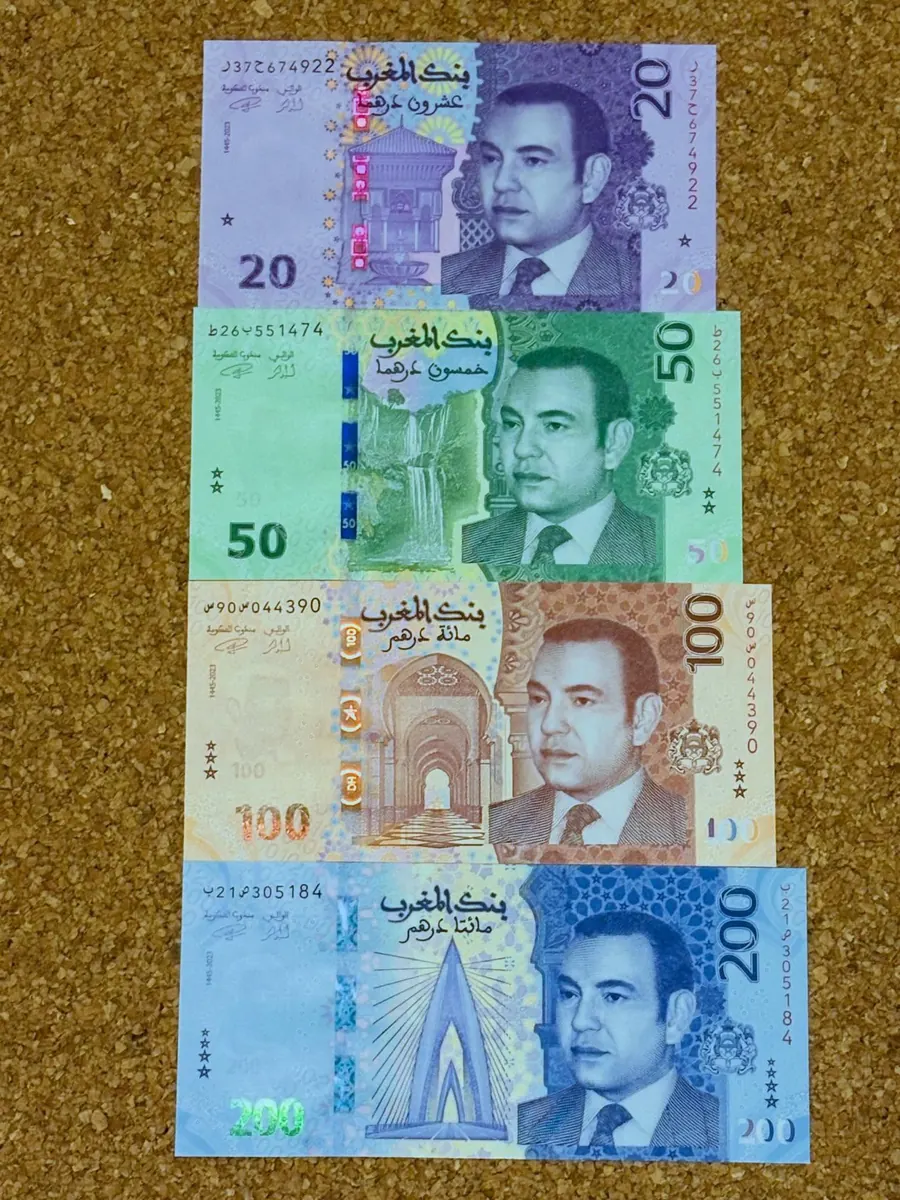
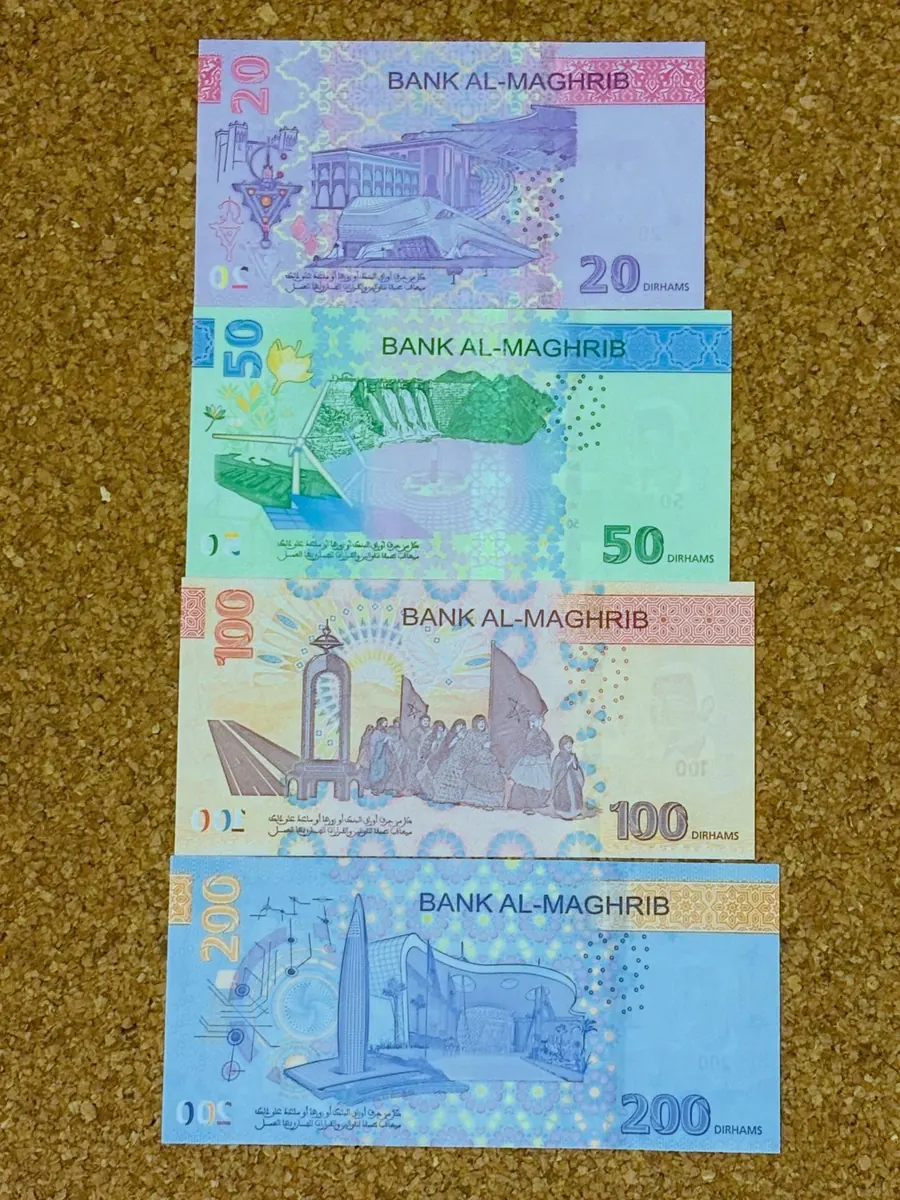
| Note | Issued | On the back |
|---|---|---|
| 20 MAD | 21 Aug 2024 | Grand Théâtre de Rabat and the Aït Ben Haddou kasbah |
| 50 MAD | 30 Jul 2024 | Noor Ouarzazate solar plant, wind turbines and the Ouirgane dam |
| 100 MAD | 24 Nov 2023 | Mechouar Square in Laayoune, the Tiznit-Dakhla expressway and the Tan-Tan moussem |
| 200 MAD | 12 Jan 2024 | Mohammed VI Tower and Marrakech-Menara airport |
Dates and designs as announced by Bank Al-Maghrib at each release.
Coins range from centimes up to 10 dirhams. On 24 November 2023, alongside the new 100-dirham note, a new coin series came into circulation: 10 and 20 centimes, half a dirham, and 1, 5 and 10 dirhams. Older coins remain in use alongside them.
Since 1 January 2026, the 10, 50, 100 and 200-dirham notes issued in 1987, the 10-dirham note of 1990 and the 20-dirham note of 1996 are no longer legal tender. According to Bank Al-Maghrib, they can be exchanged without limit at its offices and at any bank until 31 December 2030. If you are handed a note that looks nothing like the ones in these photos, check it at a bank or ask for another.
For everyday spending, small notes are your best friends. A taxi, a fresh orange juice in the square or a tip is much easier to pay with 20 and 50-dirham notes and 5 or 10-dirham coins than with a 200, which small stalls cannot always break.
How much money can you take to Morocco?
Morocco’s currency rules are simple, and it is worth knowing them before you reach customs. The UK government sets out the declaration rule, and the travel advice of the Spanish Ministry of Foreign Affairs adds the cash limit and the advice on receipts:
- Dirhams in cash: you can bring in or take out a maximum of 2,000 dirhams.
- Foreign currency (pounds, euros, dollars): there is no limit, but you must declare it at customs when you enter and leave if it is worth 100,000 dirhams or more, around £8,000.
- Exchange receipts: keep the receipt for every transaction and, if you made one, your currency declaration. They help avoid problems when leaving and are usually requested if you want to change unused dirhams back.
Rules can change. If you are travelling with a large amount, check the latest official advice before you go.
Where to change money in Morocco
The Spanish Foreign Ministry recommends changing money at banks or bureaux de change in the tourist areas of each city, and also mentions the airport and authorised hotels. Some hotels, restaurants and bazaars in the big cities accept euros, but the rate they apply may not match the official one. Paying in dirhams almost always works out better.
- Change a small amount at the airport, just enough for the taxi and your first few hours.
- Compare rates and always ask whether there is a commission before handing over your money.
- Count the notes in front of the cashier and keep the receipt.
- Never change money with strangers in the street.
Using cards and cash machines in Morocco
Cards are accepted in hotels, many restaurants and fixed-price shops in the cities, and you will find cash machines easily in town. Paying with a foreign card avoids the exchange-rate problem, although your bank may add fees or foreign transaction charges. Before you travel, check what your card charges for payments and withdrawals abroad.
Outside the cities it is a different story. In mountain villages, at weekly markets and on the road to the desert, cash is still the normal way to pay, so take enough dirhams before heading out on an excursion.
One practical tip: if a card machine or cash machine offers to charge you “in pounds” instead of dirhams, choose dirhams. The conversion offered on the spot is usually less favourable than your own bank’s.
Pounds to dirhams: a quick converter
Move the slider to get a rough idea of what you will receive. The starting rate is derived from the UK government’s figure of about £8,000 for 100,000 dirhams. Replace it with the rate of the day you see at the exchange desk.
You would get about0 DH
Rough estimate only, fees not included. Starting rate derived from UK government guidance (100,000 MAD is about £8,000).
Money in the souk: rials, haggling and small notes
One detail puzzles many visitors: in Marrakech and much of the country, people often count in rials, a traditional spoken unit that does not exist as notes or coins. One dirham is 20 rials, so if a seller says “a hundred rials” they mean 5 dirhams. If in doubt, always ask for the price in dirhams.
In the souks, prices are rarely marked and are open to negotiation. To learn how haggling works and what to buy, read our guide to the Marrakech souks.
The UK government points out that passing fake banknotes carries significant prison sentences and that defacing banknotes is also illegal. Check the notes you are given, and split your money between your wallet and another pocket or bag rather than keeping it all in one place.
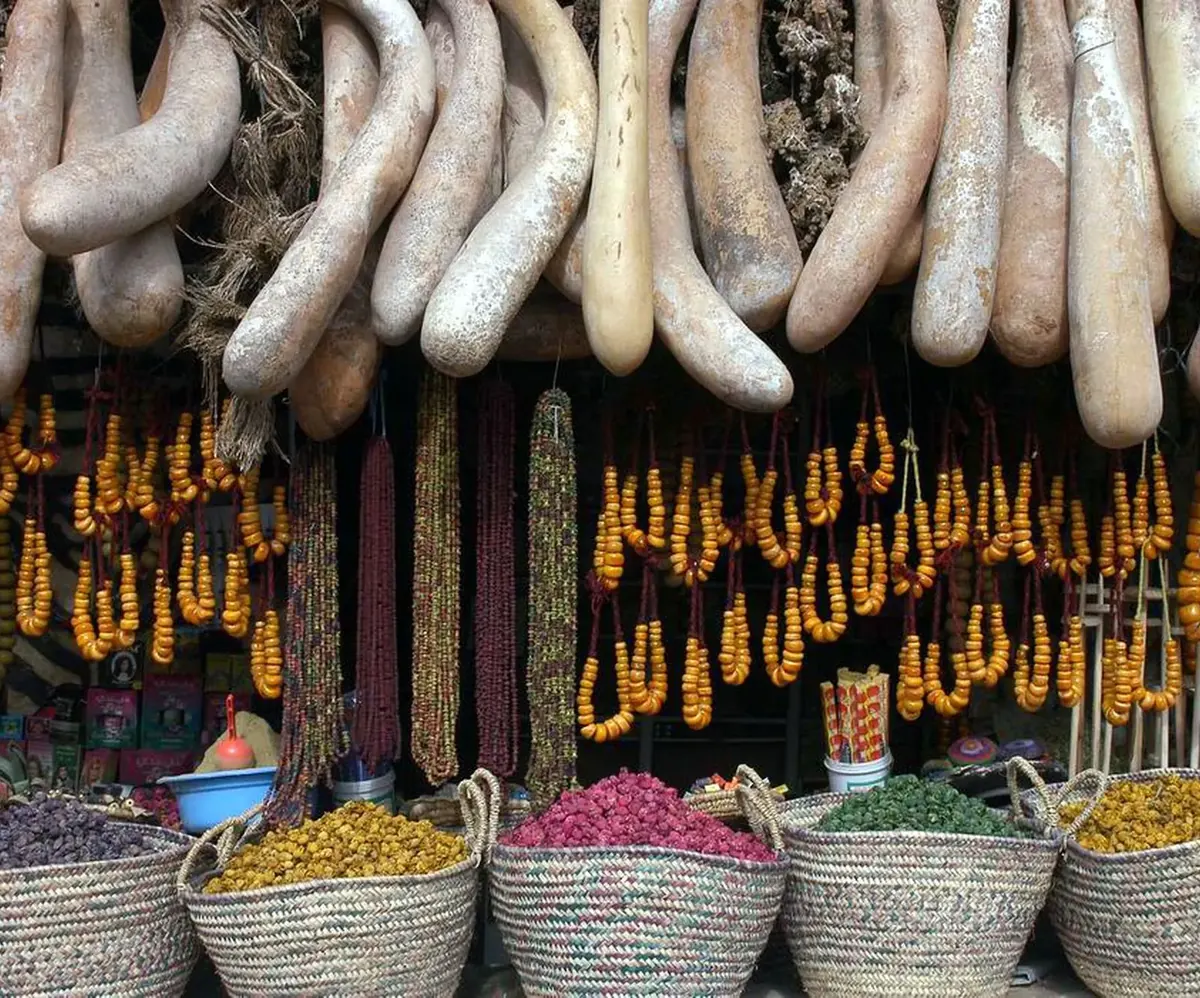
From francs to dirhams: a little history
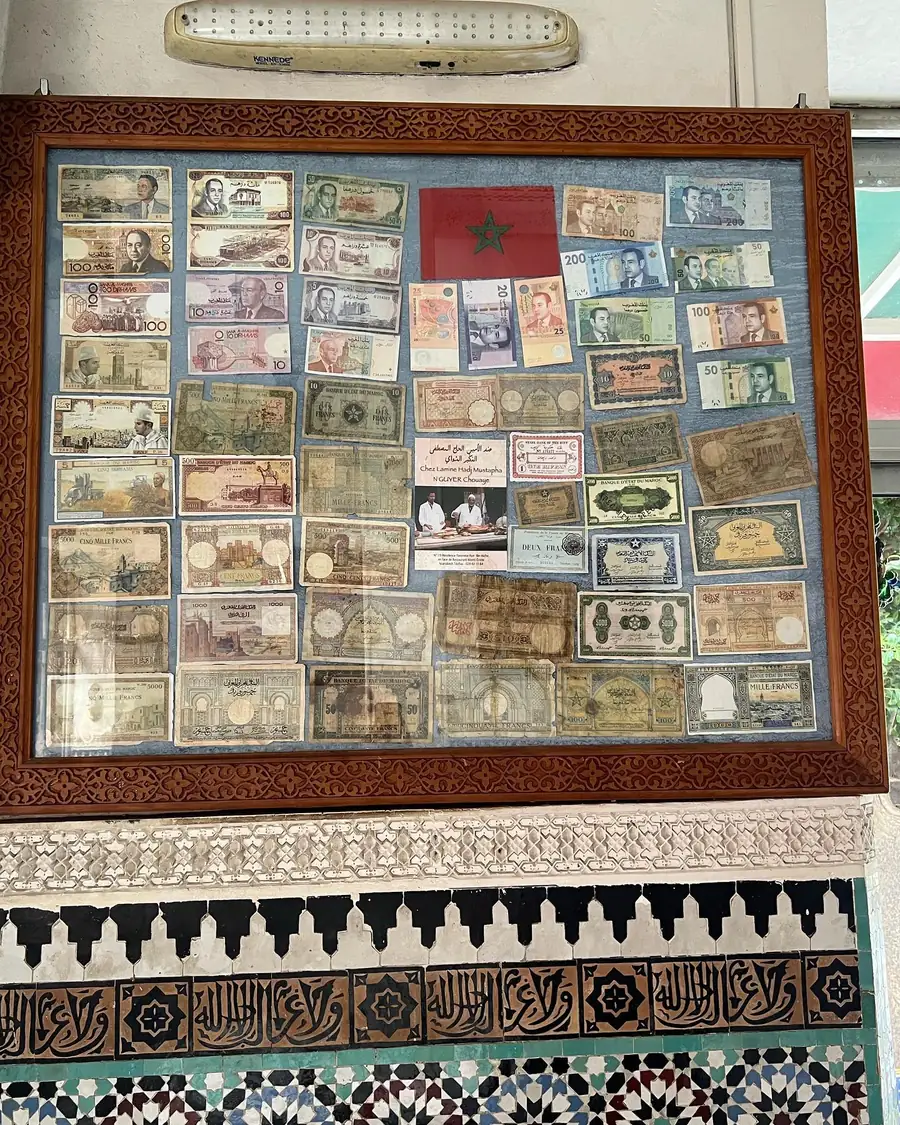
Before the dirham, Morocco paid in francs, issued by the Banque d’État du Maroc, founded in 1906. After independence the country set up its own central bank in 1959, then called Banque du Maroc, and adopted the dirham as its national currency that same year. For a while the dirham was still divided into francs, until the centime replaced them in 1974. The bank took its current name, Bank Al-Maghrib, in 1987.
In Marrakech you can see that history framed on a wall. At Chez Lamine, a well-known méchoui (slow-roasted lamb) spot in the city, a display brings together notes from several eras: francs from the Banque d’État du Maroc, notes from the Protectorate period and dirhams from later decades.
Moroccan currency: frequently asked questions
What is the currency of Morocco?
The Moroccan dirham (MAD or DH), divided into 100 centimes and issued by Bank Al-Maghrib, the central bank.
Can I buy Moroccan dirhams in the UK?
Generally not: the dirham is a closed currency. Bring pounds, euros or a card and change money when you arrive, at banks, bureaux de change, the airport or authorised hotels.
Are old Moroccan banknotes still valid?
Notes from the 2012 and 2023 series are valid. However, since 1 January 2026 the 10, 50, 100 and 200-dirham notes of 1987, the 10-dirham note of 1990 and the 20-dirham note of 1996 are no longer legal tender. Banks will exchange them until 31 December 2030.
How many dirhams can I take out of Morocco?
Up to 2,000 dirhams in cash. Change anything above that back before you leave, with your exchange receipts to hand.
Do I need to declare money when entering Morocco?
Only if you carry foreign currency worth 100,000 dirhams or more, around £8,000. In that case you must declare it at customs on arrival and departure.
Can I pay by card in Morocco?
Yes, in hotels, many restaurants and city shops. In souks, villages and rural areas cash is still essential.
Is it better to pay in euros or dirhams?
Dirhams. Some places accept euros, but the rate they apply may be lower than the official one.
What are rials?
A traditional way of counting money that is still used in conversation. One dirham equals 20 rials. There are no rial notes or coins.
Sources
- UK government: Foreign travel advice, Morocco, entry requirements (currency and declaration rules).
- Spanish Ministry of Foreign Affairs, European Union and Cooperation: travel recommendations for Morocco (currency, exchange and customs).
- Bank Al-Maghrib: banknotes and coins FAQ (notes withdrawn in 2026 and exchange deadline).
- Bank Al-Maghrib: the Bank in a few dates (adoption of the dirham, the centime, the bank’s name).
- Bank Al-Maghrib: release announcements for the new banknote series (2023-2024) and the new coin series (2023).