

The argan tree looks like nothing else you will see in Morocco: short, twisted, covered in thorns and able to shrug off temperatures of 50 °C. It grows naturally only in the south-west of the country, and its seeds give the argan oil now sold all over the world. Yet many travellers meet it for a different reason: the goats that climb into its branches on the road to Essaouira. Here is what makes this tree special, what hides inside its fruit, how the oil is made, what the goats are really up to, and where to see it on your trip.
The argan tree (Argania spinosa) is endemic to south-western Morocco and can live for around 200 years. Its olive-sized fruit holds a rock-hard nut with one to three kernels inside: these are the argan seeds, and up to half their weight is oil. The traditional method takes about 50 kg of fruit and close to 24 hours of work for a single litre. The argan forest has been a UNESCO Biosphere Reserve since 1998, and the know-how around it was added to UNESCO’s Intangible Cultural Heritage list in 2014. Goats climb the trees mostly in autumn, when there is little left to graze on the ground.
What is the argan tree?
Botanists call it Argania spinosa. It belongs to the Sapotaceae family and, as the FAO points out, it is the only member of that family found in Morocco. The species name is a fair warning: the branches bristle with thorns. It is a low tree that can reach about 10 metres, with a gnarled trunk, often split from the base, and a wide crown whose shade is precious out in the countryside.
What really sets it apart is its toughness. It withstands temperatures of up to 50 °C, and in a severe drought it can go dormant and skip fruiting for the year. A tree starts producing at around five years old, peaks at about sixty and can live for roughly two centuries. Its leaves are also valuable fodder for goats, sheep and cattle, which goes a long way to explaining its close relationship with livestock.
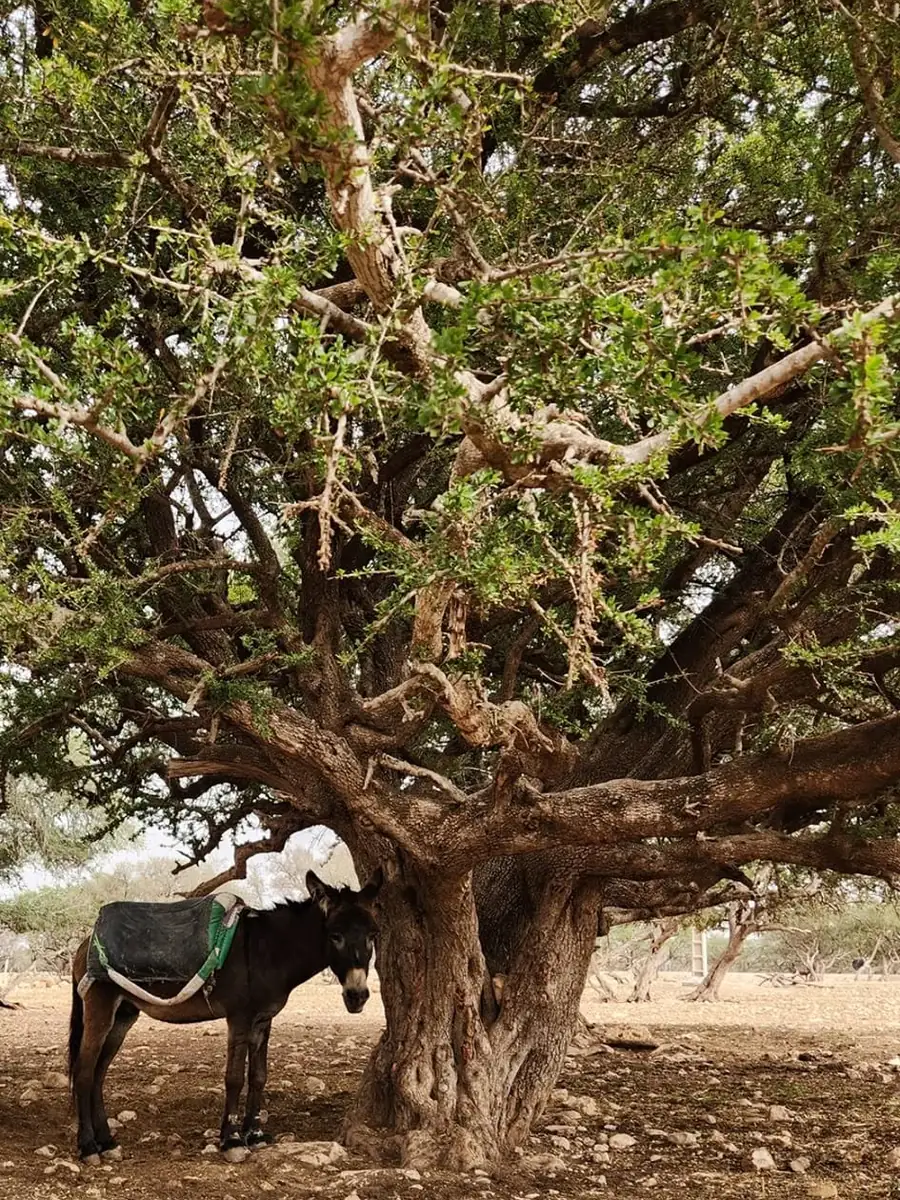
Where do argan trees grow?
The argan tree is endemic to Morocco. It grows naturally in the south-west of the country, across the broad plain that opens onto the Atlantic between the High Atlas and the Anti-Atlas, mainly between Agadir, Essaouira and Taroudant. In 1998 UNESCO made the area the Arganeraie Biosphere Reserve, the first in Morocco: some 2.5 million hectares, home to more than three million people.
The forest has shrunk, though. According to a study by Said Gharby and Zoubida Charrouf, it fell from about 1.5 million hectares to roughly 800,000 by the year 2000, under the combined pressure of drought and human activity. Morocco has made its protection a national priority. It set up a dedicated agency, ANDZOA, for oasis and argan areas in 2009, and under its Generation Green and Forests of Morocco 2020-2030 strategies it plans to plant 50,000 hectares of argan trees and restore 400,000 hectares of forest by 2030.
International recognition has followed. In 2018 the FAO named the argan-based agro-sylvo-pastoral system of Ait Souab-Ait Mansour a Globally Important Agricultural Heritage System. And in 2021, on a proposal from Morocco co-sponsored by 113 countries, the UN General Assembly declared 10 May the International Day of Argania.
Argan fruit and argan seeds
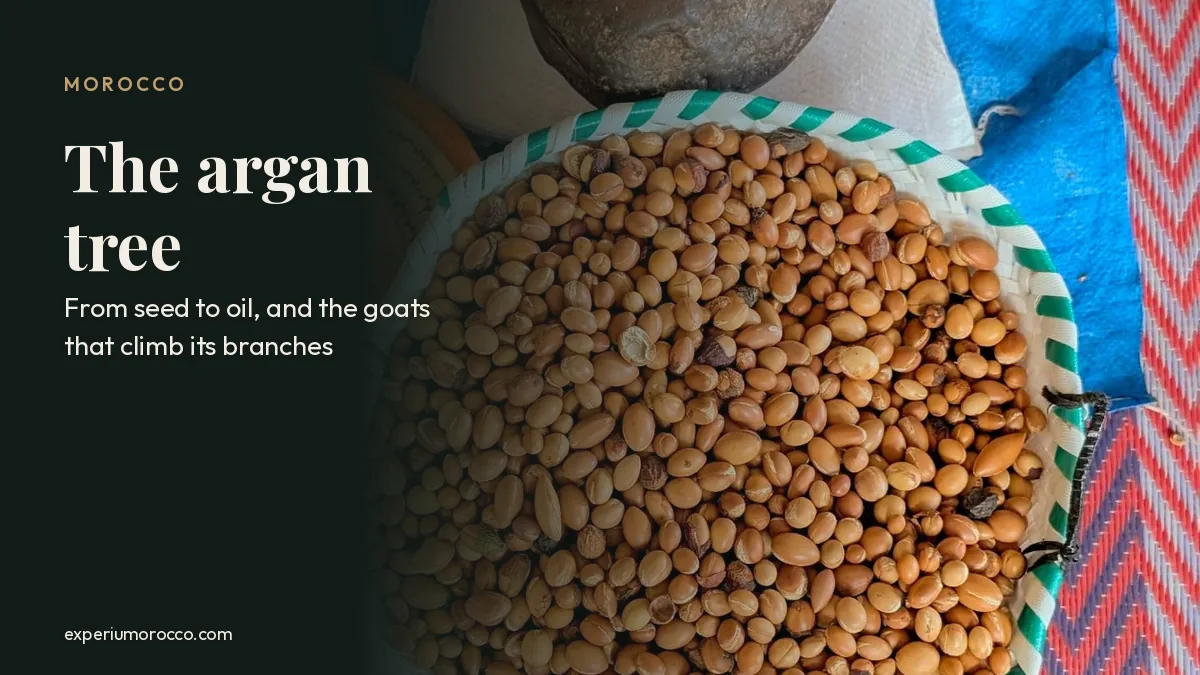
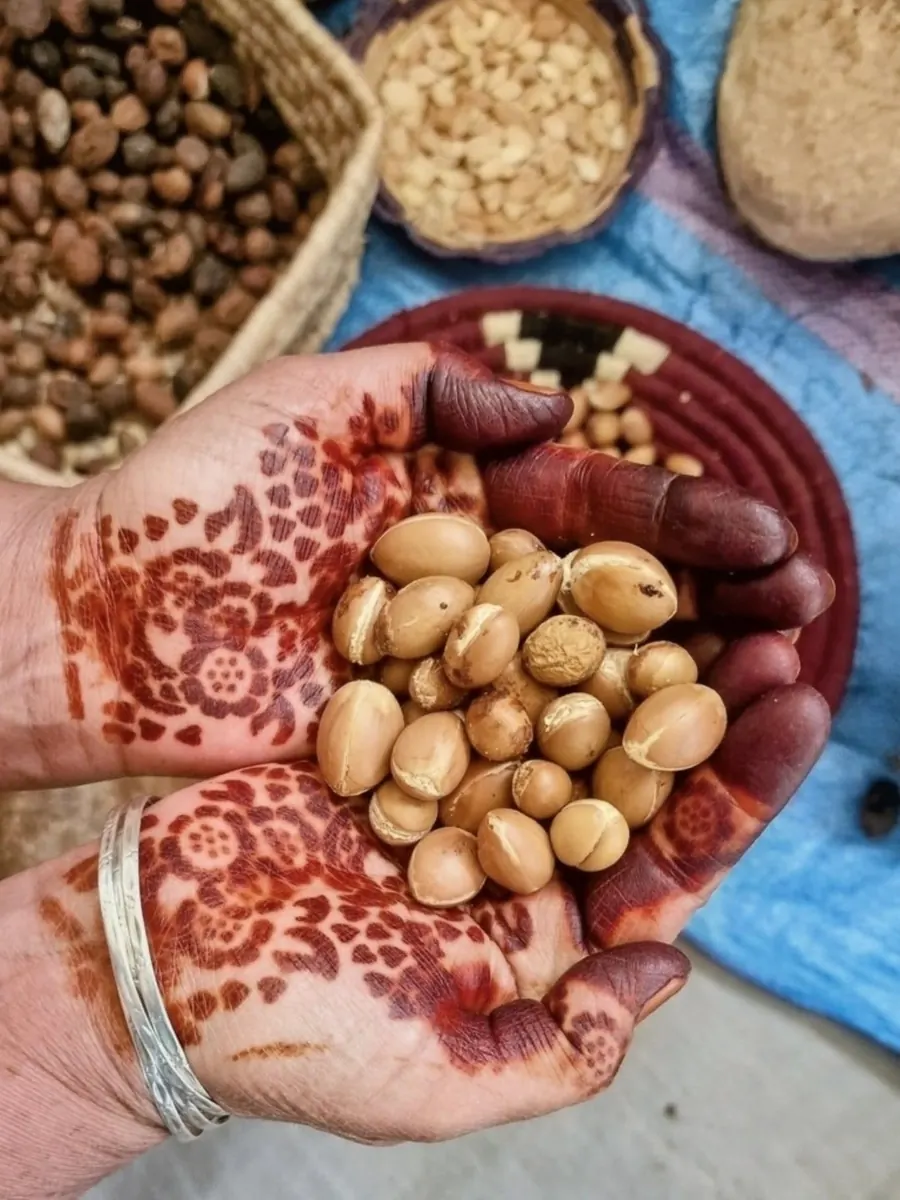
“Argan seeds” is a slightly confusing term, because the fruit comes in layers. From the outside it looks like a large olive, green at first and yellow when ripe. Under the peel is a fleshy pulp, and inside that sits a nut with an extremely hard shell. The nut holds one to three white, bitter kernels. Those kernels are the true seeds, and they are where the oil comes from.
- Peel and pulp. Green, turning yellow as it ripens. Once dry, it comes away from the nut and is fed to livestock.
- Nut. An extremely hard shell, cracked by hand between two stones. The empty shells are burned as fuel.
- Kernels. One to three per nut: these are the true argan seeds, and up to half their weight is oil.
- Oil. Roasted kernels make cooking oil, raw kernels make cosmetic oil. The leftover press cake feeds livestock.
≈ 50 kg of fruit → ≈ 24 hours of work → 1 litre of oil
Traditional method. Sources: FAO; Gharby and Charrouf (2022).
The FAO puts the average yield at about 8 kg of fruit per tree per year, and almost nothing is wasted: the pulp and the press cake left after extraction go to the animals, and the shells are burned as fuel.
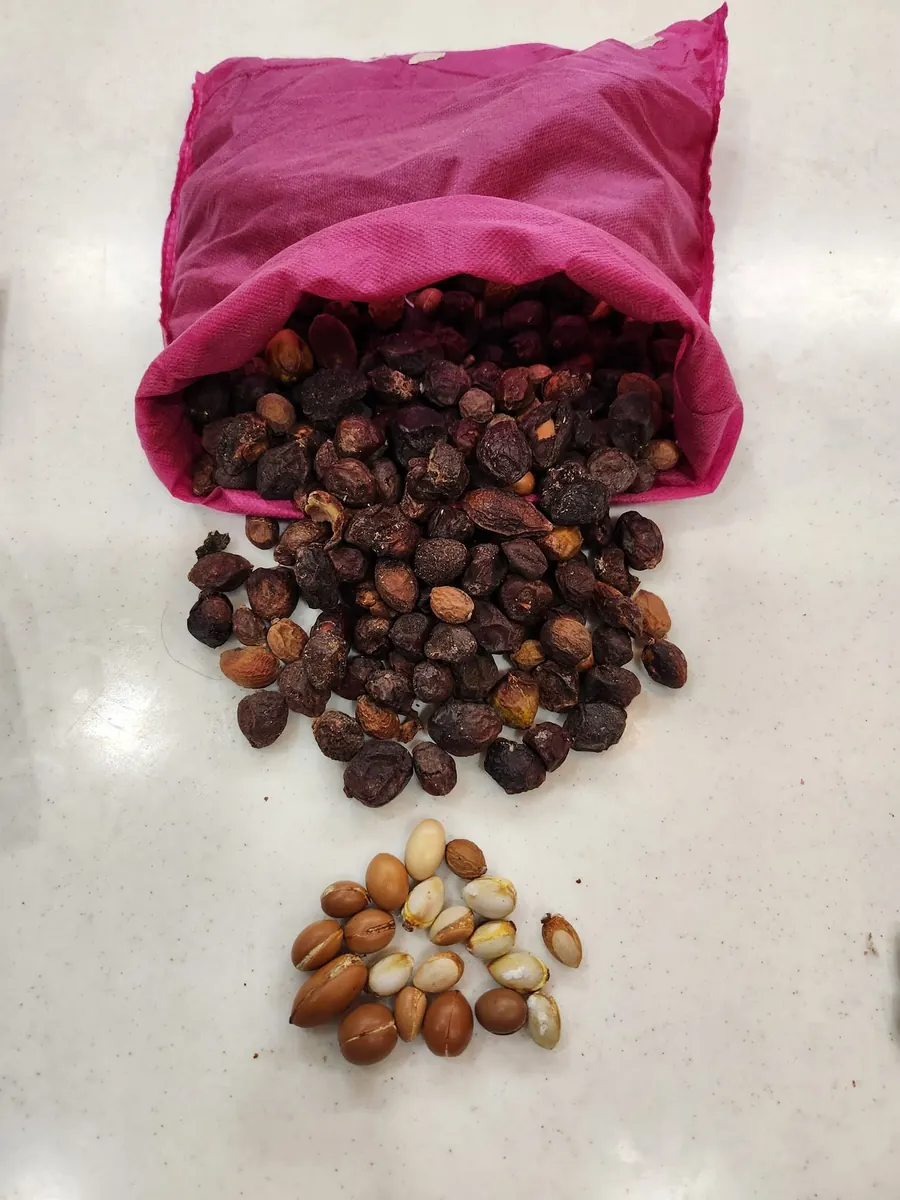
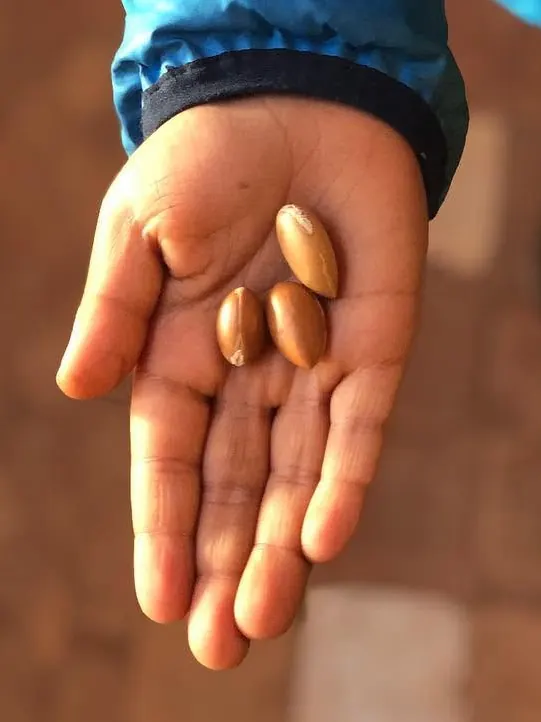
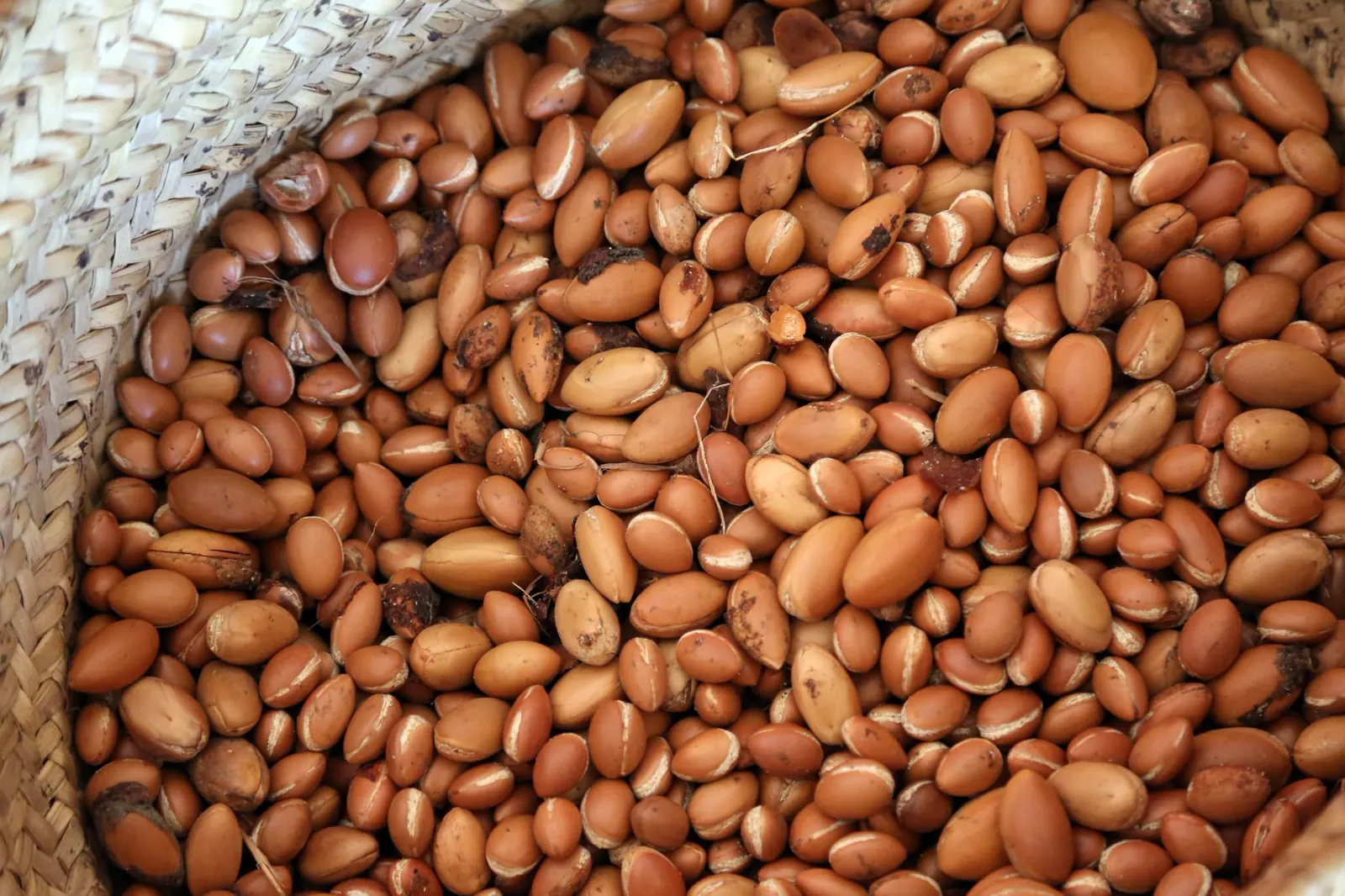
How argan oil is made, step by step
UNESCO describes in detail the skills that the women of the argan forest pass on from mother to daughter. Done the traditional way, it is a slow process:
- Harvest. Between May and August, ripe fruit is gathered, mostly once it has fallen to the ground.
- Drying and pulping. The fruit is sun-dried until it has lost about half its weight, then the dry pulp is knocked off the nut.
- Cracking. The slowest step by far. Each nut is cracked by hand, with one stone against another, to free the kernels.
- Roasting, for cooking oil only. The kernels are roasted over heat; by hand, a kilo takes 30 to 40 minutes. Cosmetic oil is made from raw kernels.
- Grinding. The kernels go through a stone hand mill, made by local craftsmen, until they turn into a thick paste.
- Kneading. Warm water is added little by little, in precise amounts, and the paste is kneaded until it releases its oil, which is collected by hand.
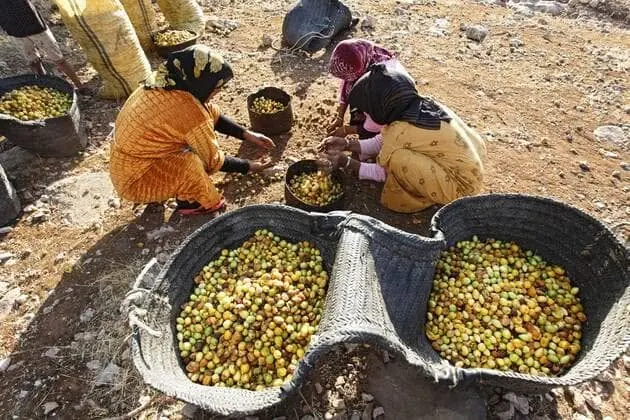
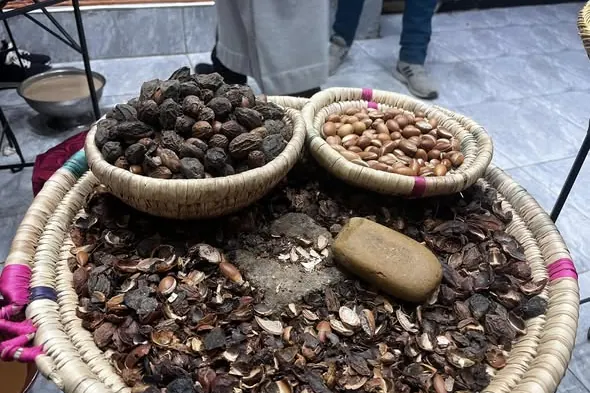
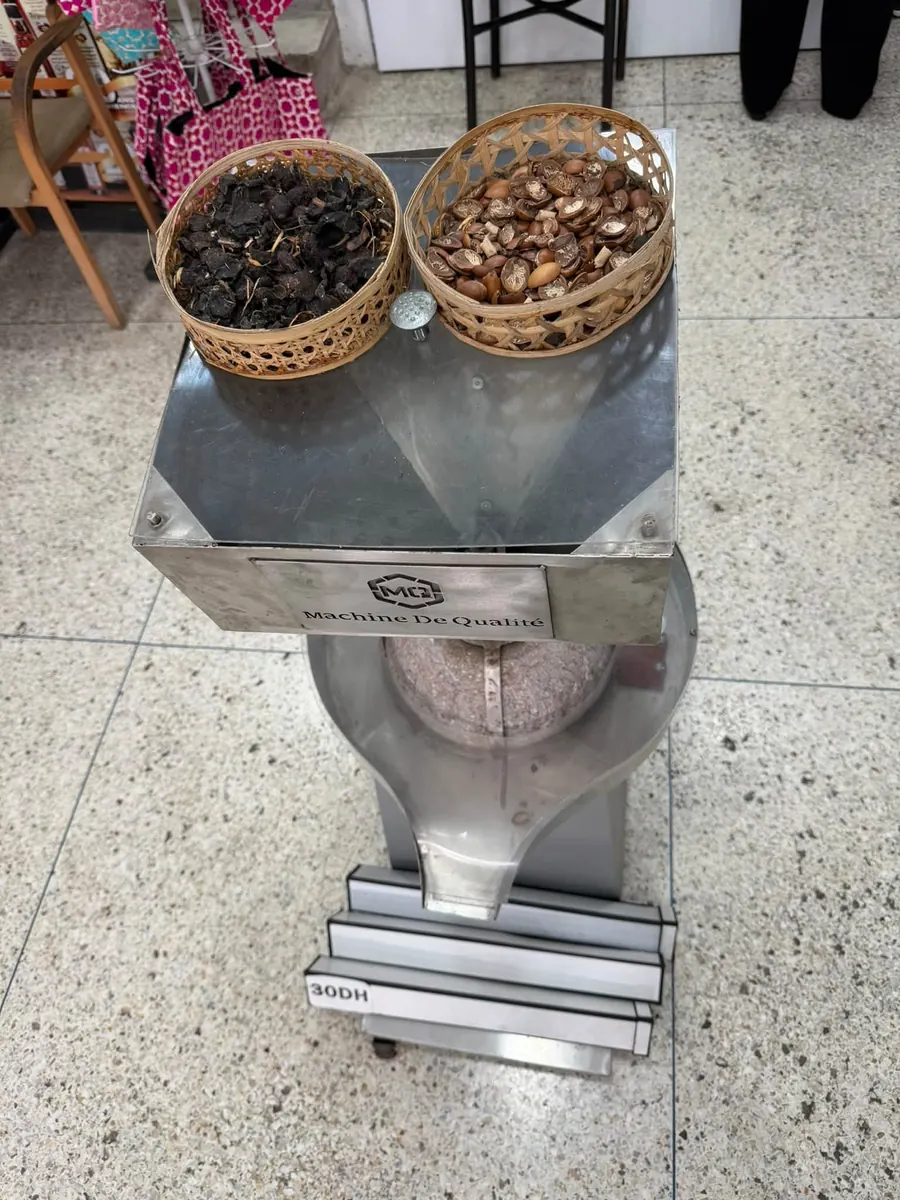
Cooperatives have mechanised part of the work, especially grinding and pressing. Cracking the nuts, however, is still nearly always done by hand: according to the World Intellectual Property Organization, the shell is so hard that machines have not done the job well.
Cooking oil, with its toasted, nutty flavour, is also the base of amlou, a spread of almonds, argan oil and honey often eaten with bread at breakfast. Cosmetic oil, pressed from raw kernels, is the one used on skin and hair.
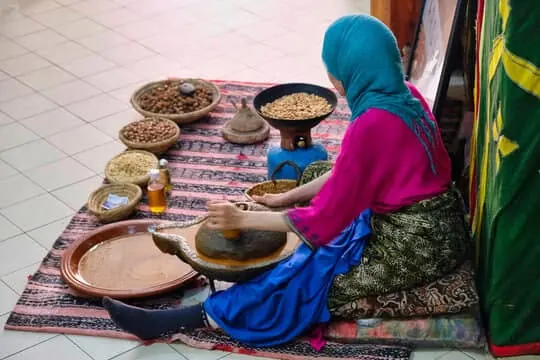
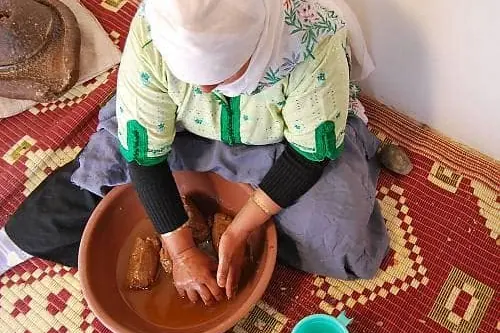
The argan women and their cooperatives
Argan know-how is above all held by women. When UNESCO added the practices and knowledge surrounding the argan tree to its Intangible Cultural Heritage list in 2014, it noted that the so-called “argan women” teach the craft to their daughters from an early age. The oil is part of social life too: it is given as a wedding gift and served in festive dishes.
Since the 1990s, many of these women have formed cooperatives. Morocco’s official news agency, MAP, counts more than 850 women’s cooperatives processing and selling argan products today, and UNDP estimates that around 50,000 women in the Souss-Massa region earn a direct income from the sector. The oil has also carried a protected geographical indication, “Argane”, since 2010.
Visiting a cooperative is the best way to watch the process up close and to buy oil knowing exactly where it comes from.
Goats in argan trees: why do they climb?
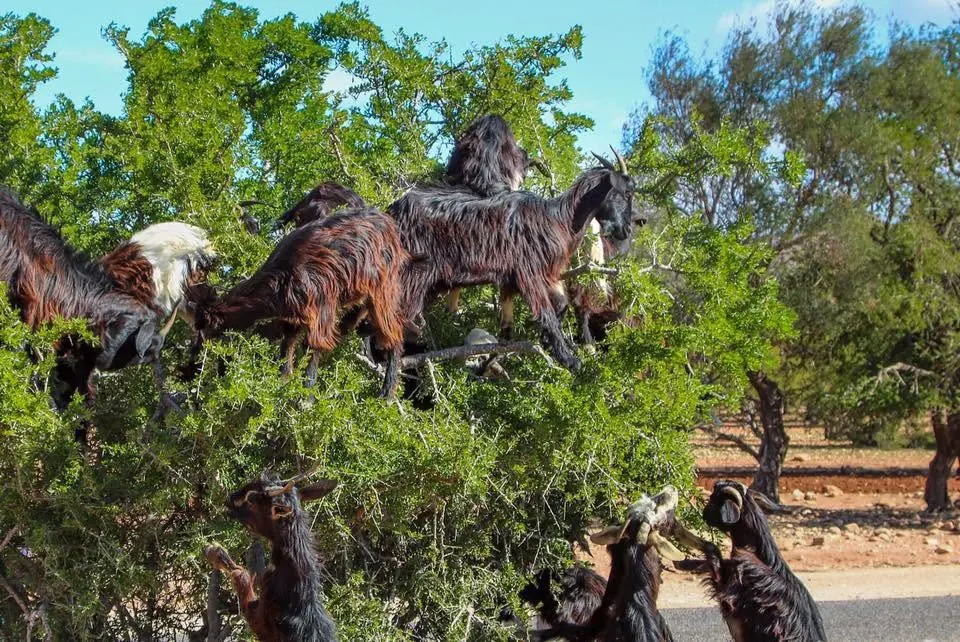
It is the photo everyone wants: a dozen goats perched in the crown of an argan tree, balanced on branches that look far too thin to hold them. It is not fake. Goats in the region really do climb argan trees to eat the leaves and fruit, especially in autumn, when the ground is bare. At that time of year, they spend around three quarters of their foraging time up in the trees.
In 2017, Spanish ecologists from the Doñana Biological Station (CSIC) found something even more intriguing. While chewing the cud, the goats bring the seeds back up and spit them out clean, often well away from the parent tree. Without meaning to, they help plant the next generation of argan trees. Herders sometimes prune the trees to make climbing easier and help the young goats learn.
For a long time this partnership also had a practical side. The FAO recorded that the seeds spat out by goats were gathered by hand to make oil. Today, cooperatives work with fruit picked up directly in the field.
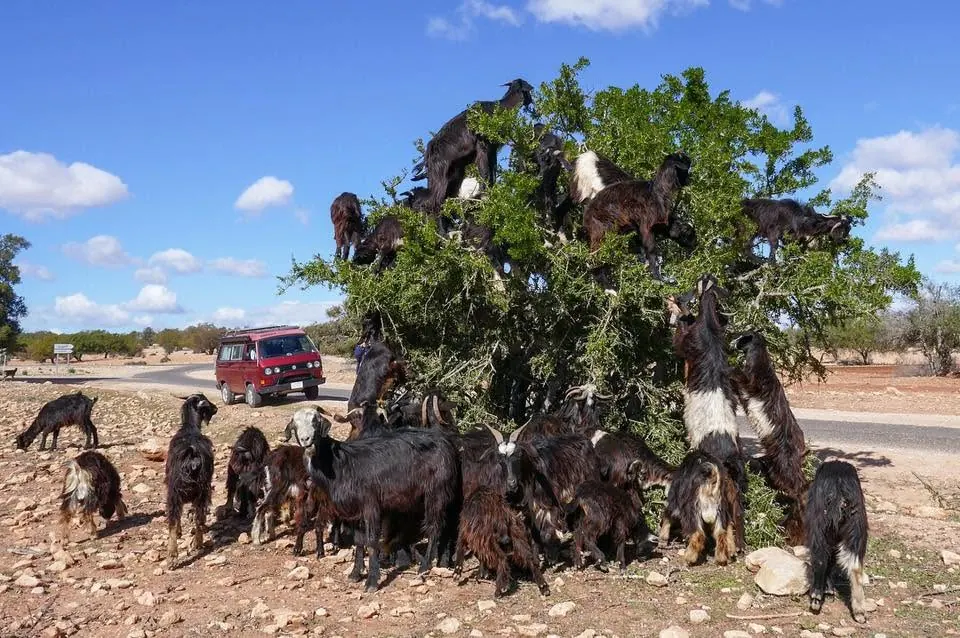
On the road from Marrakech to Essaouira, you are likely to pass these herds. Be aware that some roadside trees have become photo stops: the herder gathers the goats in the same tree and expects a tip. If you stop, ask before taking pictures, do not feed the animals and take a look at how they are kept. Watching goats climb freely out in the countryside, on a hike, is a very different experience.
From tree to jewellery: argan seeds set in silver
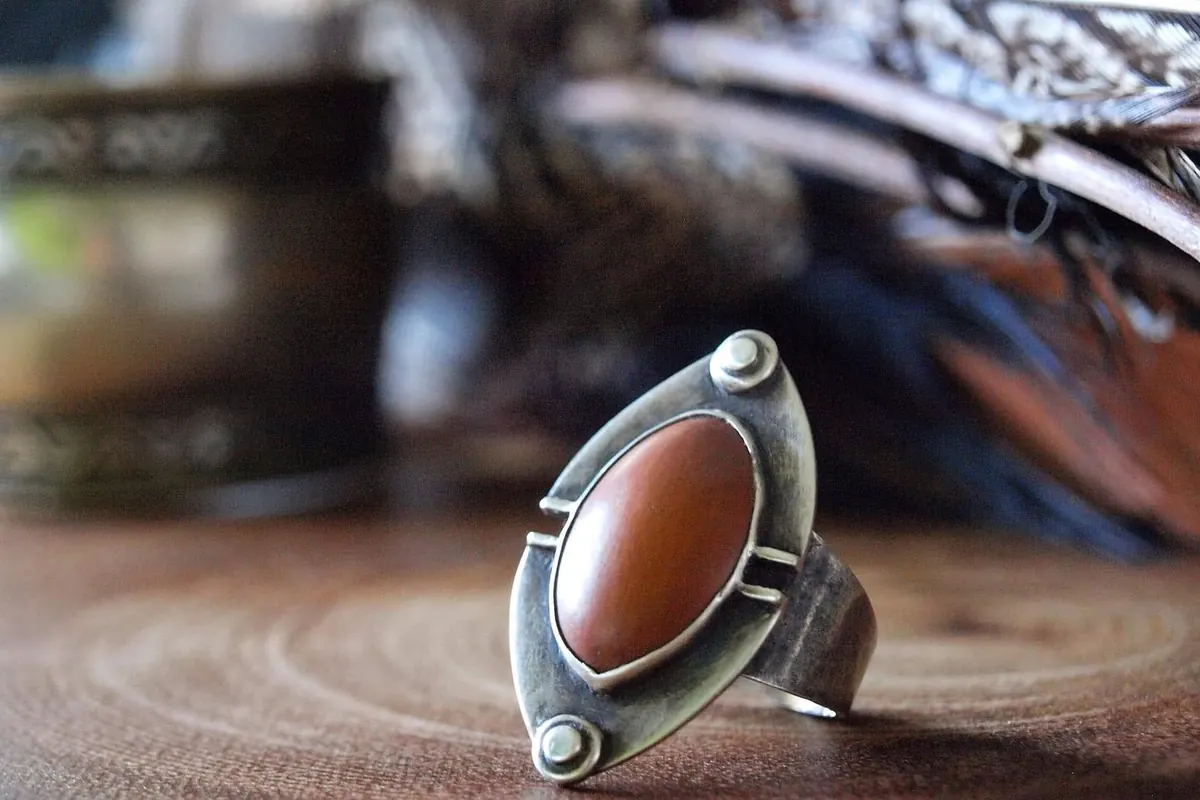
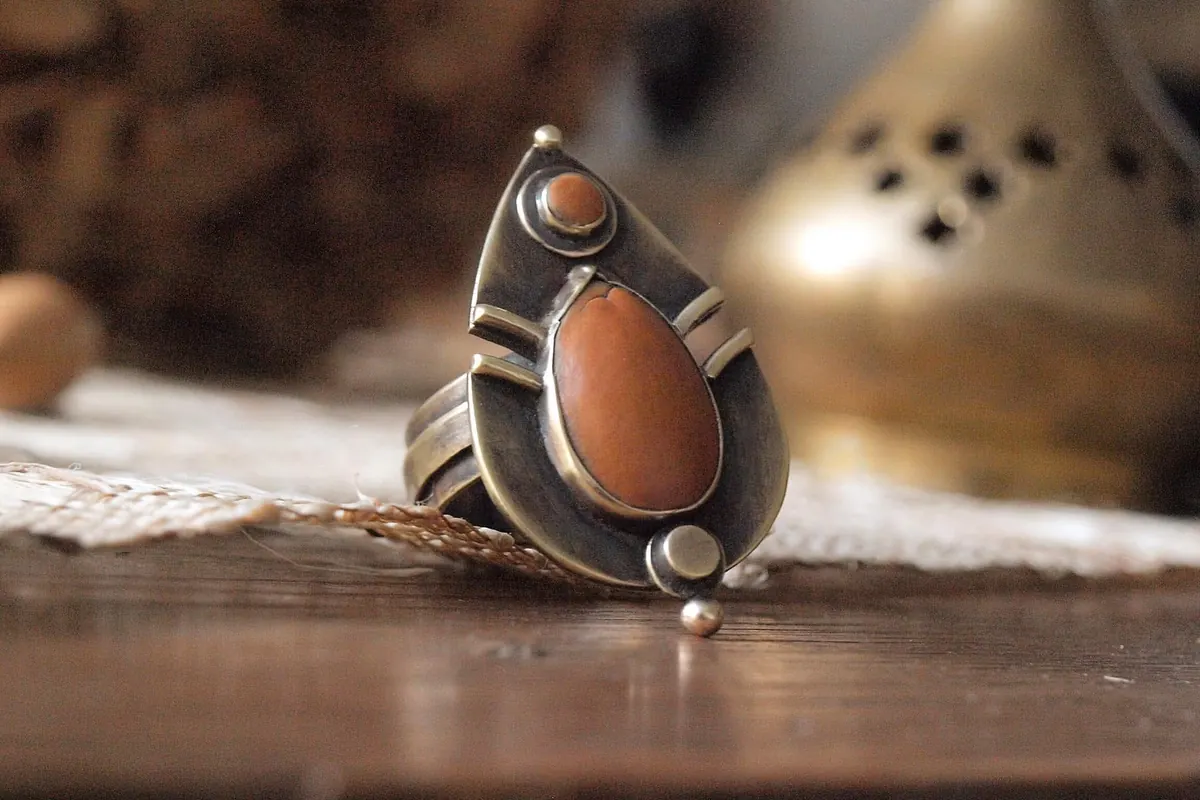
The argan seed has found a second life that few people would guess. Some jewellery designers polish it and set it in silver or brass as if it were a gemstone, in rings, earrings and pendants. Its colour, somewhere between ochre and caramel with natural streaks, is reminiscent of amber or carnelian, and no two pieces are alike, because no two seeds are.
It is a lovely way to take a little of the argan forest home, and it comes with a story: a fruit that ripened on a thorny tree, perhaps passed through a goat’s mouth and ended up on a craftsman’s bench. If you are tempted, ask where it was made and choose handmade pieces.
Where to see argan trees in Morocco, and when
You will see argan trees along the road to Essaouira, around Agadir and in the Souss valley towards Taroudant. Essaouira makes a good base, since the argan forest surrounds the town; see our list of things to do in Essaouira.
If you would rather explore on foot, the Atlantic coast south of Essaouira is ideal: the trail crosses Mount Igzoulne, covered in argan trees, with views over the ocean. We cover it in our guide to hiking Morocco’s Atlantic coast, and it is the route of our Atlantic coast trek to Essaouira.
- May to August: the fruit ripens and the harvest begins.
- Autumn: the best time to see goats up in the trees.
- 10 May: International Day of Argania.
Tips for buying argan oil
- Know the two types. Culinary oil, from roasted kernels, smells of toasted nuts; cosmetic oil, from raw kernels, has a much milder scent.
- Buy from cooperatives or shops that state the origin. The “Argane” geographical indication is an extra guarantee.
- Be wary of very low prices. Every litre represents dozens of kilos of fruit and many hours of work.
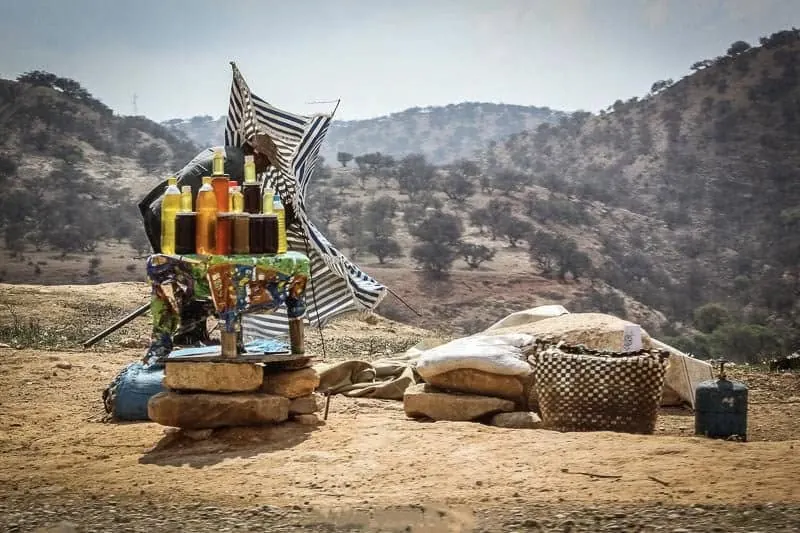
- You will also find it in the souks. Take your time and compare, as with anything you buy in the Marrakech souks.
Argan tree FAQ
Where do argan trees grow?
Naturally, in south-western Morocco, between the High Atlas, the Anti-Atlas and the Atlantic, mainly between Agadir, Essaouira and Taroudant. The tree is endemic to Morocco.
Why do goats climb trees in Morocco?
They climb argan trees to eat the leaves and fruit, especially in autumn when there is little to graze on the ground. Some stops along the Essaouira road, however, are set up for tourists.
What are argan seeds?
They are the kernels inside the nut of the argan fruit, one to three per nut. They contain up to 50% oil and are the raw material of argan oil.
Are argan seeds edible?
Raw, they are bitter. They are eaten in the form of culinary oil, made from roasted kernels, and in amlou, a spread of almonds, argan oil and honey.
How long does an argan tree live?
Around 200 years. It starts bearing fruit at about five years old and reaches full production at around sixty.
Can you grow an argan tree from seed?
Yes, the argan tree grows from seed, and Morocco now plants it on a large scale. It is slow-growing, suited to hot, dry climates, and takes about five years to bear its first fruit.
What is the difference between cosmetic and culinary argan oil?
Culinary oil is pressed from roasted kernels and tastes of toasted nuts. Cosmetic oil comes from raw, unroasted kernels and is used on skin and hair.
Sources
- UNESCO: Arganeraie Biosphere Reserve and argan, practices and know-how concerning the argan tree (2014).
- FAO: argan-based agro-sylvo-pastoral system, Ait Souab-Ait Mansour, argan monograph (Minor oil crops) and the landscape and communities behind argan.
- United Nations: International Day of Argania and resolution 75/262.
- Gharby and Charrouf (2022), Frontiers in Nutrition: argan oil, from tradition to science.
- Delibes, Castañeda and Fedriani (2017), Doñana Biological Station (CSIC), Frontiers in Ecology and the Environment: tree-climbing goats disperse seeds during rumination.
- MAP, Morocco’s official news agency: argan sector targets for 2030.
- UNDP Morocco: International Day of Argania and women’s cooperatives (in French).
- World Intellectual Property Organization: the argan geographical indication (in French).