

Anyone who arrives in the Sahara expecting nothing but sand is in for a surprise. Flat-topped acacias, twisted tamarisks, tufts of grass holding the dunes in place and, in the valleys, whole forests of date palms. All of them live on very little rain, and each has found its own way to do it. This guide covers the Sahara Desert plants and trees you will find in Morocco, how they survive, and which ones are best admired without touching.
The most visible plants in Morocco’s Sahara are the acacia, the tamarisk and the date palm, which grows in the oases. Closer to the ground you will find grasses such as drinn, which anchors the dunes, and curiosities like the rose of Jericho and the colocynth, whose fruit is highly toxic. Almost all of them share the same tricks: roots that reach water far below the surface, tiny or missing leaves, and seeds that wait in the ground until it rains.
PhotosAll the photos in this guide were taken by Mustapha AIT ISHA, licensed tour guide, on our desert routes in Morocco.
What plants grow in the Sahara Desert?
Morocco’s Sahara has few plants, but every one of them is remarkably well adapted. Cacti don’t belong here: they come from the Americas. In the Sahara the main players are thorny trees, salt-tolerant shrubs and grasses that cling to the sand. These are the ones you are most likely to see, all listed as native to Morocco in Kew’s Plants of the World Online database.
Acacia Vachellia tortilis
The flat-topped tree of the desert, called talh in Arabic. It gives shade, fodder for goats and camels, and firewood.
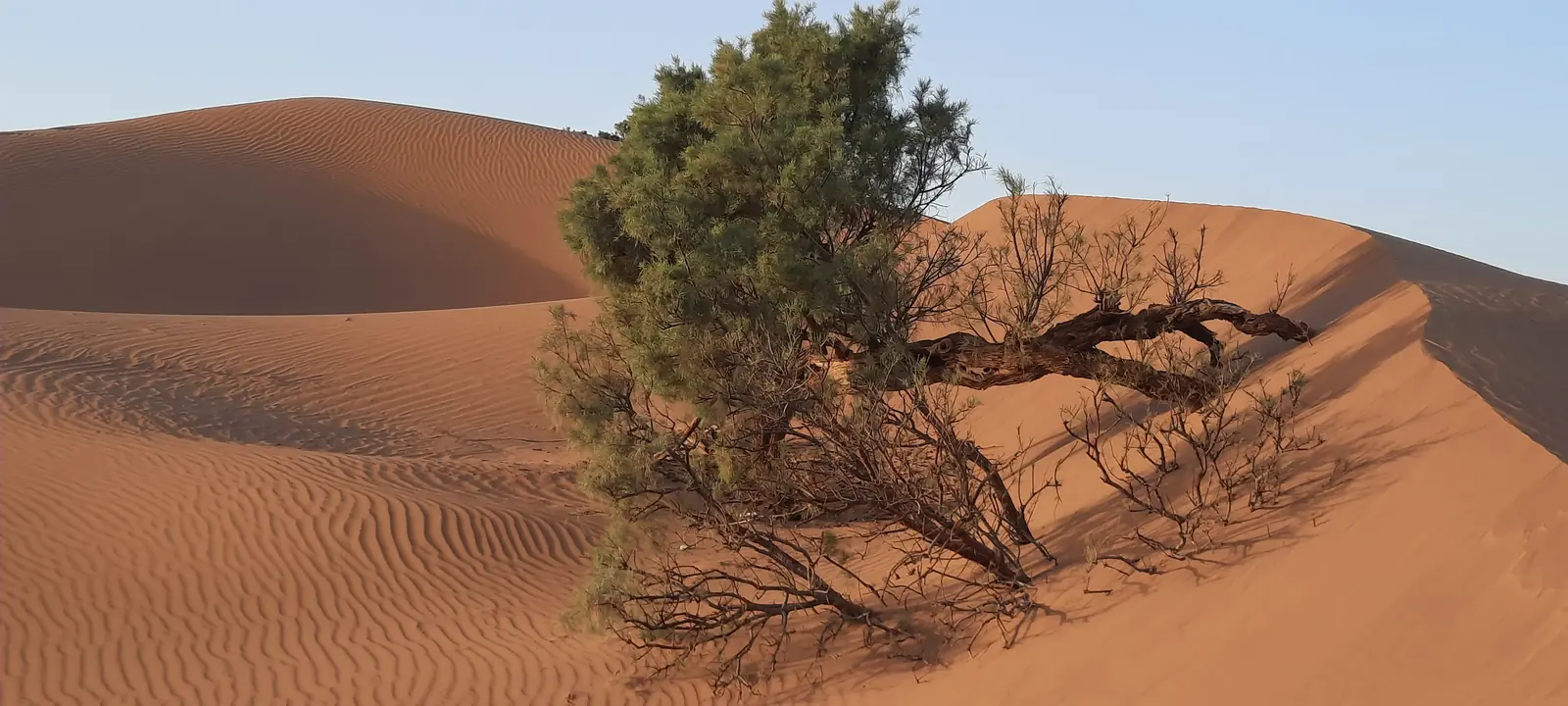
Tamarisk Tamarix aphylla
A tree with tiny scale-like leaves that tolerates salt, drought and frost. It is planted to stop dunes from advancing.
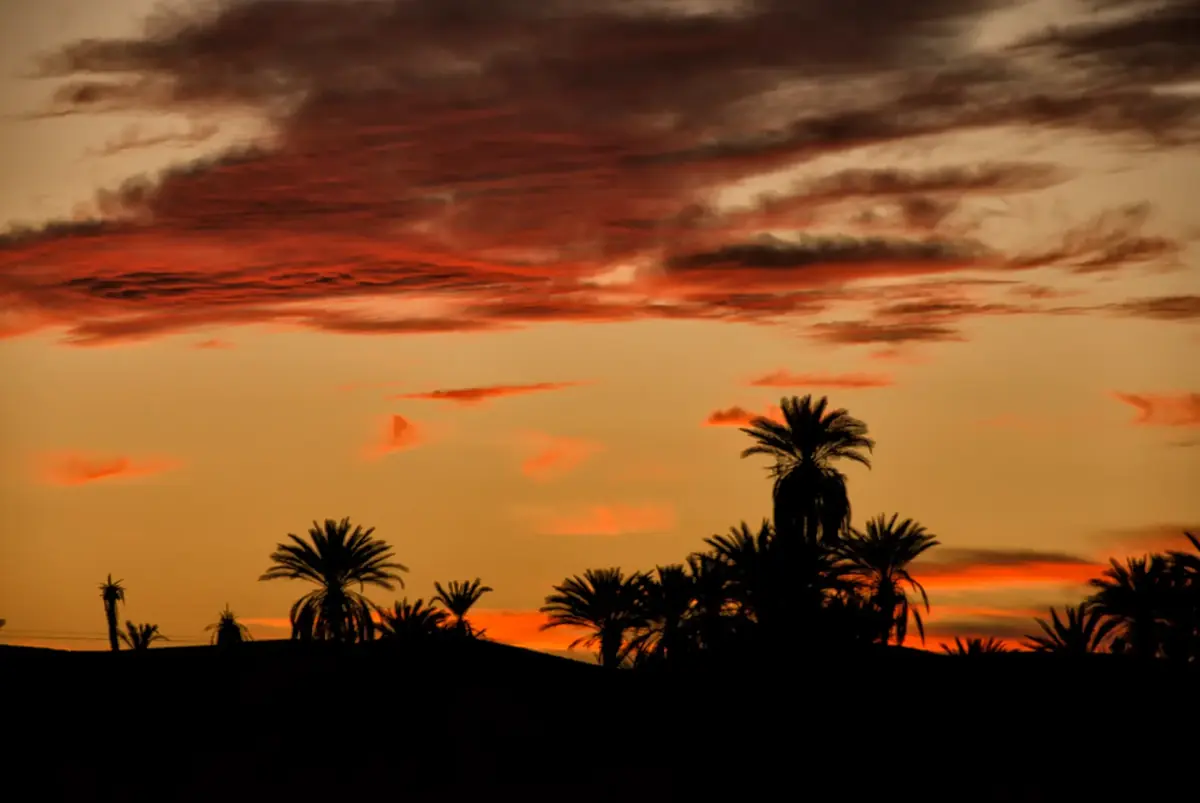
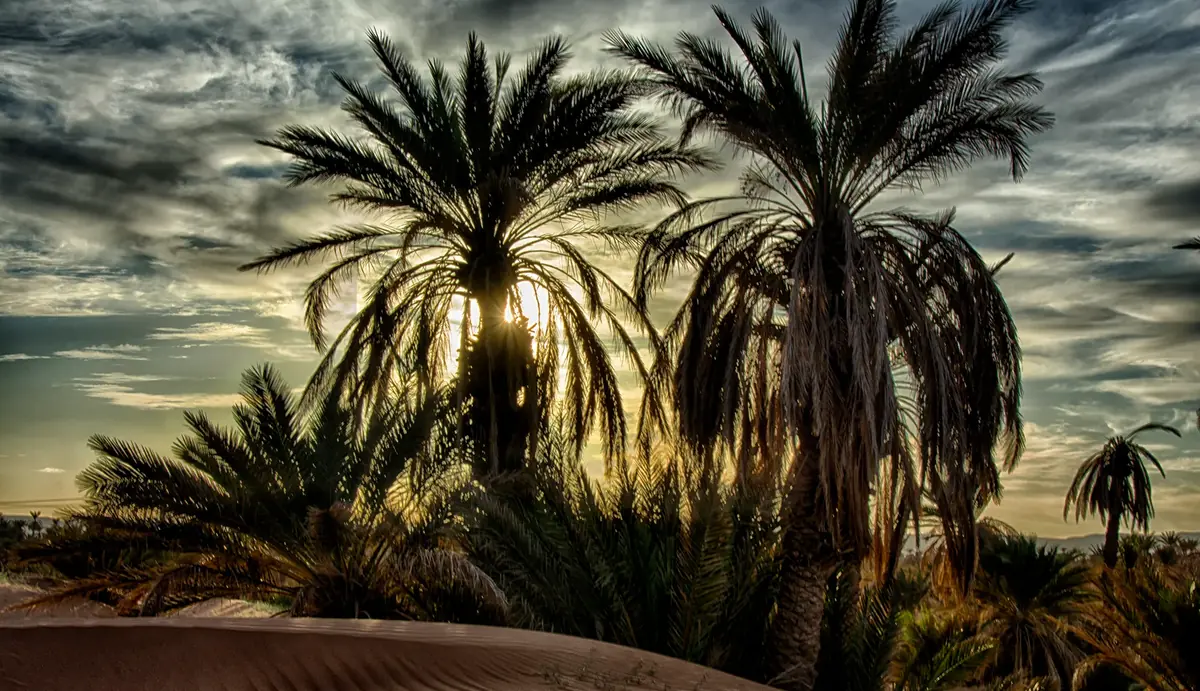
Date palm Phoenix dactylifera
The backbone of every oasis. Morocco has around 6.9 million date palms, almost all of them in the south.
Drinn Stipagrostis pungens
A dune grass that anchors the sand and that camels love to graze.
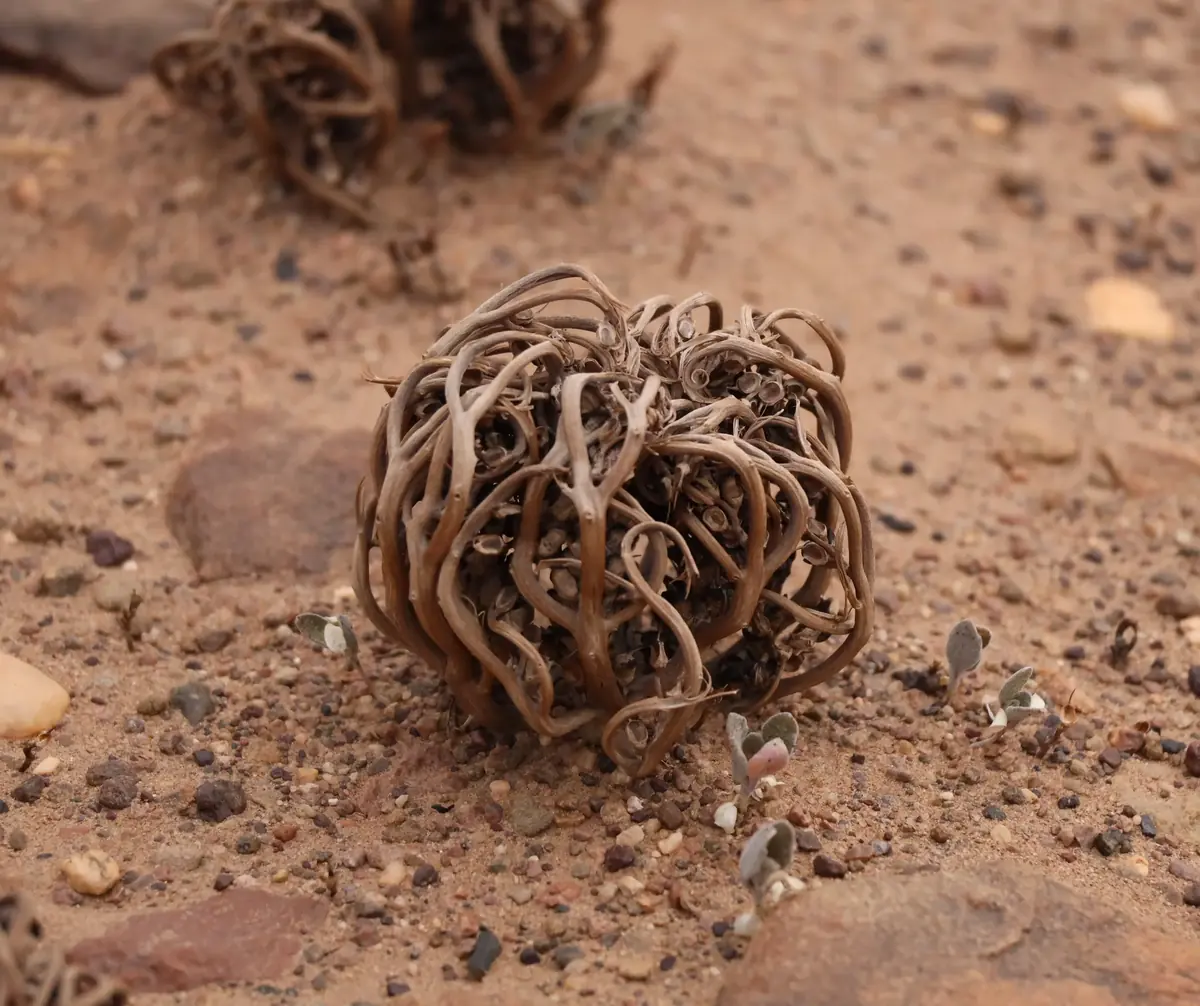
Rose of Jericho Anastatica hierochuntica
An annual that curls into a ball when it dries out and opens again when it gets wet.
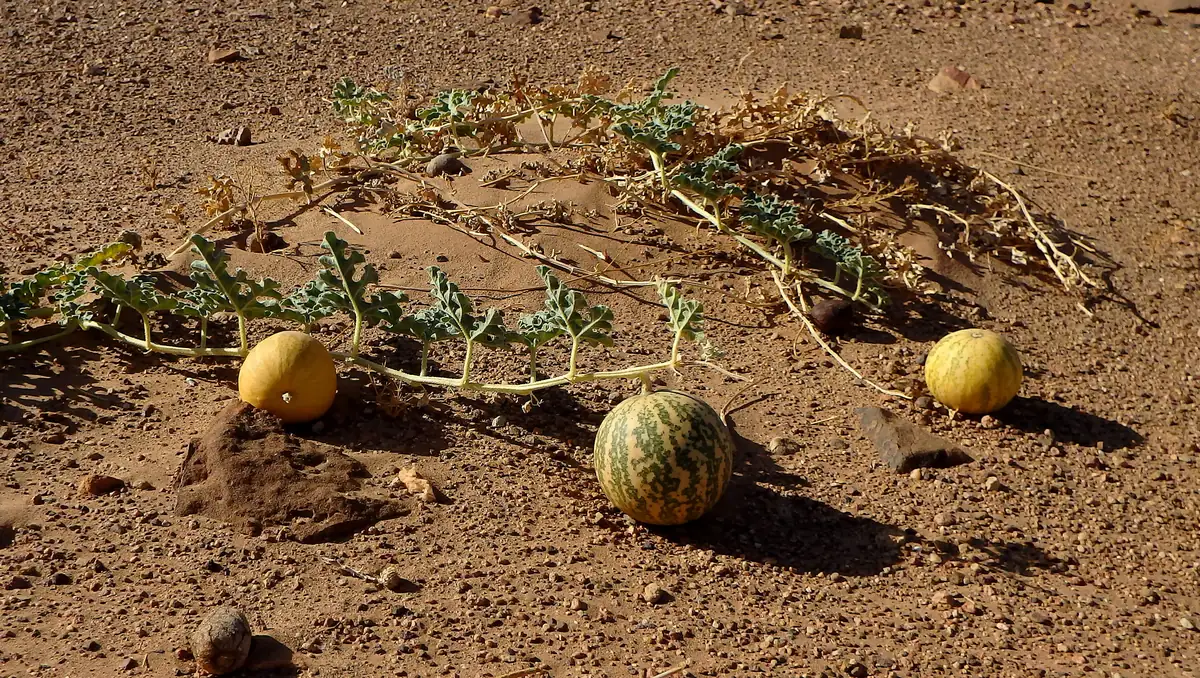
Colocynth Citrullus colocynthis
A creeping plant with fruits that look like small watermelons. They are extremely bitter and toxic.
How do plants survive in the Sahara Desert?
Errachidia, the nearest town to Merzouga with official weather records, gets about 136 mm of rain a year (just over 5 inches), spread over around 45 rainy days. London gets four times as much.
- Errachidia 136 mm
- Ouarzazate 115 mm
- London 558 mm
Errachidia and Ouarzazate: 1991-2020 averages. London: 1981-2010 averages. All figures from the World Meteorological Organization.
Sources: WMO, Errachidia; WMO, Ouarzazate; WMO, London.
With so little water to go round, desert plants rely on three strategies, summarised by the University of Nevada, Las Vegas:
- Go deep. Some trees send their roots several metres down to reach moisture in the subsoil. That is why so many plants in the Sahara have long roots.
- Lose as little as possible. Small, narrow leaves, or no leaves at all, so the sun can’t draw the water out of them.
- Wait it out. Annual plants spend the drought as seeds and only germinate when there has been enough rain to complete their life cycle in a few weeks.
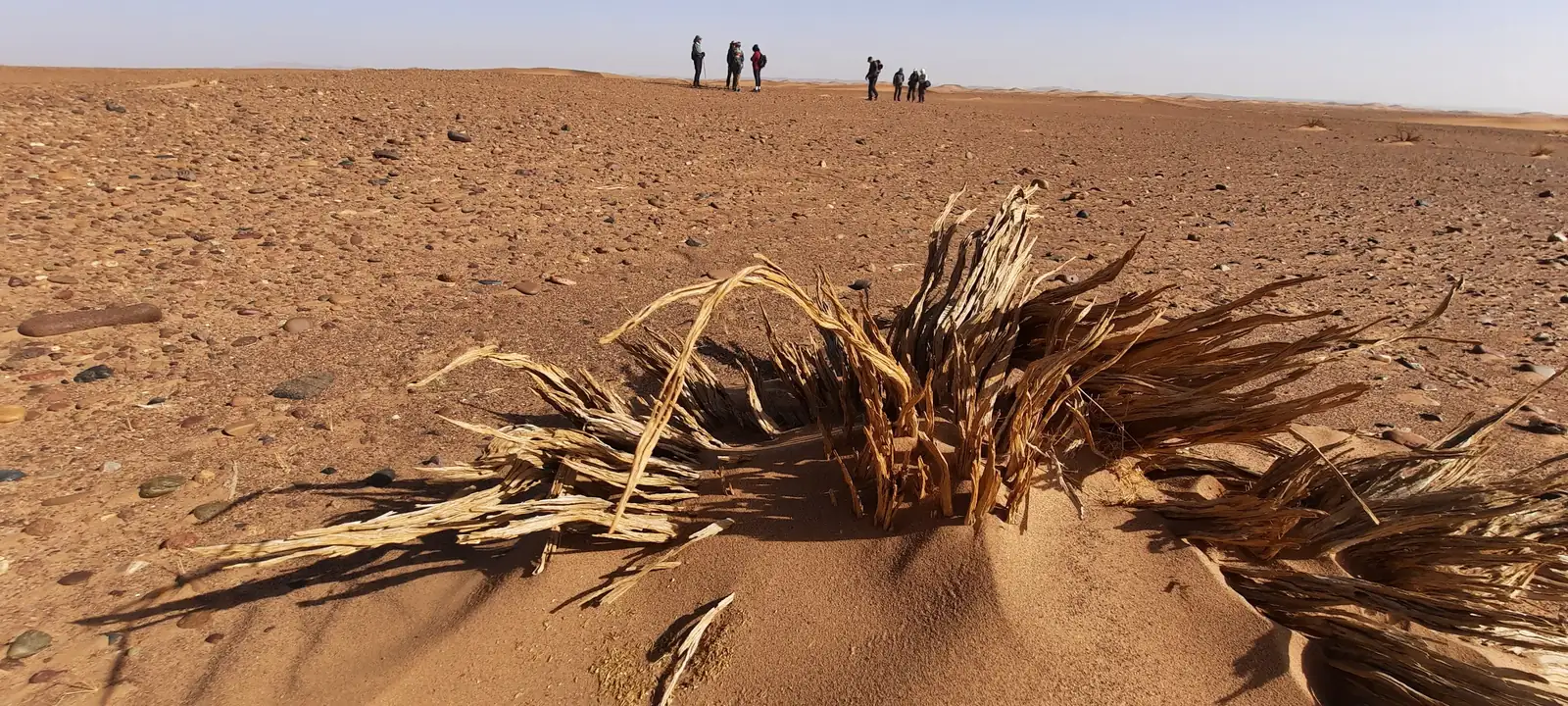
The acacia, the tree of the desert
If one tree sums up Morocco’s desert, it is the flat-topped acacia, Vachellia tortilis subsp. raddiana, still widely known as Acacia raddiana. The French Research Institute for Development (IRD) devoted a whole book to it, Un arbre au désert, which is the source of most of what follows.
Its secret is underground: a taproot that grows particularly deep, reaching moisture the surface never has. Above ground, its leaves, pods, young shoots and even its thorns are valuable food for goats and camels. Its shade cools the ground beneath it, and its wood is a prized fuel, burned as firewood or turned into charcoal.
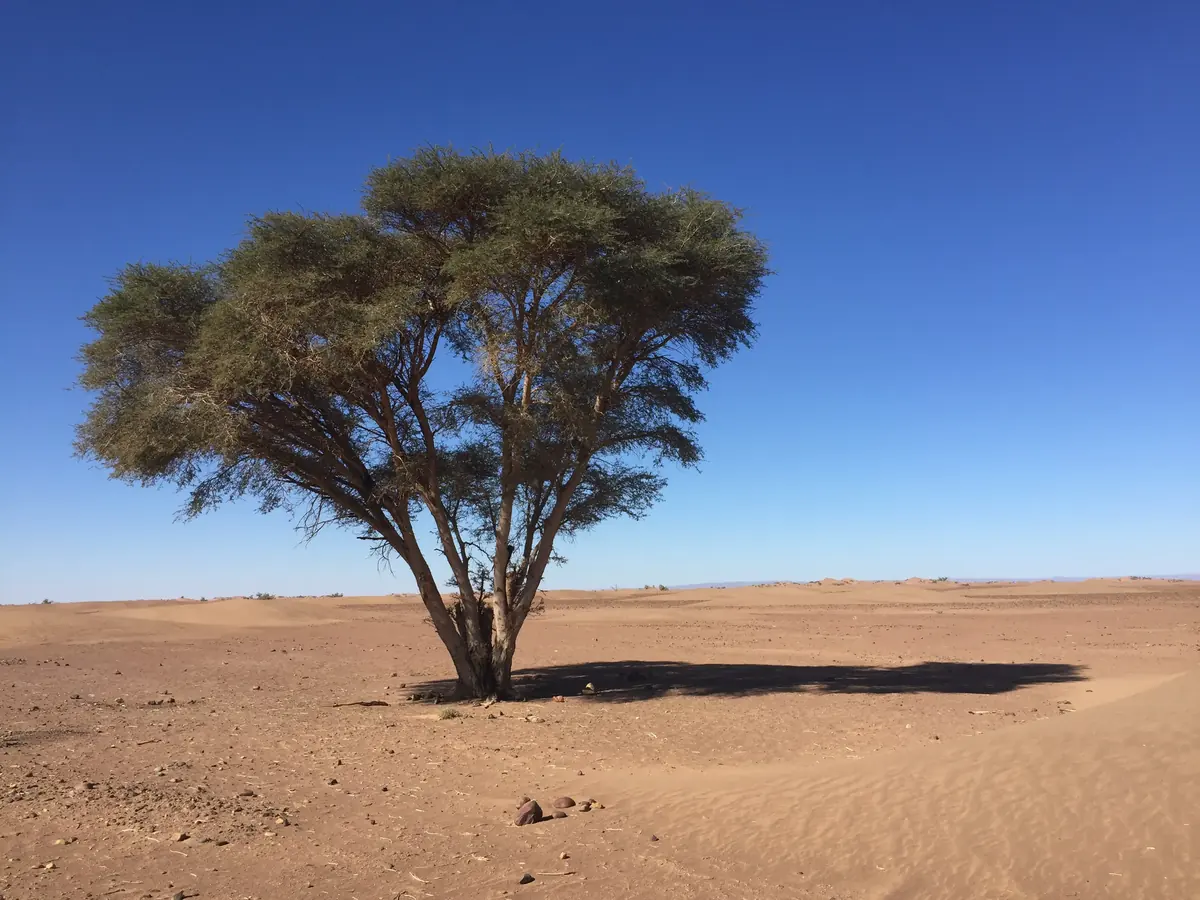
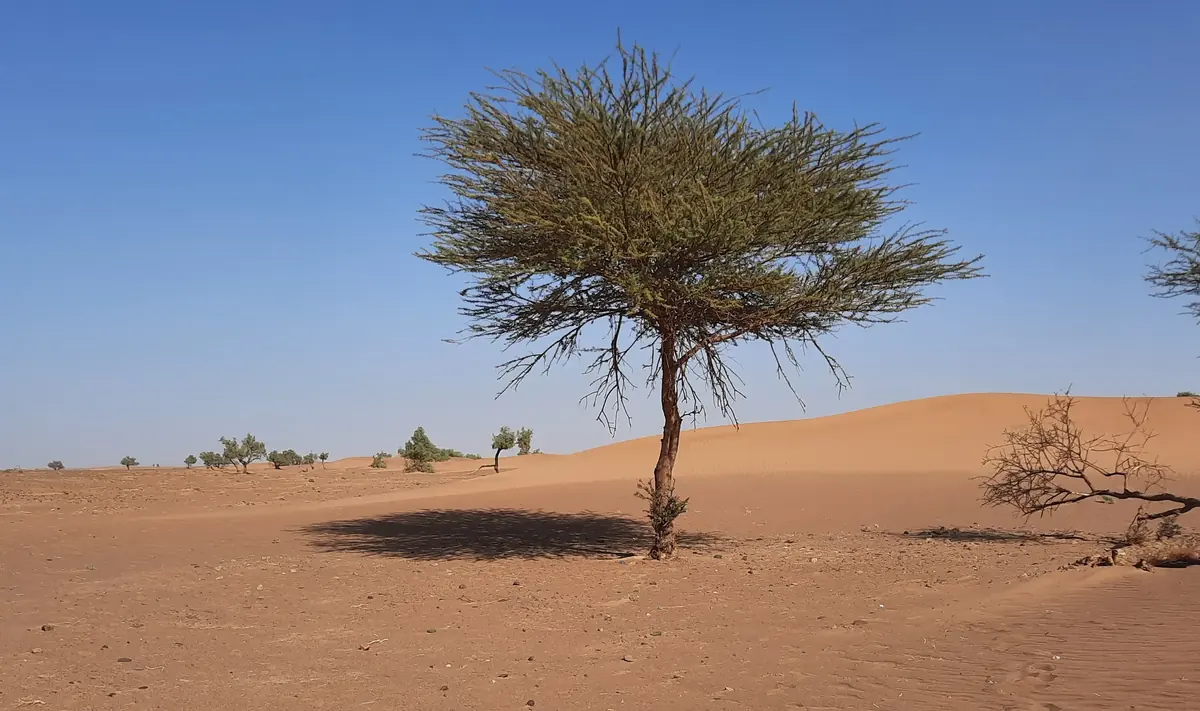
In Morocco, acacias form dense stands of around 260,000 hectares on the northern slopes of the Anti-Atlas. Their value as firewood is also their weak point: the IRD warns that in some areas the stands are under threat from overexploitation.
The tamarisk, the tree that holds the dunes
The tamarisk (Tamarix aphylla), known in Arabic as athl or tarfa, is another great survivor. According to World Agroforestry, it tolerates drought, heat, frost and salt, which it gets rid of through glands on its surface, and its roots go down about 10 metres.
Its job in the desert is to slow the sand down. The FAO lists it among the species used to fix sand and shelter land from sand-laden winds. When it grows on dunes, sand builds up around its lower branches and forms small mounds, with the tree itself on top.
The date palm and the oases
Without palms there would be no oases. The date palm shades the crops that grow beneath it and provides fruit that keeps all year, along with wood, fronds and fibre for almost everything else. According to a study by Moulay Ismail University and Morocco’s INRA published in Cahiers Agricultures, the country has about 6.9 million date palms today, around 4% of the world total, and nearly 90% of them grow in the provinces of Ouarzazate, Errachidia and Tata.
There used to be far more. The same study estimates that Morocco once had around 15 million palms. One of the main culprits is bayoud, a fungal disease which, according to INRA researchers, killed about 10 million palms in the country.
- In the past around 15 million
- Today 6.9 million
- 160,000 tforecast date harvest for the 2025-2026 season
- 76%of that harvest comes from the Drâa-Tafilalet region
- 400+date varieties grown in Morocco
Sources: El Bakouri et al., 2025, Moulay Ismail University and INRA; Khayi et al., 2023; Moroccan government portal.
To protect this landscape, UNESCO designated the Oases of Southern Morocco Biosphere Reserve in 2000. It covers more than 7 million hectares, including palm groves and acacia woodland. The Draa Valley, which you can visit on our 2-day Zagora desert trip, is one of the great palm groves of the south.
Smaller plants with big stories: colocynth, rose of Jericho and drinn
Down at ground level, the desert hides some quieter plants with surprising stories.
Colocynth (Citrullus colocynthis) is a creeping plant found on sandy soils across the Sahara, according to the FAO’s Feedipedia database. Its orange-sized fruits look like miniature watermelons, but compounds called cucurbitacins make them intensely bitter and toxic. It has been used against diabetes in the traditional medicine of the Tafilalet, yet researchers list it among Morocco’s main toxic plants.
Colocynth pulp is a violent purgative. In large doses it can cause severe bloody diarrhoea and can even be fatal, according to a study in the Saudi Medical Journal. Look at it, photograph it and leave it where it is.
The rose of Jericho (Anastatica hierochuntica) is an annual that curls its branches into a tight ball as it dries. When it gets wet the branches open and, as a Cairo University study in Annals of Botany explains, it is the raindrops themselves that release the seeds. The dry skeleton guards the seeds until that moment comes. In some countries it is sold for tea, but researchers at Sultan Qaboos University advise against drinking it without medical supervision, especially during pregnancy.
Drinn (Stipagrostis pungens) is one of the grasses that form tufts on the dunes. The FAO notes that it is widely used to fix dunes naturally, because its very hairy roots spread out and grip the sand. A study by the University of Ouargla and CIRAD describes it as the perennial camels graze most, and one of the toughest: it can survive four to five years of drought.
How to travel in the desert without harming its plants
Desert vegetation grows very slowly and struggles to recover. The oases of Drâa-Tafilalet, which according to the FAO cover almost 90% of the region, are under pressure from population growth, climate change and water shortages. As a visitor, a few simple habits help.
- Don’t snap branches off acacias or tamarisks for a campfire: firewood is exactly what threatens them most.
- Don’t pull up plants as souvenirs, even ones that look dead: many are holding their seeds.
- Don’t eat fruit you don’t recognise, and never colocynth.
- Stick to paths on foot and to tracks in a 4×4: tyres crush the tufts that hold the sand together.
- Take your rubbish with you, food scraps included, as they take a long time to break down in the desert.
Curious about the wildlife too? Our guide to Sahara Desert animals covers who lives among these plants. And to explore on foot, the Draa Valley desert trek passes through the dunes of Tidri, Erg Sahel and Ras Errich.
Sahara Desert plants: FAQ
What plants grow in the Sahara Desert?
In Morocco’s Sahara you will find trees such as the acacia (Vachellia tortilis) and the tamarisk (Tamarix aphylla), date palms in the oases, grasses like drinn, and plants such as the rose of Jericho and the colocynth.
Are there cacti in the Sahara Desert?
Not naturally. Cacti are native to the Americas. In the Sahara their place is taken by thorny trees like the acacia and by plants with tiny leaves.
Why do plants in the Sahara Desert have long roots?
To reach water. Rain is scarce and evaporates quickly, so some trees send their roots several metres down to the moisture in the subsoil.
How many date palms are there in Morocco?
About 6.9 million, according to a 2025 study by Moulay Ismail University and INRA. Nearly 90% are in the provinces of Ouarzazate, Errachidia and Tata.
Can you eat colocynth?
No. The fruit is extremely bitter and toxic, and large doses can be fatal.
What is the rose of Jericho?
A desert annual that curls into a ball when it dries out. When it gets wet it opens up, and the rain releases its seeds.