


At midday the Sahara looks empty. Walk out of camp at sunrise, though, and the sand tells a different story: tiny footprints, the drag marks of a tail, the trail of something that passed in the night. Morocco’s Sahara is home to camels, birds, reptiles, insects and small mammals that get by on very little water in extreme heat. This guide covers the Sahara Desert animals you can find around Merzouga, Zagora and Erg Chigaga, how they survive, and which ones deserve a little caution.
The animal you will see most in Morocco’s desert is the dromedary camel, and it is a domestic animal. After that come small birds such as the desert sparrow and the white-crowned wheatear, plus lizards and beetles that come out as soon as the sun warms the ground. Most wild mammals, like the fennec fox and the jerboa, are nocturnal and rarely seen. Scorpions and vipers do live here, but they avoid people and are far less active in the cooler months.
PhotosAll the photos in this guide were taken by Mustapha AIT ISHA, licensed tour guide, on our desert routes in Morocco.
What animals live in the Sahara Desert in Morocco?
Morocco’s Sahara is not just sand. Seas of dunes such as Erg Chebbi near Merzouga and Erg Chigaga alternate with stony plains, dry riverbeds and palm groves, and each of these landscapes has its own residents: the camel, which people have bred here for centuries, and a discreet cast of wild birds, reptiles, insects and small mammals.
The table below lists the best-known species, with their scientific name, their status on the IUCN Red List and the protection they have. In Morocco, Law 29-05 makes it illegal to catch, keep or sell protected species without a permit, with fines of 5,000 to 100,000 dirhams per animal depending on the category.
| Animal | IUCN | Protection |
|---|---|---|
| Dromedary camelCamelus dromedarius | Domestic | Livestock |
| Fennec foxVulpes zerda | LC | CITES Appendix II |
| Sand catFelis margarita | LC | CITES Appendix II |
| Dorcas gazelleGazella dorcas | VU | CMS Appendix I |
| Lesser Egyptian jerboaJaculus jaculus | LC | · |
| Desert sparrowPasser simplex | LC | · |
| White-crowned wheatearOenanthe leucopyga | LC | · |
| Horned viperCerastes cerastes | LC | Protected in Morocco |
| Spiny-tailed lizardUromastyx nigriventris | LC | CITES Appendix II |
LC: Least Concern. VU: Vulnerable. Sources: IUCN Red List; Convention on Migratory Species; CITES; Moroccan Decree 2-12-484, which lists the horned viper as a protected species.
Day or night: how desert animals beat the heat
Desert animals don’t fight the heat, they dodge it. The most common strategy is to be active at night and spend the hottest hours underground, in burrows where the temperature stays far milder. That is how the fennec fox, the jerboa and the sand cat live, and the horned viper hunts the same way.
The second strategy is not to rely on drinking water at all. According to the University of Michigan’s Animal Diversity Web, the fennec fox can go indefinitely without drinking, while the jerboa and the dorcas gazelle get their water from the plants and insects they eat. The third is built into the body: the fennec’s ears, around 15 cm long, help it shed heat, and the sand cat has fur on the pads of its feet to walk on scorching sand.
| Animal | By day | At night |
|---|---|---|
| Camels | ||
| Small birds | ||
| Lizards | ||
| Darkling beetles | ||
| Scorpions | ||
| Horned viper | ||
| Fennec fox, jerboa, sand cat |
Sources: Animal Diversity Web (University of Michigan); Swichtenberg et al., 2023, on darkling beetles; Moroccan Poison Control Centre data on scorpion stings.
That is why the desert feels so still at noon and is so full of tracks at dawn. If you sleep at a camp, it is worth getting up early and reading the sand before the wind wipes it clean.
Camels: the desert animal everyone meets
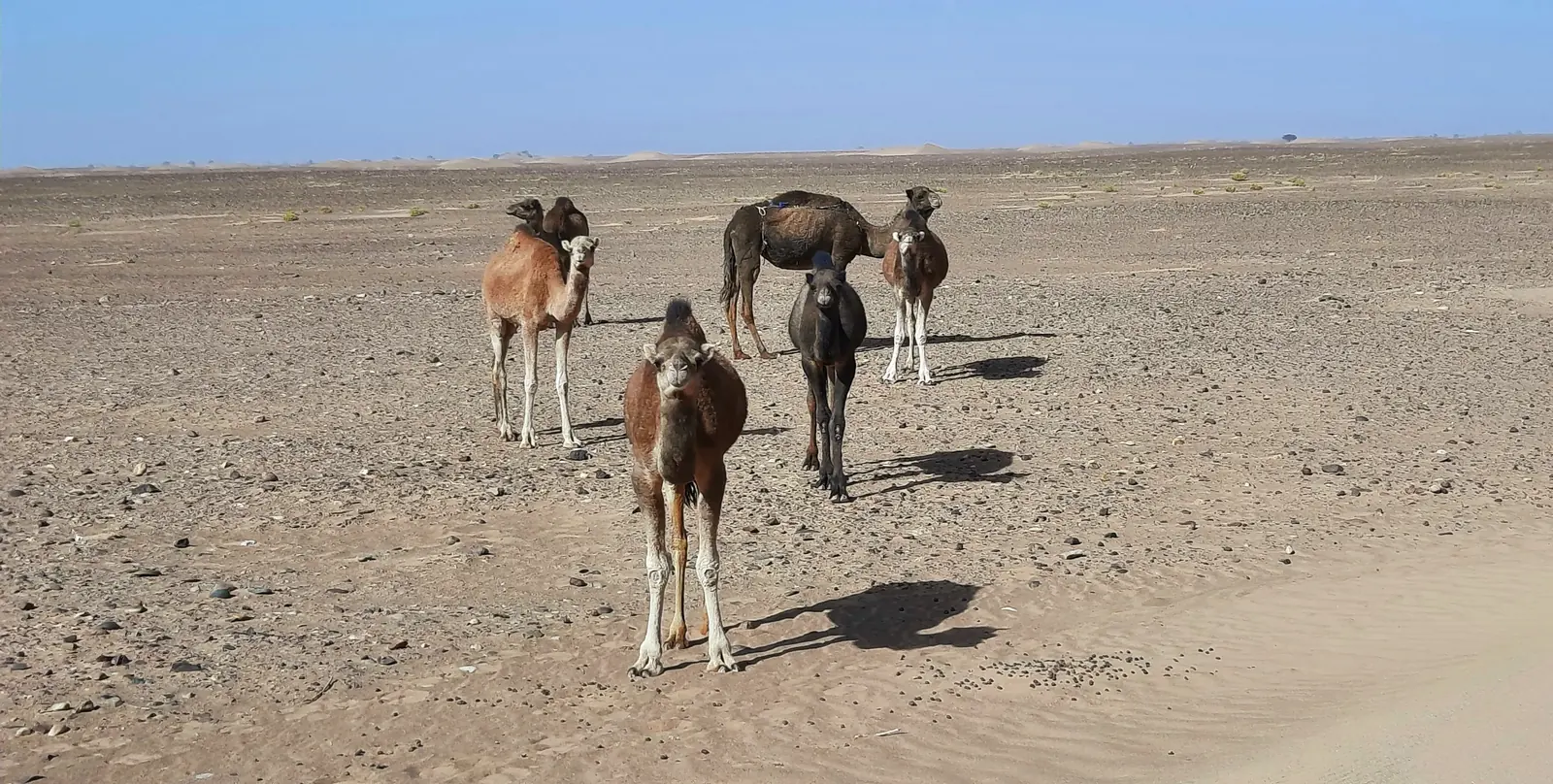
The camels you see in Morocco are dromedaries, the one-humped species, and they are the only animals on this list that are not wild. There are no truly wild dromedaries left anywhere; all are domestic, apart from some feral herds in Australia. Morocco’s 2025 livestock census by the Ministry of Agriculture counted 106,044 camels, most of them in the southern provinces.
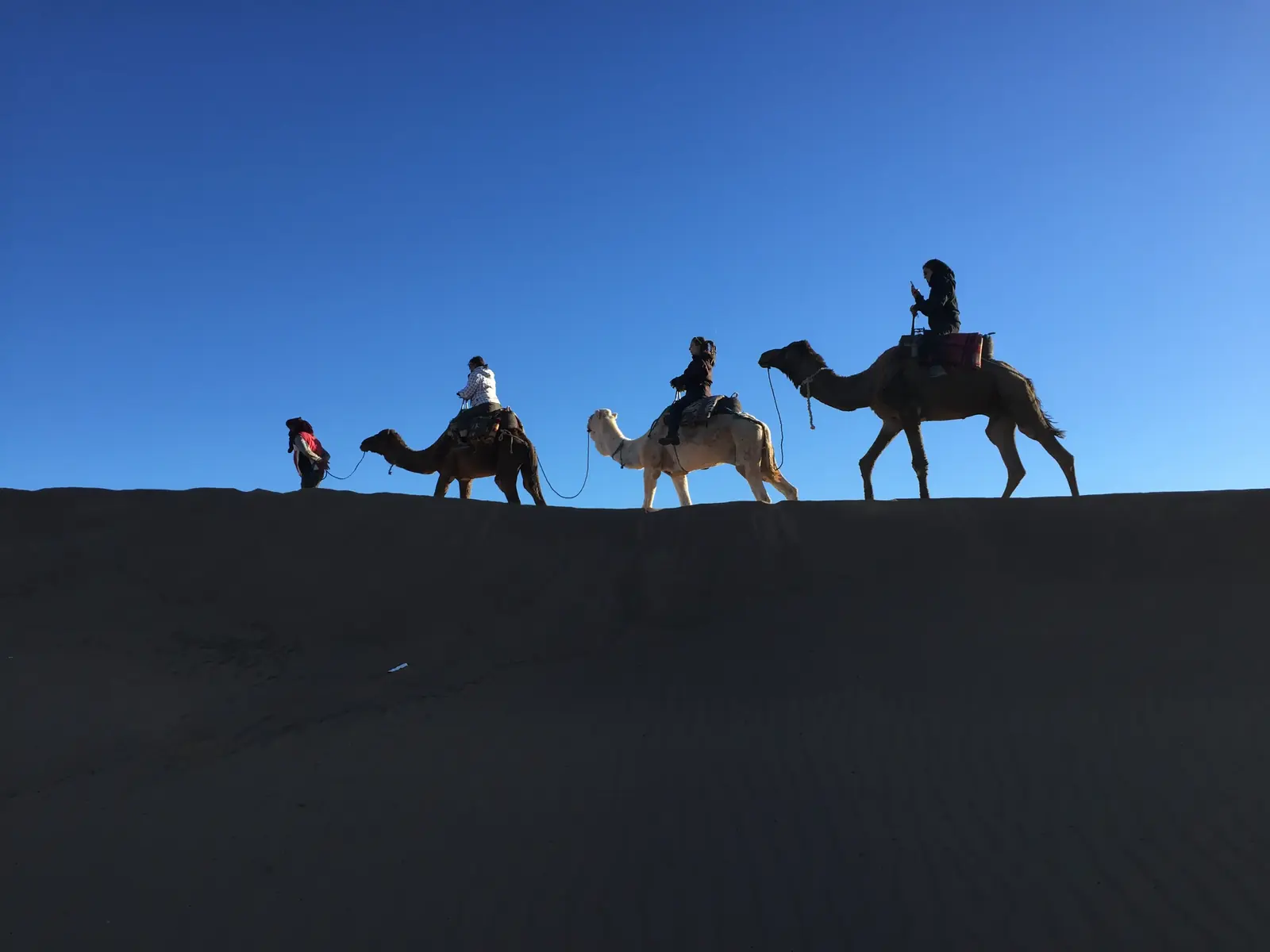
Their reputation for going without water is well earned, but the hump has nothing to do with it. It stores fat, not water, as an energy reserve for when food runs short. The real secret is physiology: a camel can lose more than 30% of its body water, while most mammals die at around 15%, and it can drink 100 litres in just ten minutes.
Source: Animal Diversity Web, University of Michigan. Scale from 0 to 40%.
There is another trick. A camel’s body temperature rises and falls through the day, between 34 and 41.7 °C (93 to 107 °F). By letting its body warm up in the hot hours, it sweats less and saves water.
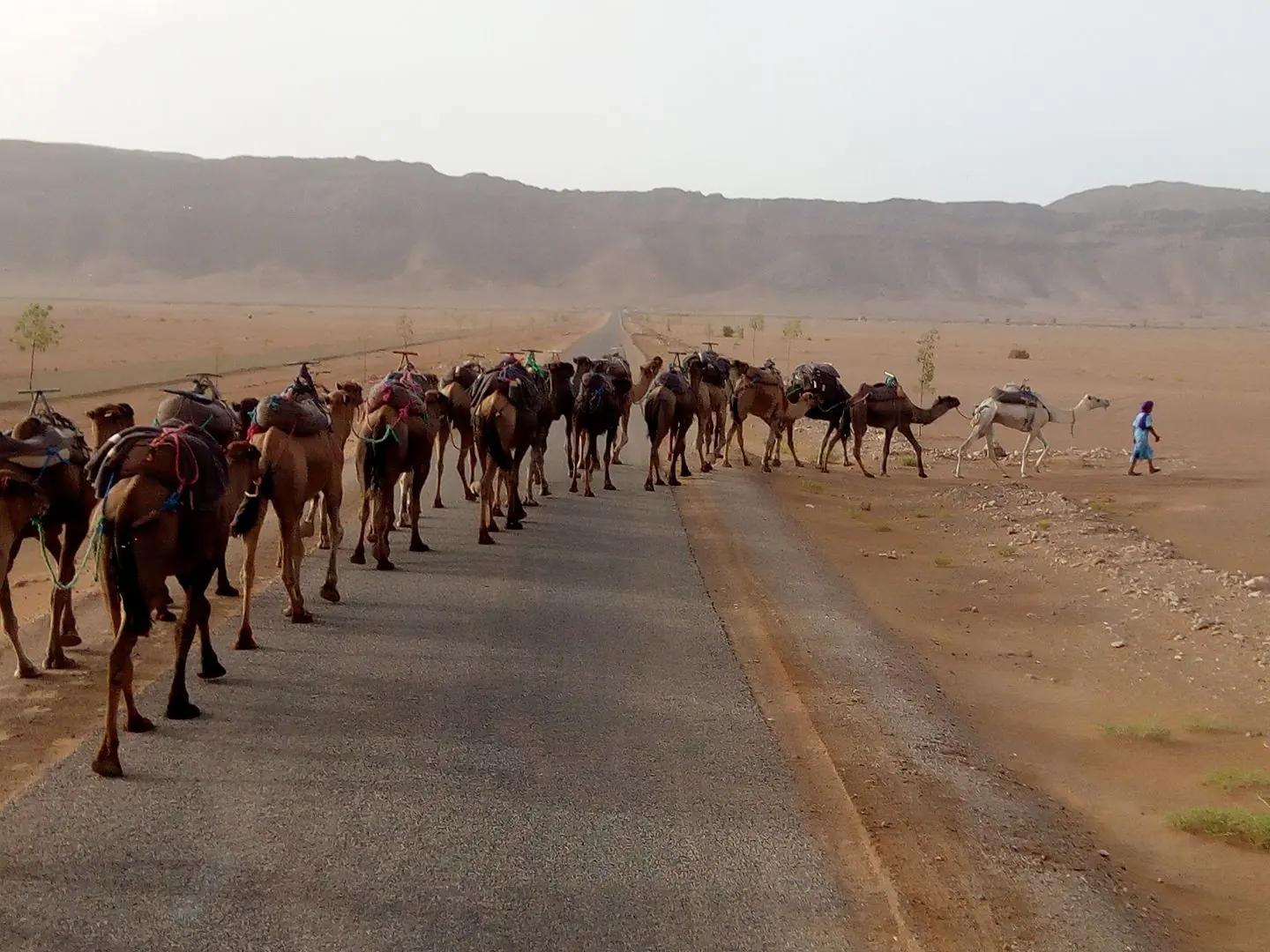
You will get to know them up close on our trips. On the 3-day Merzouga desert tour you ride to camp by camel, about an hour and a half through the dunes, and on the 2-day Zagora desert trip the ride is shorter. On the Draa Valley desert trek, the camels carry the water, food and luggage while the group walks.
Sahara birds: the desert sparrow and the white-crowned wheatear
Birds are the easiest wildlife to spot during the day, especially in the morning. Two species feature in our photos.
The desert sparrow (Passer simplex) is a small, sand-coloured bird that almost disappears when it sits still on the ground. The male stands out with a black bib and a dark line through the eye; the female is paler and plainer.
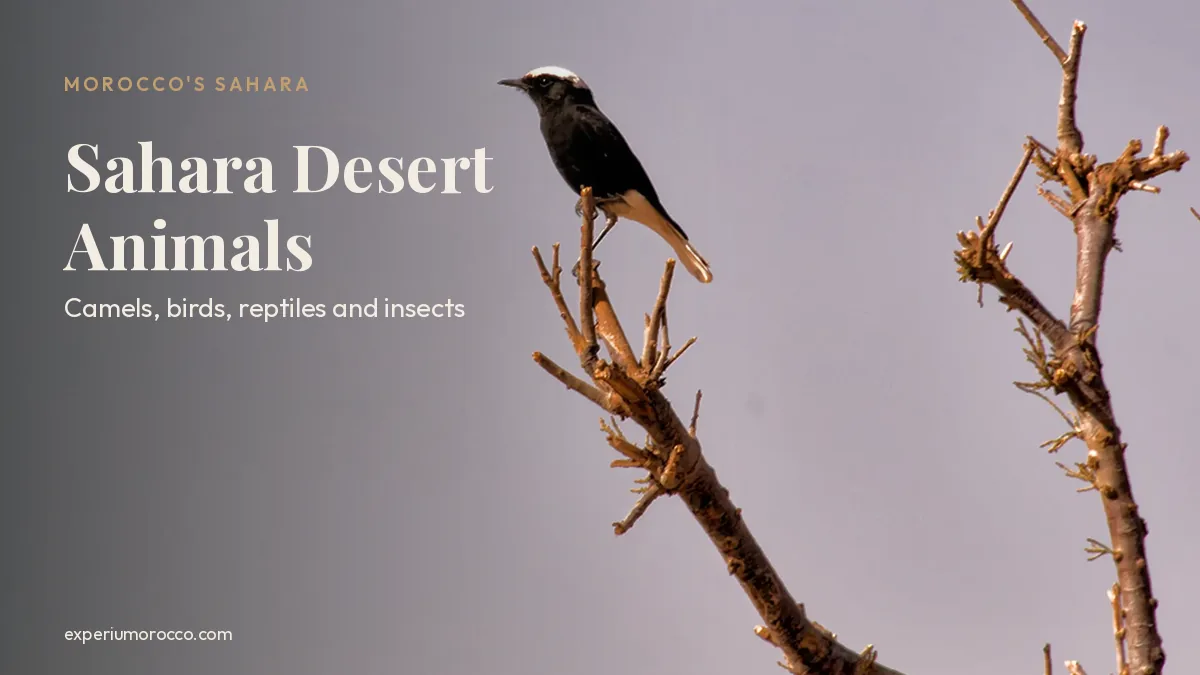
The white-crowned wheatear (Oenanthe leucopyga) is its opposite: glossy black and easy to see on a branch or a rock. According to the Cornell Lab of Ornithology, only adults have the white cap that gives the bird its name, and it lives on rocky slopes and in dry desert wadis. Both species are listed as Least Concern.
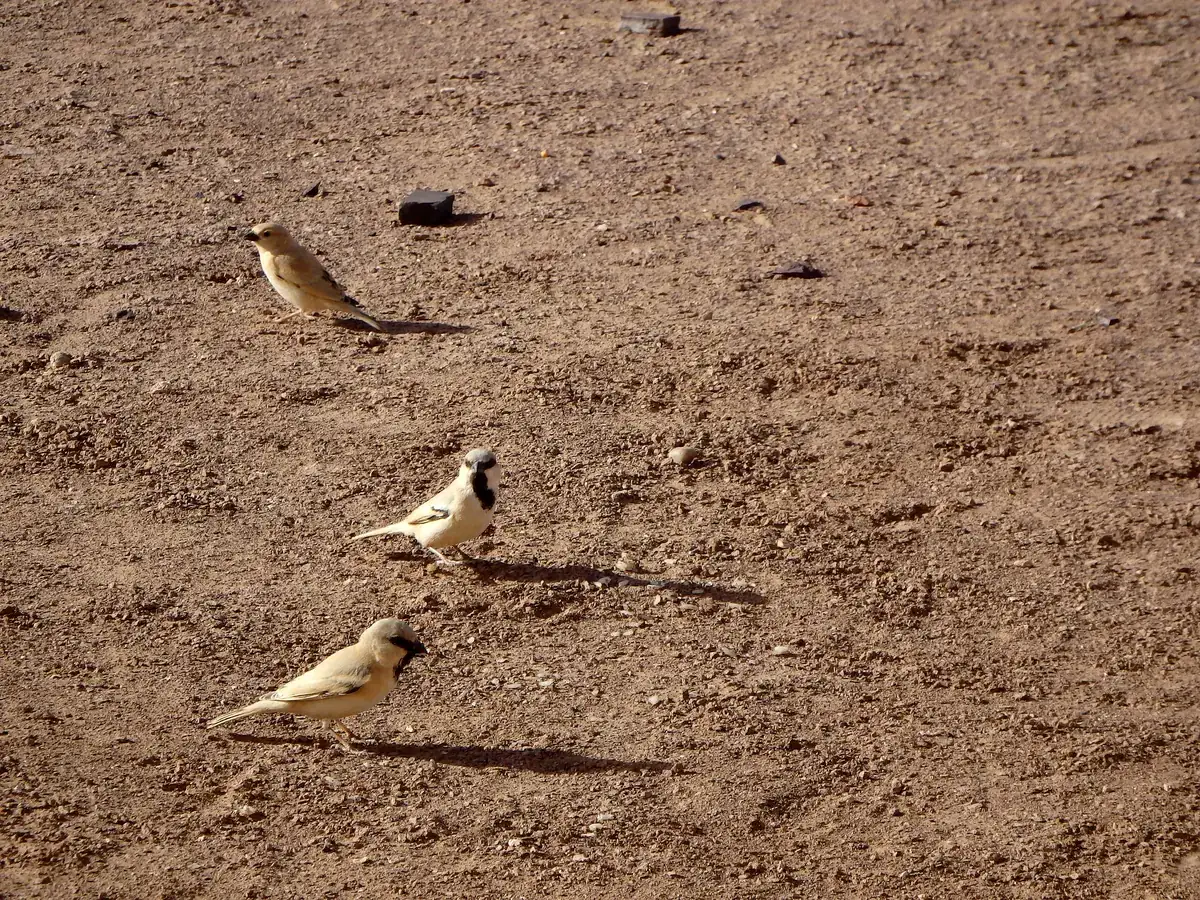
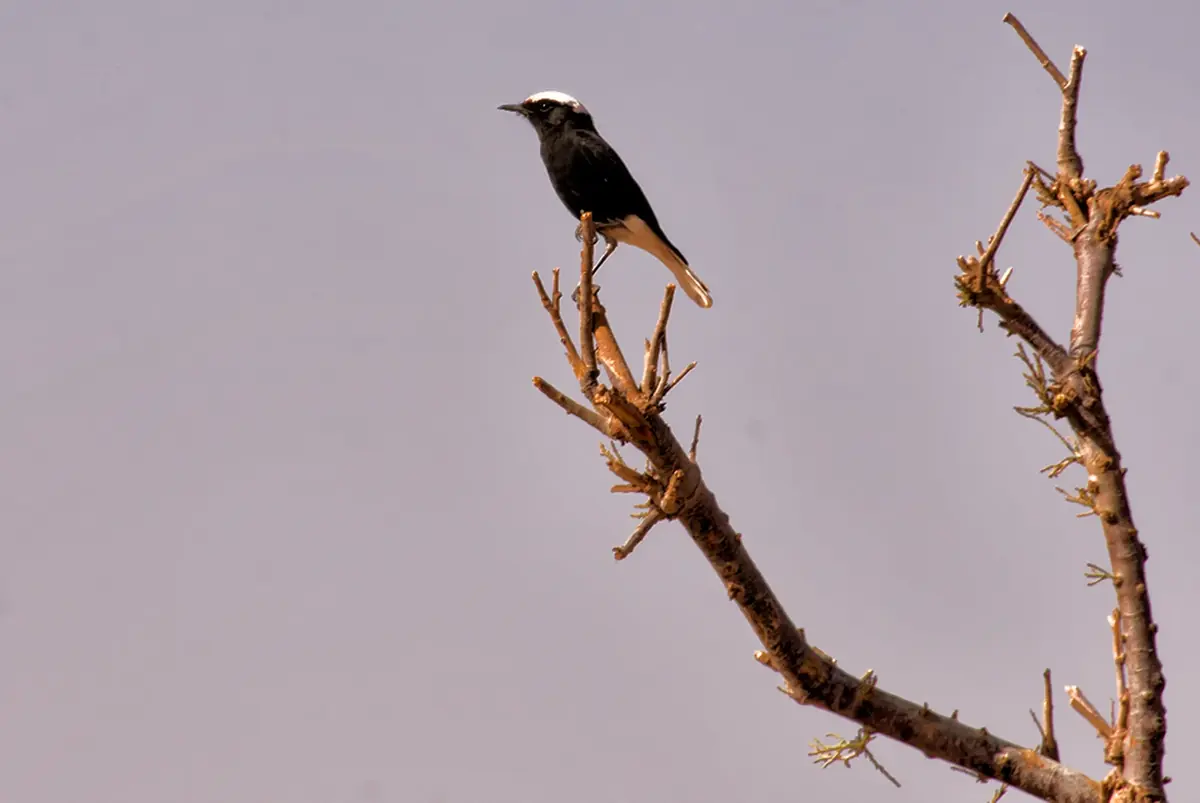
Other desert birds, such as sandgrouse and the cream-coloured courser, are on Morocco’s list of protected species.
Desert reptiles: lizards and the horned viper
As soon as the sun warms the stones, the lizards come out. They are the reptiles you are most likely to see by day: basking without moving, darting into the shade of a rock when someone comes close, then reappearing a minute later. Some are surprisingly colourful, like the blue-headed lizard in our photo, taken on the gravel with camels’ legs in the background.
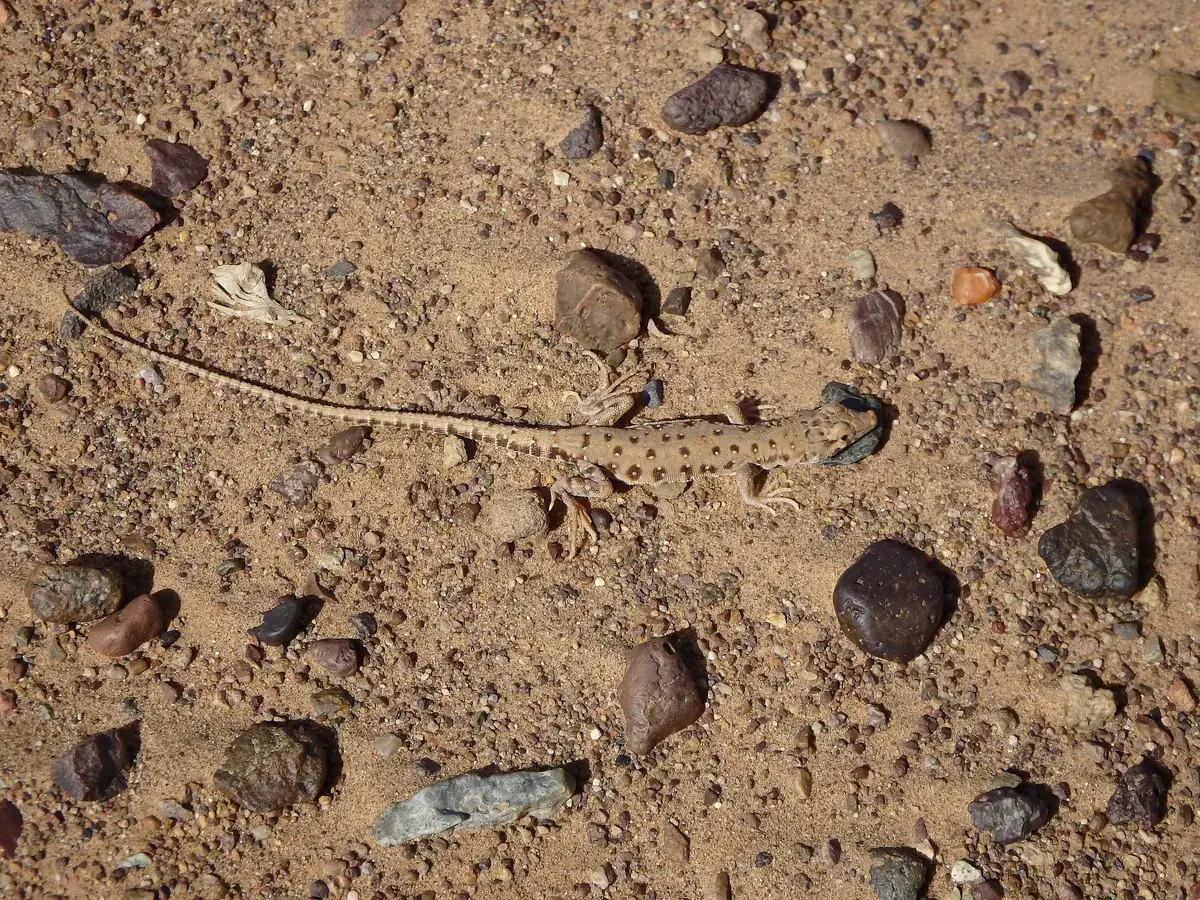
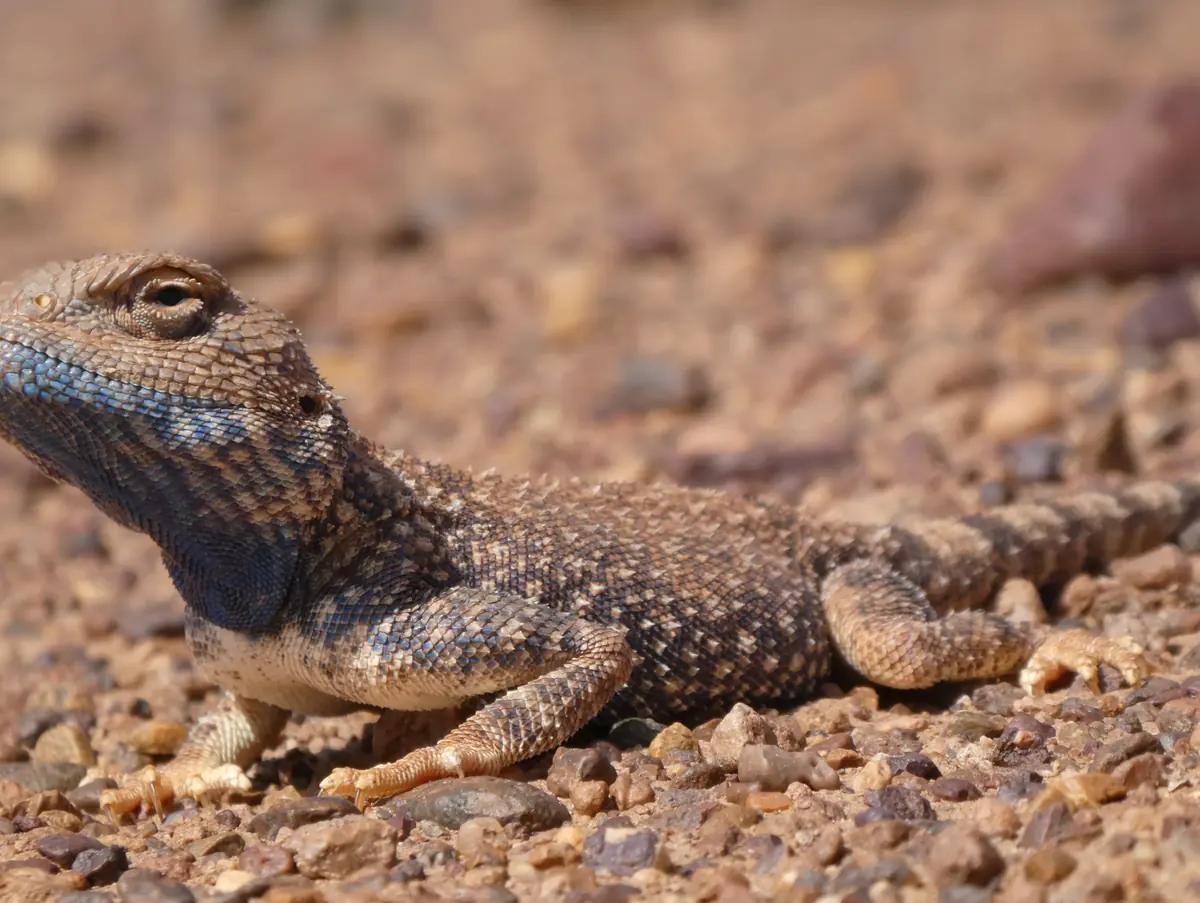
Another typical Sahara reptile is the spiny-tailed lizard (Uromastyx). It eats mostly plants, shelters in burrows or rock crevices and spends much of the day basking. Every species in the genus has been on CITES Appendix II since 1977, which restricts their trade.
The best-known desert snake is the horned viper (Cerastes cerastes). Its “horns” are a single raised scale above each eye, and not every individual has them. It hunts mainly at night, buries itself in soft sand until only its eyes and nostrils show, and moves by sidewinding, leaving a distinctive row of parallel J-shaped tracks. It is venomous, although the University of Michigan notes that its venom is weaker than that of most other snakes in the region. It is a protected species in Morocco.
Desert insects: darkling beetles
The finest tracks you will find in the sand in the morning usually belong to beetles. Darkling beetles are black, long-legged and dome-backed, and they are among the insects best adapted to desert life. Their hard wing cases are fused together and trap a pocket of air underneath which, according to a study in Florida Entomologist, reduces water loss.
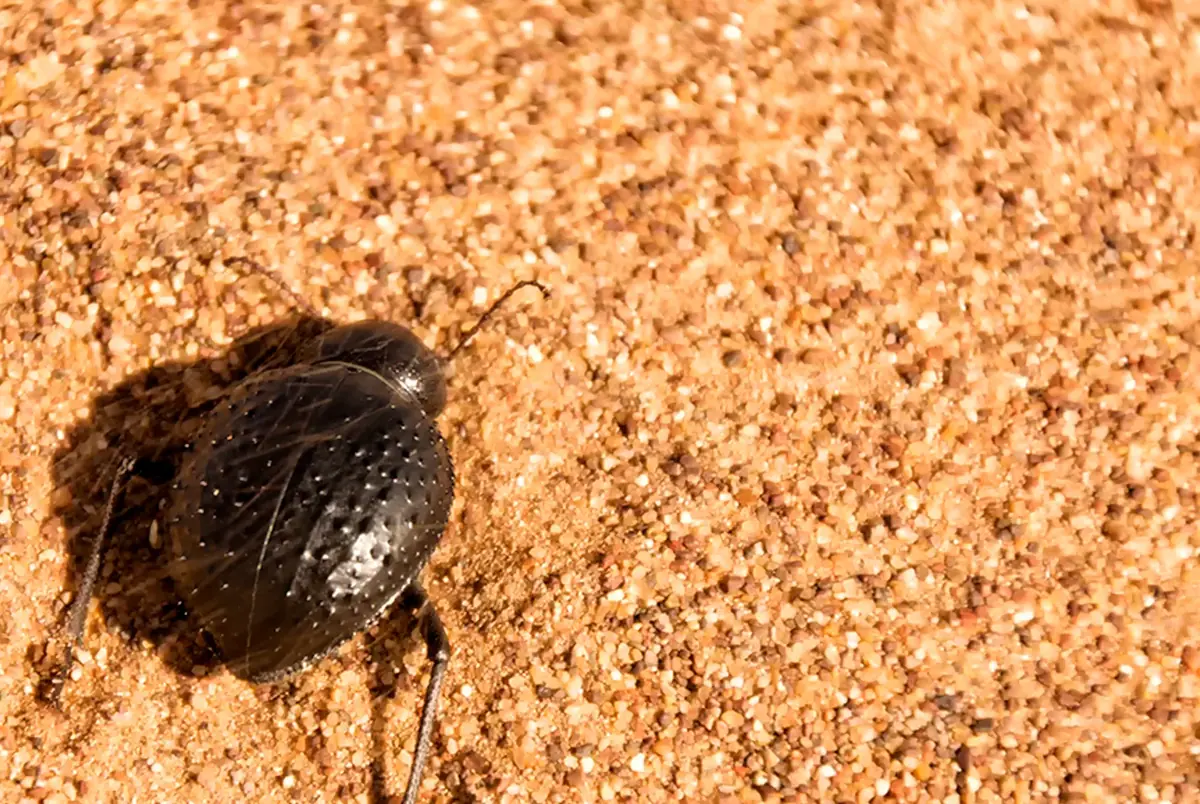
Most species in this family are active at night or around dusk, when the sand cools, though a few move about in full sun. They are completely harmless, so if you meet one, just let it go on its way.
Nocturnal mammals: fennec fox, jerboa, sand cat and gazelle
These are the animals everyone hopes to see and the hardest to find, because they spend the day hidden. You are far more likely to come across their tracks than the animals themselves.
The fennec fox is the little fox with the enormous ears. It hunts at night and sleeps in a burrow by day. According to the IUCN Canid Specialist Group, in southern Morocco it is common in sandy areas away from permanent settlements.
The jerboa is a small rodent that travels in long hops on its oversized hind legs. It only comes out at night, lives in a burrow with several exits and never needs to drink.
The sand cat is a small nocturnal wild cat that gets its moisture from its prey. The IUCN Cat Specialist Group records it in sandy areas of Morocco with acacias and clumps of grass.
The dorcas gazelle can live its whole life without drinking, taking its water from plants. It is the most threatened animal on this list: the IUCN rates it Vulnerable, and it is on Appendix I of the Convention on Migratory Species, the highest level of protection.
Are there dangerous animals in the Sahara Desert?
There are scorpions and venomous snakes, as in most of Morocco, but they do not go looking for people. Figures from Morocco’s Poison Control and Pharmacovigilance Centre (CAPM), released by the Ministry of Health in 2026, help put the risk in context:
Source: Moroccan Ministry of Health and Social Protection, CAPM figures for 2025, national envenomation campaign of June 2026.
Most stings happen at night, in rural areas and inside homes, and they peak in summer. A study by the Faculty of Sciences Semlalia at Cadi Ayyad University in Marrakech shows the seasonal pattern clearly:
- 19.1
- 58.9
- 17.1
- 4.9
Our desert trips run from October to April, outside the busiest scorpion months.
Source: Touloun et al., 2001, Cadi Ayyad University. Data from 1994 to 1998 in the Haouz and Souss plains.
The same study names the black fat-tailed scorpion (Androctonus mauretanicus) as Morocco’s most dangerous: it caused almost half of all stings and 60% of deaths in those plains. The yellow scorpion (Buthus occitanus) is common but less dangerous.
Stay calm and go straight to the nearest health centre, without trying traditional remedies. Morocco’s Poison Control Centre runs a free 24-hour line on 080 100 01 80, according to the official government portal. Tell your guide straight away too.
How to watch desert wildlife without disturbing it
Seeing wildlife in the desert comes down to timing, patience and keeping quiet. These habits help you see more and disturb less.
- Get up early. The first hours of the morning are the best for birds and for reading the tracks left by night animals.
- Bring binoculars. Desert birds are small and quick; binoculars let you watch them without moving closer.
- Don’t feed the animals. Not the birds around camp, not the camels: bread and leftovers are not part of their diet.
- Don’t handle reptiles or insects, and don’t lift stones with your bare hands, as a scorpion may be underneath.
- Shake out your shoes before putting them on in the morning, and don’t walk barefoot after dark.
- Don’t buy wild animals or pose for photos with them: many species are protected under Law 29-05.
Still choosing where to go? Our guide to desert trips from Marrakech compares the options, and if you are staying overnight, read what a night in a Sahara desert camp is like to pack for the cold.
Sahara Desert animals: FAQ
What animals live in the Sahara Desert?
In Morocco’s Sahara you will find domestic camels and wild animals such as the fennec fox, the jerboa, the sand cat and the dorcas gazelle; birds like the desert sparrow and the white-crowned wheatear; reptiles including the horned viper and the spiny-tailed lizard; darkling beetles; and scorpions.
How do animals survive in the Sahara Desert without water?
Many get the water they need from their food, like the fennec fox, the jerboa and the dorcas gazelle. Most also avoid the heat by being active at night and spending the day in burrows. Camels can lose more than 30% of their body water and drink 100 litres in ten minutes.
Will I see a fennec fox in the desert?
Probably not. Fennec foxes hunt at night and sleep in burrows during the day, so you are much more likely to find their tracks in the morning sand than to see one.
What does a camel store in its hump?
Fat, not water. The hump is an energy reserve for times when food is scarce.
Are there dangerous animals in the Sahara Desert in Morocco?
There are scorpions and a few venomous snakes, such as the horned viper. They avoid people, are mostly active at night and in summer, and simple precautions like shaking out your shoes and not lifting stones keep the risk low.
What should I do if a scorpion stings me in Morocco?
Stay calm, tell your guide and go to the nearest health centre without trying traditional remedies. Morocco’s Poison Control Centre has a free 24-hour line on 080 100 01 80.