

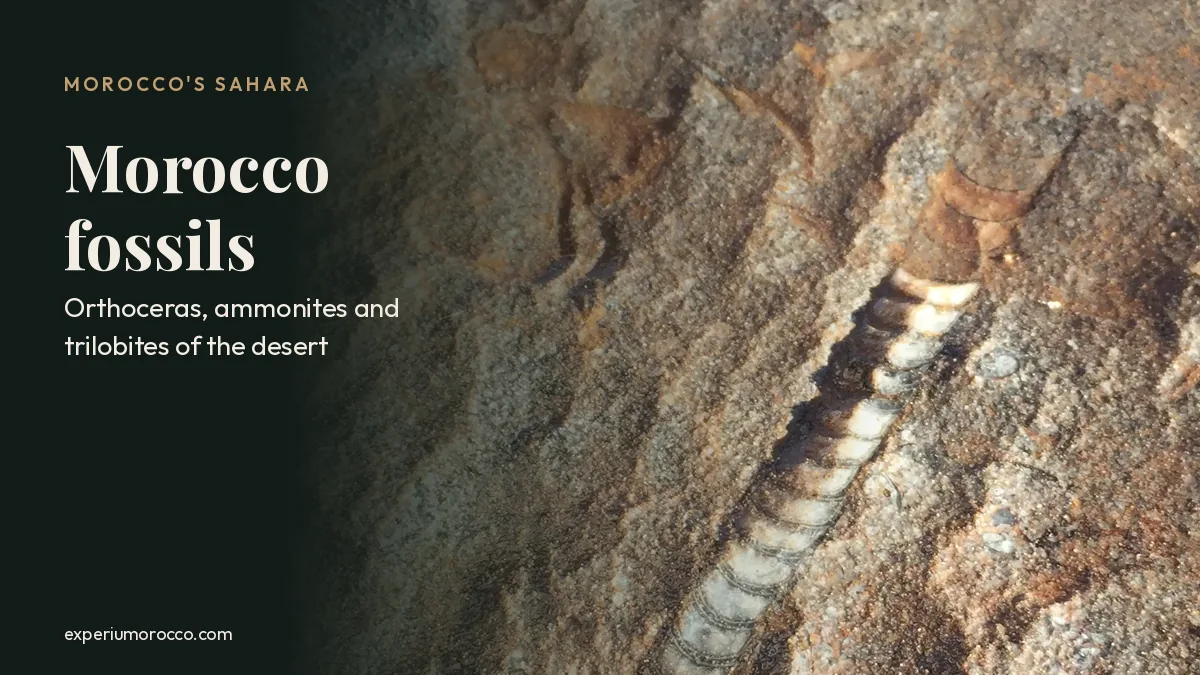
In Morocco’s desert, the sea is right under your feet. Among the dark stones of the hamada you’ll spot straight shells shaped like pencils, coiled spirals and the armour of trilobites that lived in an ocean hundreds of millions of years ago. This guide explains which fossils Morocco is known for, why they turn up in the middle of the Sahara, how to tell the common ones apart and what to know before you buy one.
Southeastern Morocco lay at the bottom of a sea for much of the Palaeozoic. That is why the Erfoud area and the Anti-Atlas are full of orthocerids (the straight shells sold as “Orthoceras”), coiled ammonoids and trilobites, most of them Silurian or Devonian, roughly 440 to 360 million years old. Plenty of the polished fossils on sale are genuine, but faked and heavily restored trilobites are common too. Morocco regulates the export of fossil specimens through its Geology Directorate.
PhotosThe photos of fossils in the rock credited in their captions were taken by Mustapha AIT ISHA, licensed tour guide, on his routes through southern Morocco.
Why are there sea fossils in the Moroccan desert?
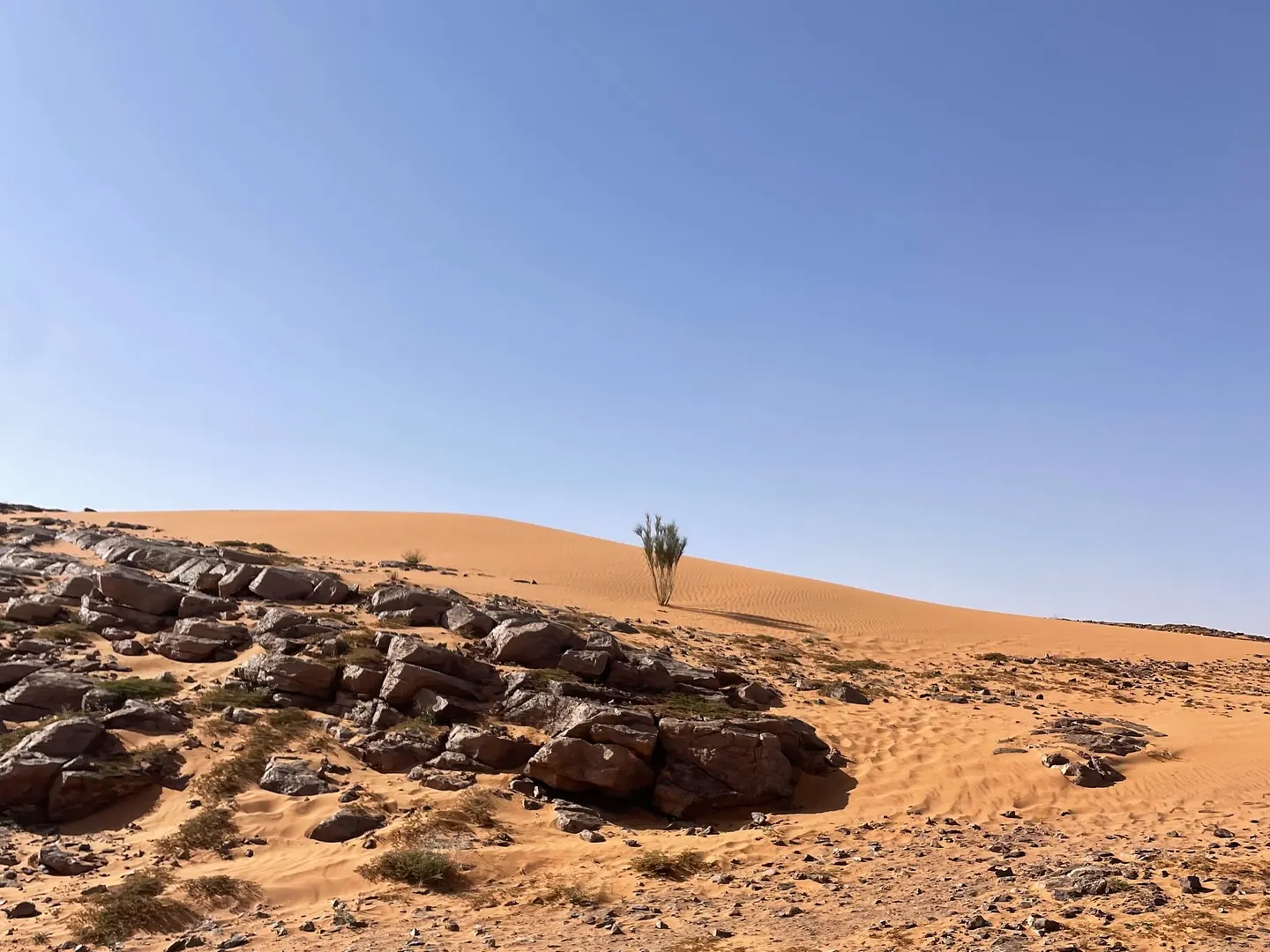
It’s hard to picture now, but the rocks of southeastern Morocco formed underwater. During the Palaeozoic, long before the dinosaurs, this corner of North Africa was covered by a shallow sea. Limy mud settled on its floor, and with it the shells and skeletons of the animals living there. Over time the mud hardened into rock, the sea withdrew, and erosion exposed the layers that hold those remains.
One of the most striking examples sits about 16 km southeast of Erfoud: the Kess Kess mounds of the Hamar Laghdad ridge. According to the Flanders Marine Institute (VLIZ), which studies them, they are hill-shaped build-ups of lime mud that grew on the seafloor in the Early Devonian, between 416 and 398 million years ago. Their name comes from their conical shape, which recalls the pot used to steam couscous.
That is also why you won’t find fossils in the dune sand, which is young and always on the move. They come from rock outcrops and from the hamada, the stony desert. If you’d like to know how erg, reg and hamada differ, our guide to the Sahara desert landscapes of Morocco explains it.
Moroccan fossils on the geological time scale
Morocco has fossils from almost every era, but most of what travellers see comes from a handful of periods. This column puts them in order. Its height is proportional to how long each period lasted, using the dates and standard colours of the International Commission on Stratigraphy.
- Today
- Jurassic201.4 to 143.1 million years ago
Dinosaur tracks at Iouaridène, in the M’Goun Geopark (central High Atlas). - Devonian419.6 to 358.9 million years ago
Trilobites near Alnif, the Kess Kess mounds by Erfoud and the ammonoid limestones of the Tafilalt. - Silurian443.1 to 419.6 million years ago
Orthocerids from the Orthoceras limestone around Erfoud, which runs into the Devonian. - Ordovician486.9 to 443.1 million years ago
The Fezouata site near Zagora, with soft-bodied animals.
Axis: millions of years ago. Heights are proportional to how long each period lasted. Dates and colours: International Commission on Stratigraphy, chart 2024/12. Grey marks periods this guide does not cover (Carboniferous to Triassic, and Cretaceous to today).
Two things help with the scale. First, the trilobites and orthocerids of the southeast are more than 100 million years older than the first dinosaurs. Second, the big grey stretches don’t mean Morocco has no fossils from those times; they simply aren’t the focus of this guide.
What is an Orthoceras fossil?
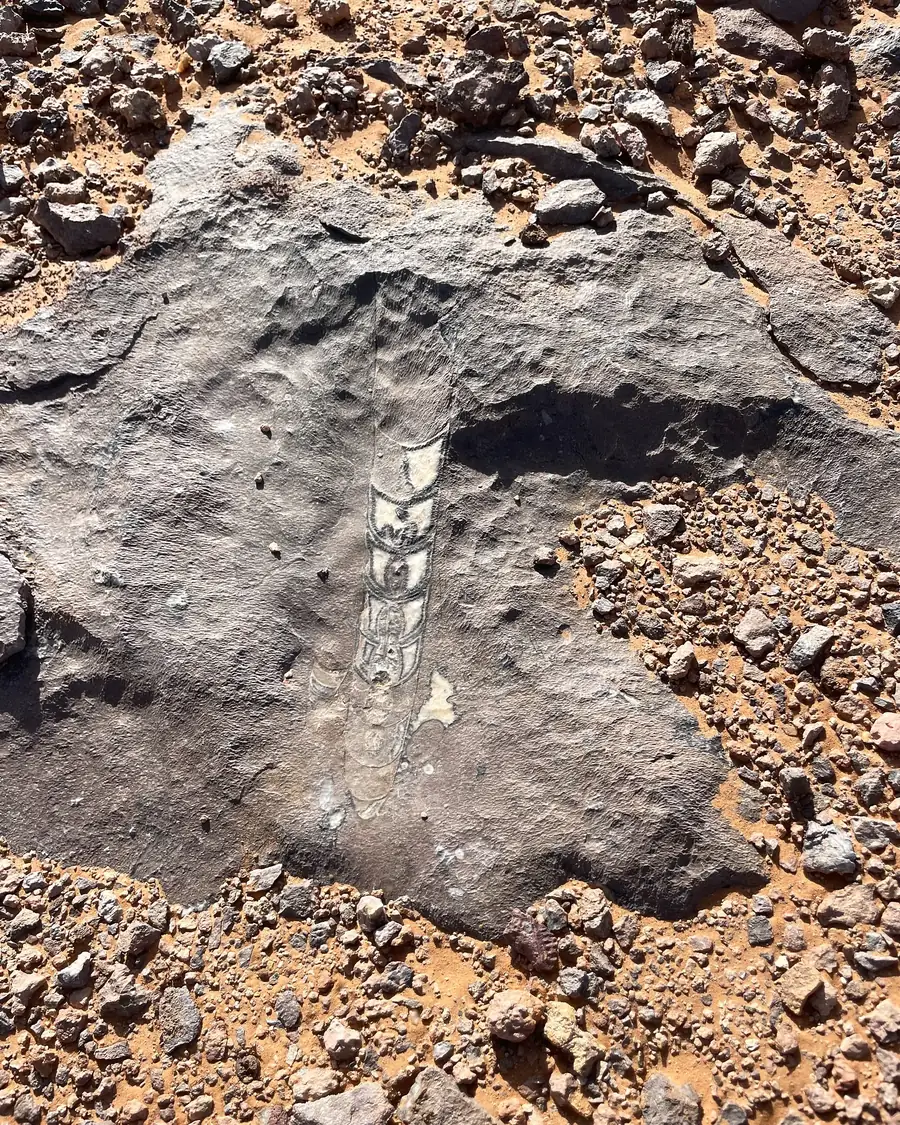
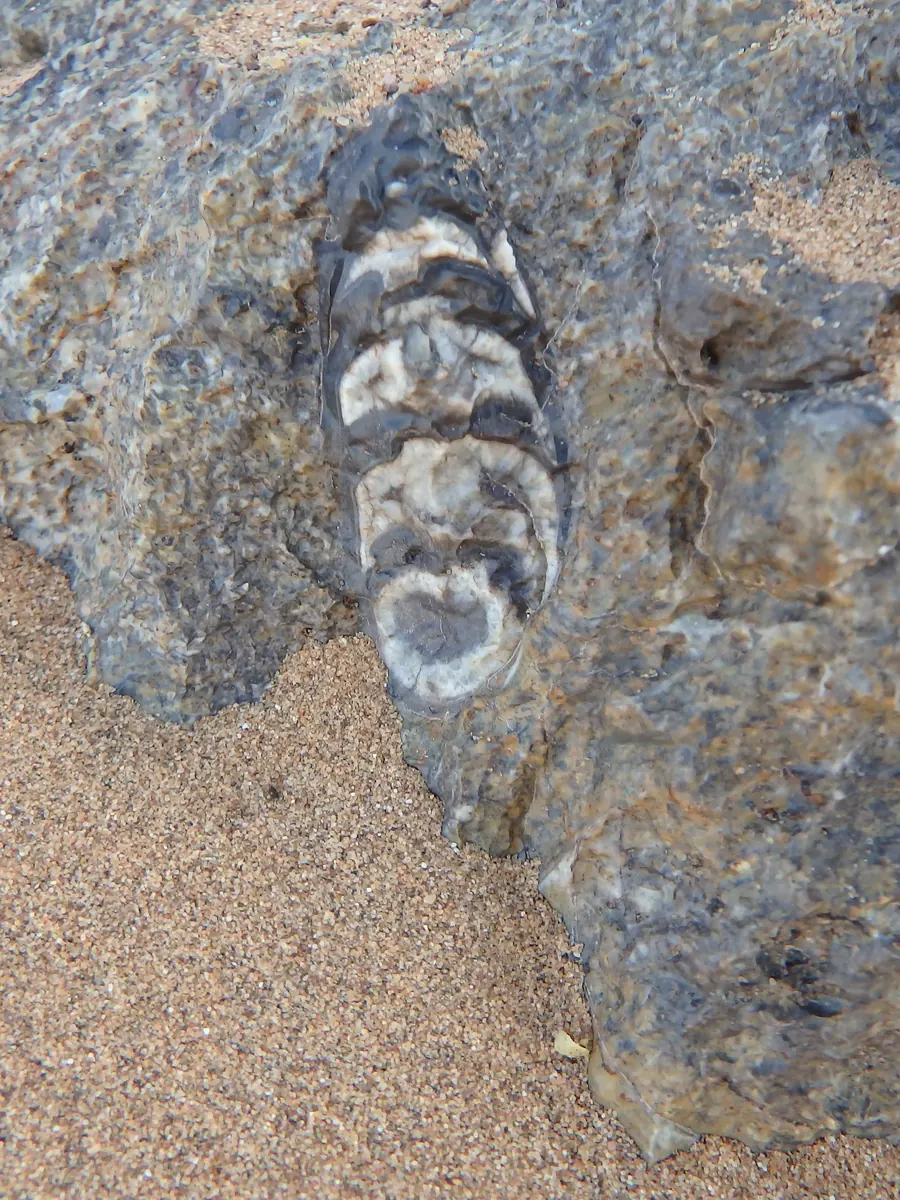
Morocco’s most common fossil is a straight, cone-shaped shell divided inside into chambers. In shops it is almost always labelled “Orthoceras”, but that name works more like a trade label. As the geology department of the College of Wooster points out, it is used for any straight-shelled nautiloid that can’t be pinned down to a genus, because a polished section doesn’t show the details needed to identify it.
These were cephalopods, distant relatives of squid and of today’s nautilus, and they hunted by swimming through Palaeozoic seas. The animal lived in the largest chamber at the open end, while the rest of the shell was divided by walls, called septa, pierced by a central tube, the siphuncle. In places they carpeted the Moroccan seafloor. According to the same source, most of the specimens on sale probably come from the Siluro-Devonian “Orthoceras limestone” exposed near Erfoud.
- Shape: a straight cone, sometimes a hand span or more, tapering towards one end.
- Chambers: repeated bands along the shell, like the rungs of a ladder.
- Colour: white or pale grey infill against dark rock. That infill is calcite that seeped into the empty shell after burial; the original aragonite shell has almost never survived.
Ammonites and goniatites: the desert’s spirals
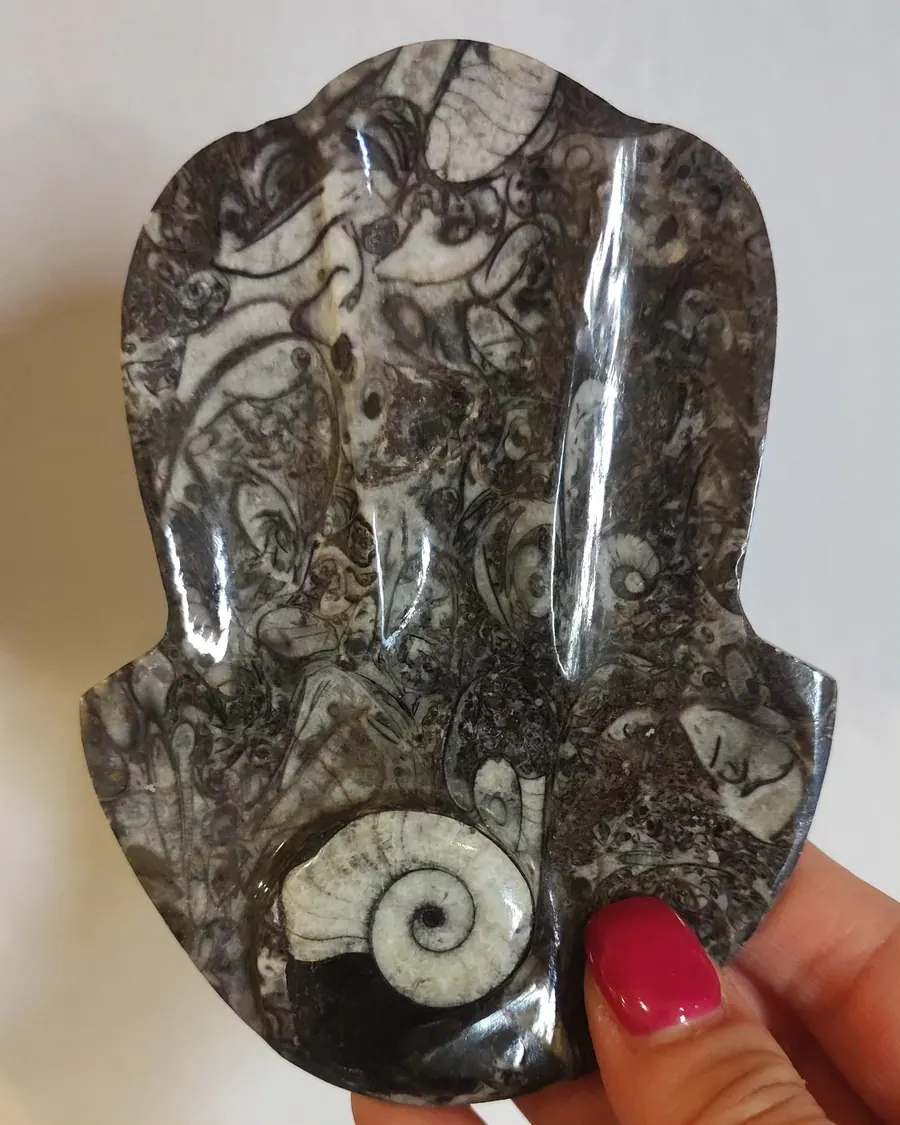
The spirals you see in plates, basins and stone tables are ammonoids, another group of cephalopods with chambered shells. The difference from orthocerids is obvious at a glance: their shells are coiled. Those from the Devonian of southeastern Morocco, such as goniatites, are far older than the Jurassic and Cretaceous ammonites many people know from Europe, even though shops sell nearly all of them as “ammonites”.
There’s a reason they are so common. The Tafilalt platform holds a run of Late Devonian limestones packed with cephalopods, known to geologists as cephalopod limestone. According to a study in the university-run journal Palaeontologia Electronica, it built up slowly in a shallow open sea.
Trilobites from Morocco
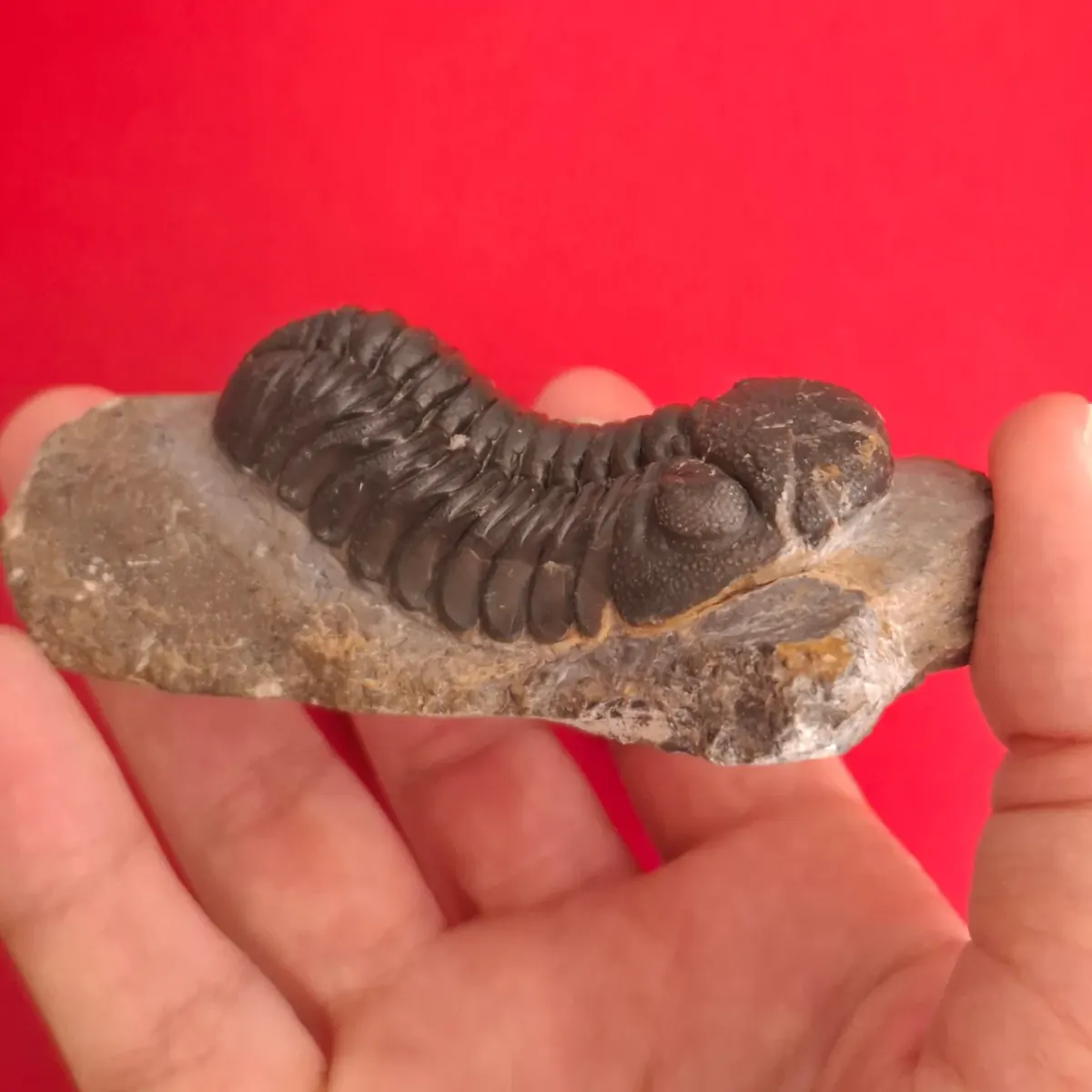
Trilobites are Morocco’s most sought-after fossils. They were marine arthropods with a shell split lengthways into three lobes, hence the name, and many had large eyes made of dozens of calcite lenses. They died out more than 250 million years ago, but the Anti-Atlas preserves them in huge numbers and remarkable detail.
One of the best-known areas is near Alnif. A University of Alberta study in the Journal of Paleontology describes a Devonian bed at Jbel Issoumour with at least eight trilobite species, and mentions the local miners who work those layers. That small-scale digging supplies much of the market.
What turns a trilobite into a showpiece is preparation: the rock is removed by hand with very fine tools until the shell stands out in relief. It is slow, painstaking work, and it is also where deception can creep in, as you’ll see below.
Orthoceras, ammonite or trilobite: how to tell them apart
| Fossil | What it was | How to spot it |
|---|---|---|
| Orthoceras | Straight-shelled cephalopod, related to the nautilus. | Long cone with chambers in a row, white against dark rock. |
| Ammonoid | Coiled cephalopod; in Morocco’s Devonian, goniatites for example. | A spiral whose internal walls draw zigzag or curved lines. |
| Trilobite | Marine arthropod with a jointed shell. | Body in three lengthwise lobes, a head with eyes and segments. |
Are Moroccan fossils real or fake?
Polished orthocerids and ammonoids are extremely plentiful, and the problem of fakes is concentrated mainly in trilobites. The American Museum of Natural History warns that since the late 1980s, composite trilobites have been made in North Africa from materials ranging from local mud to car body filler, often cast from moulds of real specimens. Genuine pieces from different species are also combined into one, and the results have fooled trained experts.
Between a fake and an honest piece lies a middle ground: restoration. Many genuine trilobites have a reconstructed or glued section, which is fine as long as the seller tells you. These tips, drawn from the same museum, help you avoid surprises:
- Be wary of trays of clones. Several trilobites identical in size, pose and colour usually come out of the same mould.
- Use a hand lens. Air bubbles are hard to hide in filler.
- Try ultraviolet light. Resins and fillers often show up under UV, and small UV torches are cheap.
- Check that it all fits. A head and tail that don’t look like the same animal are a bad sign.
- Ask straight out. A reputable seller will tell you which part is restored.
From quarry to workshop: tables, basins and desert roses
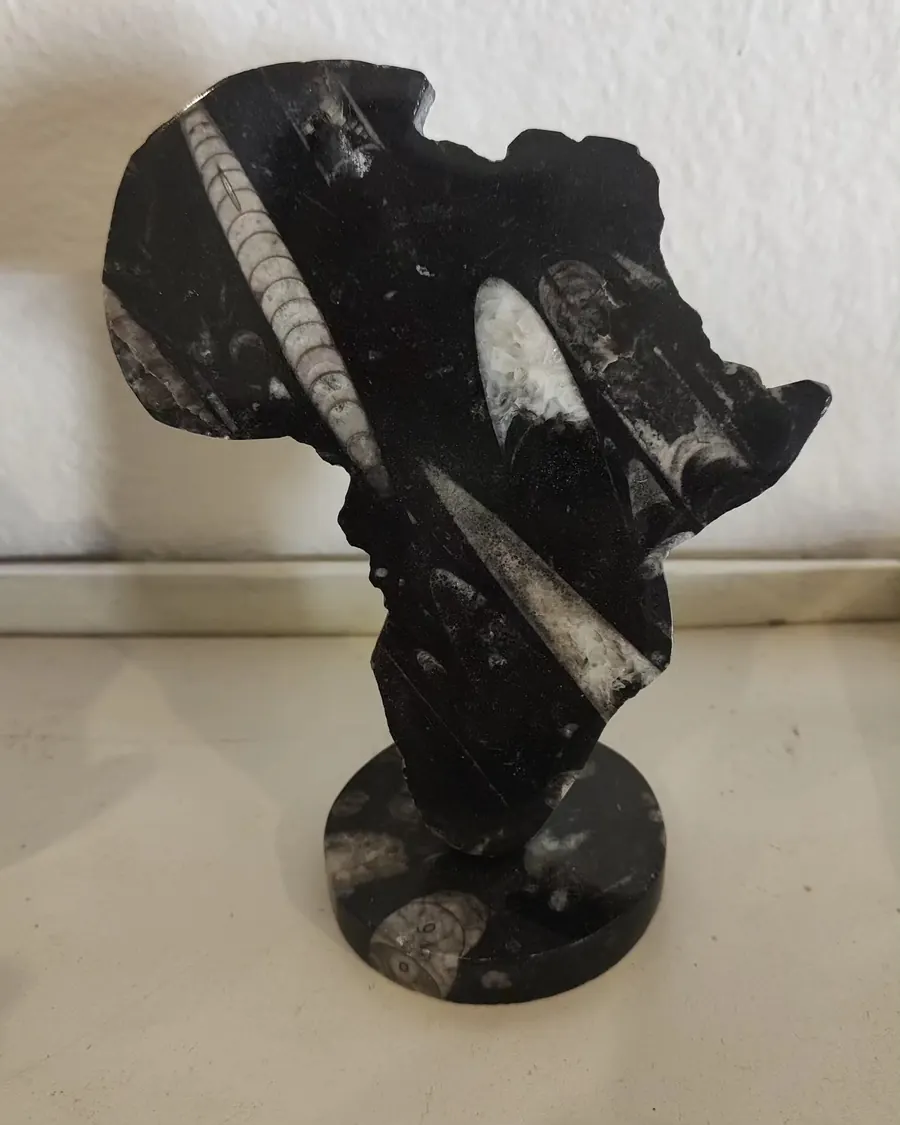
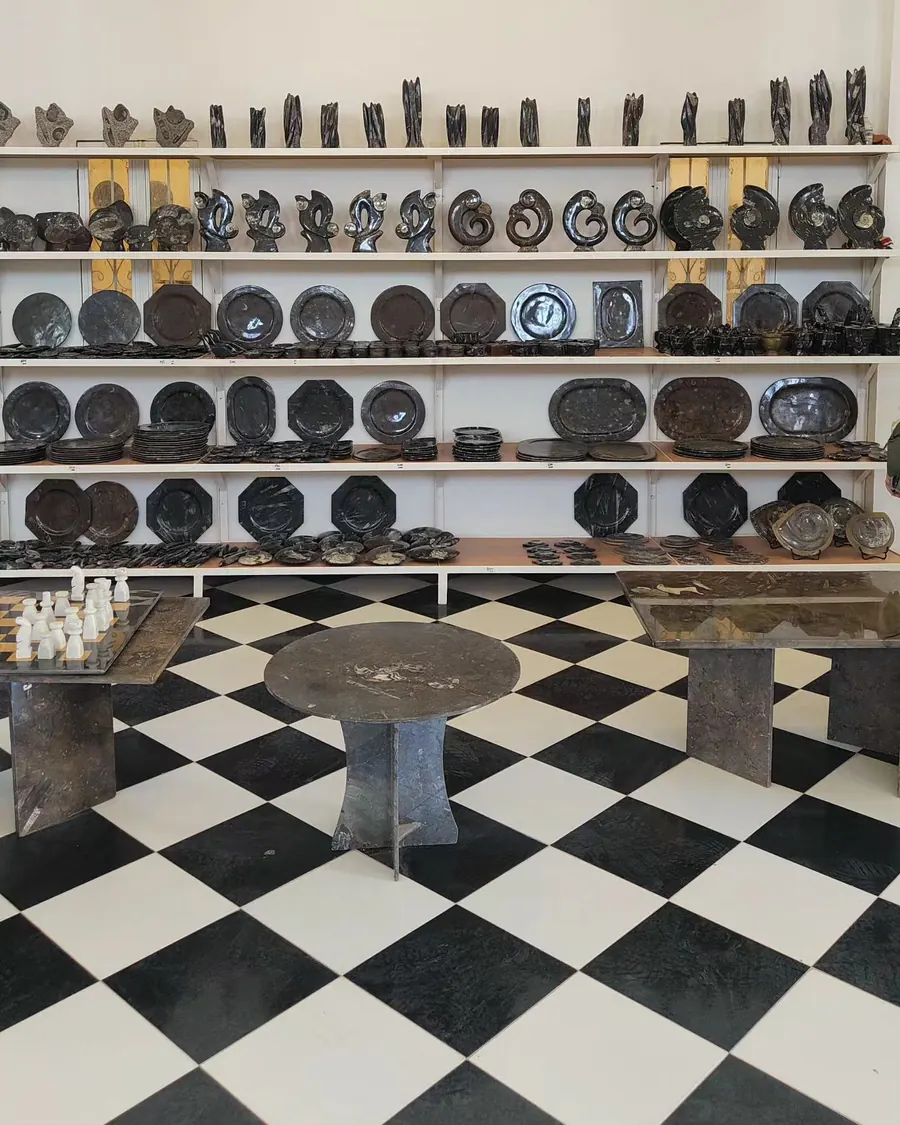
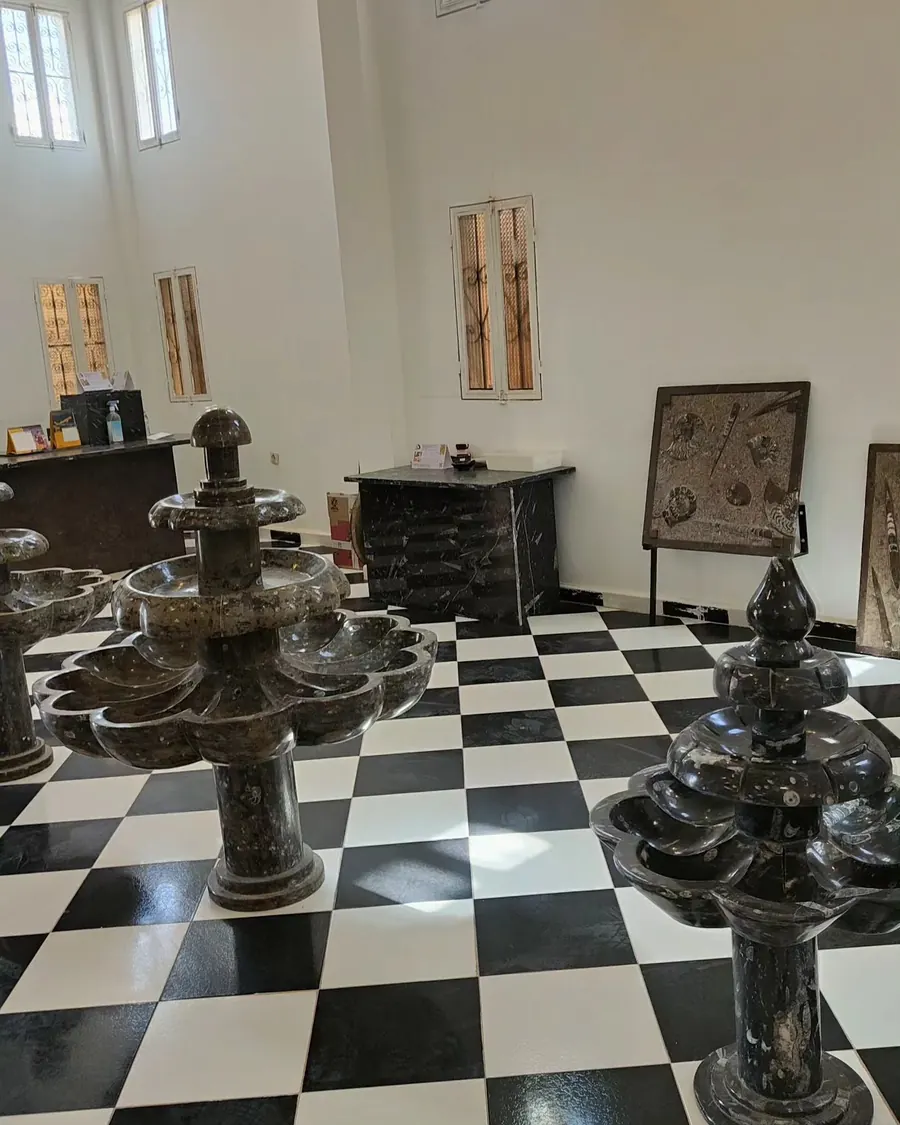
Around Erfoud, fossils are also an industry. The dark limestone packed with orthocerids and ammonoids is cut and polished to a shine and turned into tables, basins, fountains, plates and ornaments. As the College of Wooster notes, these fossils are easy to extract, take a good polish and look attractive from almost any cutting angle, which is why they turn up in rock shops all over the world. Visiting a workshop shows you the whole process, from the raw block to the finished piece.
A desert rose is not a fossil
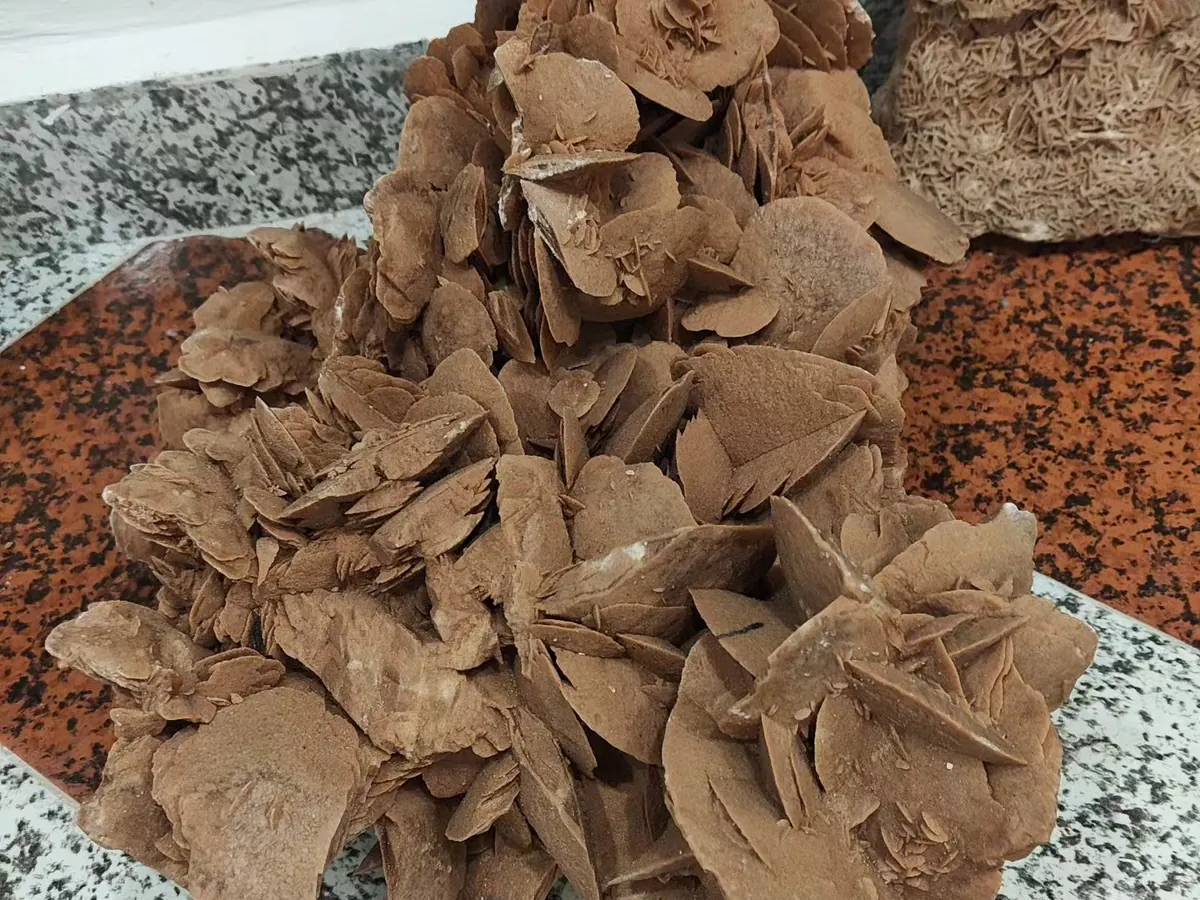
In the same shops you’ll find sand-coloured stone flowers. These are desert roses, and although they are sold alongside fossils, they aren’t fossils at all: no living thing made them. According to the Emirates Soil Museum, they are rosettes of gypsum crystals that form when water rich in calcium and sulphate evaporates in dry, sandy ground. Sand grains get trapped inside the crystals, which is why they take on the colour of the ground they grew in.
Buying fossils in Morocco and taking them home
Morocco keeps an eye on its geological heritage leaving the country. Its Department of Energy and Mines publishes the procedure for the technical opinion for the export licence of mineral and fossil specimens, handled by the Geology Directorate under law 14.91 on foreign trade. The file includes the export licence, pro forma invoices and samples of the pieces.
For travellers the practical upshot is simple: buy from shops that give you an invoice, and if you’re interested in a large or valuable piece, ask how its export is handled before you pay. If the seller can’t answer, it’s better not to take the risk. There’s a more down-to-earth point too: stone is heavy, and a table or basin won’t fit in a suitcase. Many shops offer shipping, which is worth agreeing in writing.
Prices aren’t fixed and are open to bargaining, as in any souk. Our Marrakech souks guide has tips on haggling respectfully, and our guide to Morocco’s currency explains how the dirham works and how much cash to carry.
Seeing a fossil where it lies and photographing it is a privilege. Removing it destroys it for everyone else and for science: a fossil taken from its layer loses the information that allows it to be dated. At scientific sites and at the geopark’s geosites, leave them where they are.
Where to find fossils in Morocco on the road
You don’t need a museum to see fossils in Morocco. Many routes through the southeast cross the ground where they occur, and with a guide who knows where to look, a stop on the hamada can become an open-air geology lesson. Our 3-day Merzouga desert tour, for example, passes through Erfoud before reaching the dunes of Erg Chebbi. If you’re still weighing up your options, our guide to desert trips from Marrakech compares Merzouga, Zagora and other destinations.
Further south, near Zagora, lies the Fezouata site, from the Early Ordovician. Cadi Ayyad University in Marrakech presents it as the only known site that bridges the gap between the Cambrian explosion and the great Ordovician diversification. It even preserves soft-bodied animals, which almost never fossilise. It is a research site, not a visitor attraction, and its specimens are held in scientific collections.
In the central High Atlas, the M’Goun Geopark, recognised by UNESCO in 2014 in Azilal province, protects dinosaur track sites such as Iouaridène. A study by the University of La Rioja and Mohammed V University in Rabat, published in PLoS ONE, dates those beds to the Late Jurassic. It’s the same mountain that gives its name to our M’Goun and Happy Valley trek, and a good reason to keep an eye on the ground in the Atlas Mountains too.
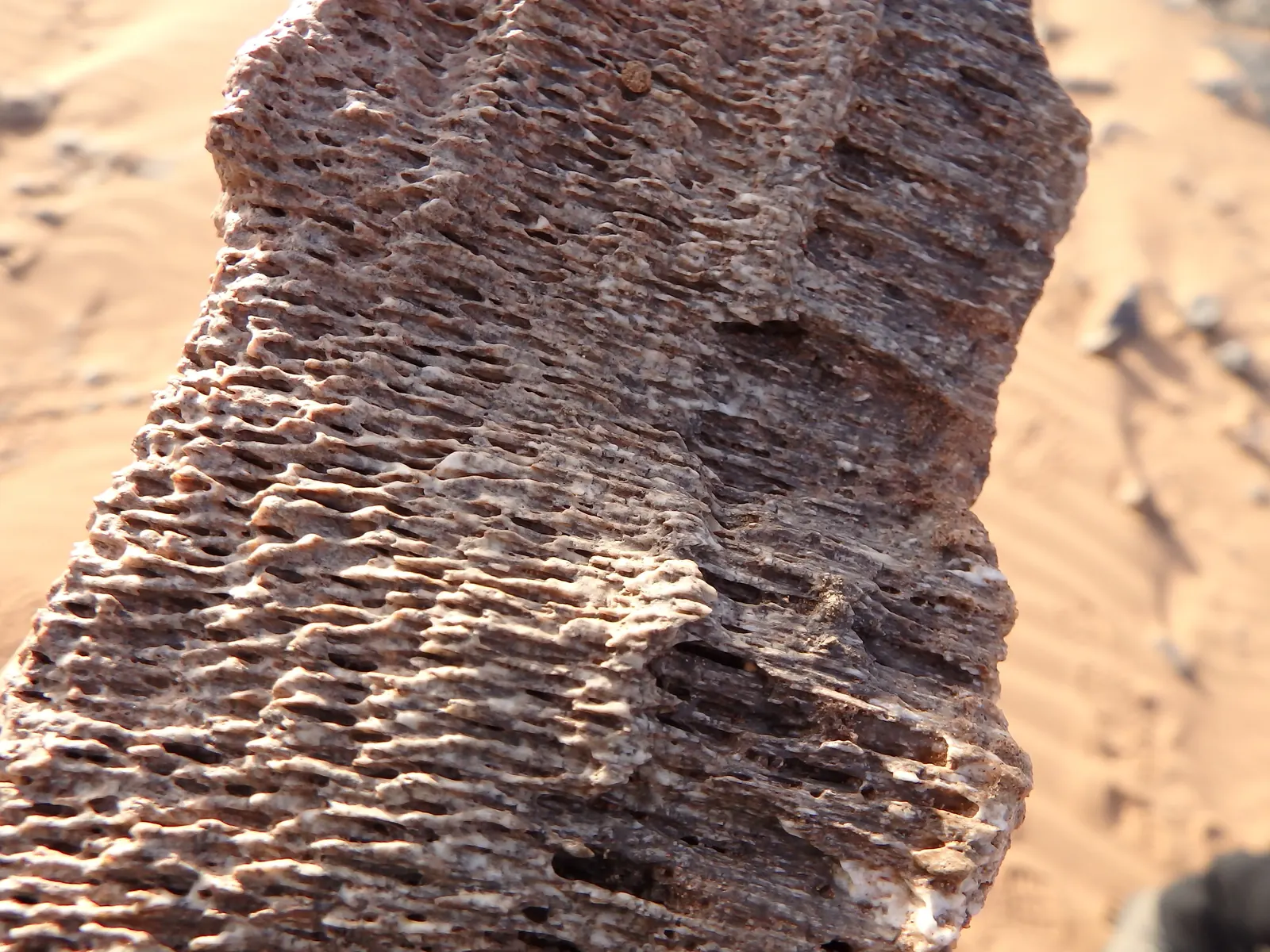
One last word of warning: not everything that looks like a fossil is one. Wind and sand sculpt the rock into textures that trick the eye, and sometimes only a specialist can tell petrified wood from weathered stone.
Morocco fossils: frequently asked questions
Why does Morocco have so many fossils?
Because during the Palaeozoic southeastern Morocco lay under a shallow sea. Shells and skeletons were buried in the mud on the seafloor, which turned into rock. Today erosion exposes those layers in the stony desert.
Where are fossils found in Morocco?
The best-known come from the southeast: the Erfoud area, with its orthocerid and ammonoid limestone, and the Anti-Atlas, especially the trilobites around Alnif. Near Zagora is the Fezouata research site, and in the central High Atlas there are dinosaur tracks in the M’Goun Geopark.
What is an Orthoceras fossil?
It’s the trade name for straight-shelled nautiloids, cephalopods related to today’s nautilus. Their long shell was divided into chambers threaded by a tube, the siphuncle. Moroccan ones date from the Silurian and Devonian.
Are Moroccan trilobites fake?
Not all of them, but many are fakes or heavily restored. The American Museum of Natural History warns of trilobites made from filler and moulds since the late 1980s. Be wary of identical pieces, check with a hand lens and UV light, and ask which part is restored.
Can you take fossils out of Morocco?
The export of fossil specimens is regulated: the Geology Directorate issues a technical opinion for the export licence. Buy with an invoice and, for large or valuable pieces, ask the shop how export is handled before you pay.
Is a desert rose a fossil?
No. It’s a cluster of gypsum crystals with trapped sand grains, formed when water rich in calcium and sulphate evaporates in dry, sandy ground.
Sources
- International Commission on Stratigraphy: International Chronostratigraphic Chart (version 2024/12).
- Morocco’s Department of Energy and Mines, Geology Directorate: technical opinion for the export licence of mineral and fossil specimens (in French).
- College of Wooster, Department of Geology: Very common orthocerid nautiloids from the Siluro-Devonian of Morocco.
- American Museum of Natural History: Fake trilobites.
- Chatterton and Gibb, University of Alberta: Latest Early to early Middle Devonian trilobites from the Erbenochile Bed, Jbel Issoumour, southeastern Morocco, Journal of Paleontology, 2010.
- Palaeontologia Electronica: Faunal content of the cephalopod limestone biofacies in the Variscan terranes.
- Flanders Marine Institute (VLIZ): the Kess Kess mounds of Hamar Laghdad.
- Cadi Ayyad University: the Fezouata site at Zagora (in French).
- Global Geoparks Network: M’Goun Geopark report (2019) (in French).
- Nouri, Díaz-Martínez and Pérez-Lorente: Tetradactyl footprints of an unknown affinity theropod dinosaur from the Upper Jurassic of Morocco, PLoS ONE, 2011.
- Emirates Soil Museum: Gypsum formed in many shapes.