


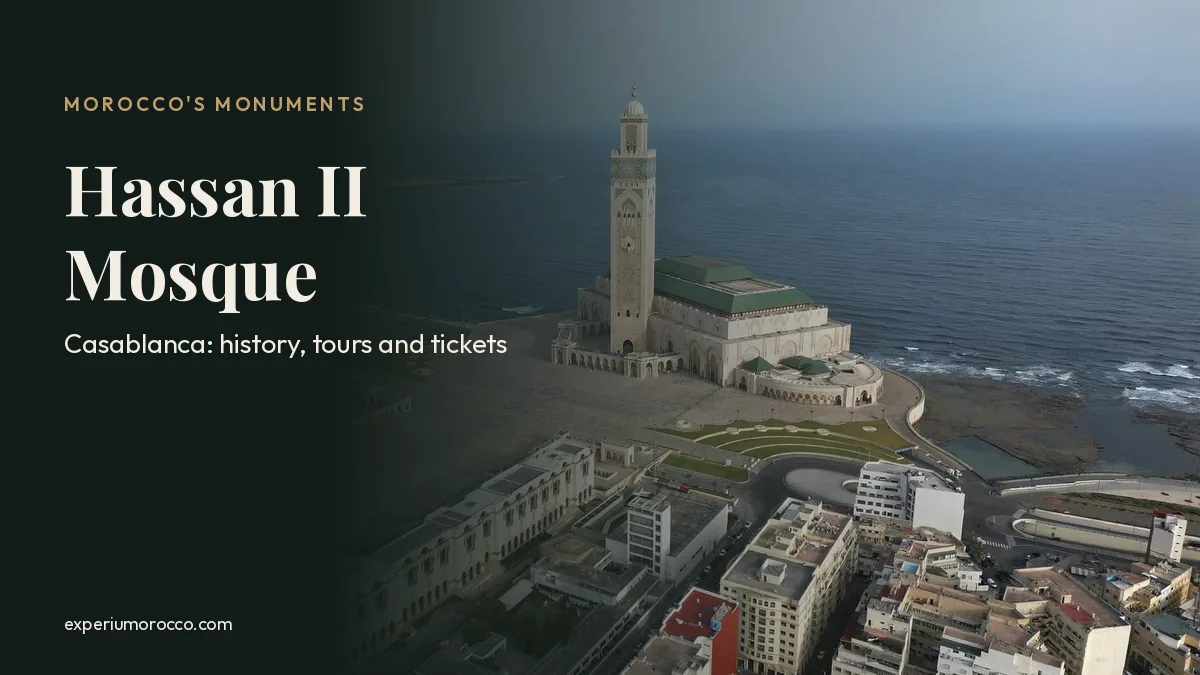
The Hassan II Mosque is Casablanca’s landmark and one of the most recognisable buildings in Morocco. It stands over the Atlantic, its minaret rises to 200 metres and the roof of its prayer hall slides open to the sky. It is also one of the few mosques in the country that non-Muslims can visit inside. This guide covers its history, what you see on the guided tour, the official ticket prices, the tour times and the rules worth knowing before you go.
What it is: Casablanca’s great mosque, inaugurated in 1993 and run by the Hassan II Mosque Foundation.
Tickets: 140 MAD for foreign adults and 70 MAD for Moroccans, residents and foreign students (a guide price, which can change).
Tour times: guided tours only, at set times. Saturday to Thursday at 9am, 10am, 11am, noon and 3pm, plus 4pm from mid-March to mid-September. There are fewer tours on Fridays.
Dress code: shoulders, torso and knees covered. You walk around barefoot and carry your shoes in a bag.
History of the Hassan II Mosque
King Hassan II laid the foundation stone on 11 July 1986, which was 5 Dhu al-Qadah 1406 in the Islamic calendar. Work went ahead under his direct supervision, and the mosque was inaugurated on 30 August 1993, or 12 Rabi al-Awwal 1414: the day of the Mawlid, which marks the birth of the Prophet.
The building was paid for by the Moroccan people. Citizens answered the royal call voluntarily, each giving according to their means.
The design came from the office of the French architect Michel Pinseau, working with Morocco’s craft guilds. According to the Foundation, 3,300 Moroccan craftsmen worked on the decoration: 1,530 in woodwork, 1,600 in carved plaster and 170 in zellige tilework. A little over a thousand of them were master craftsmen, the maâlems who lead each workshop.
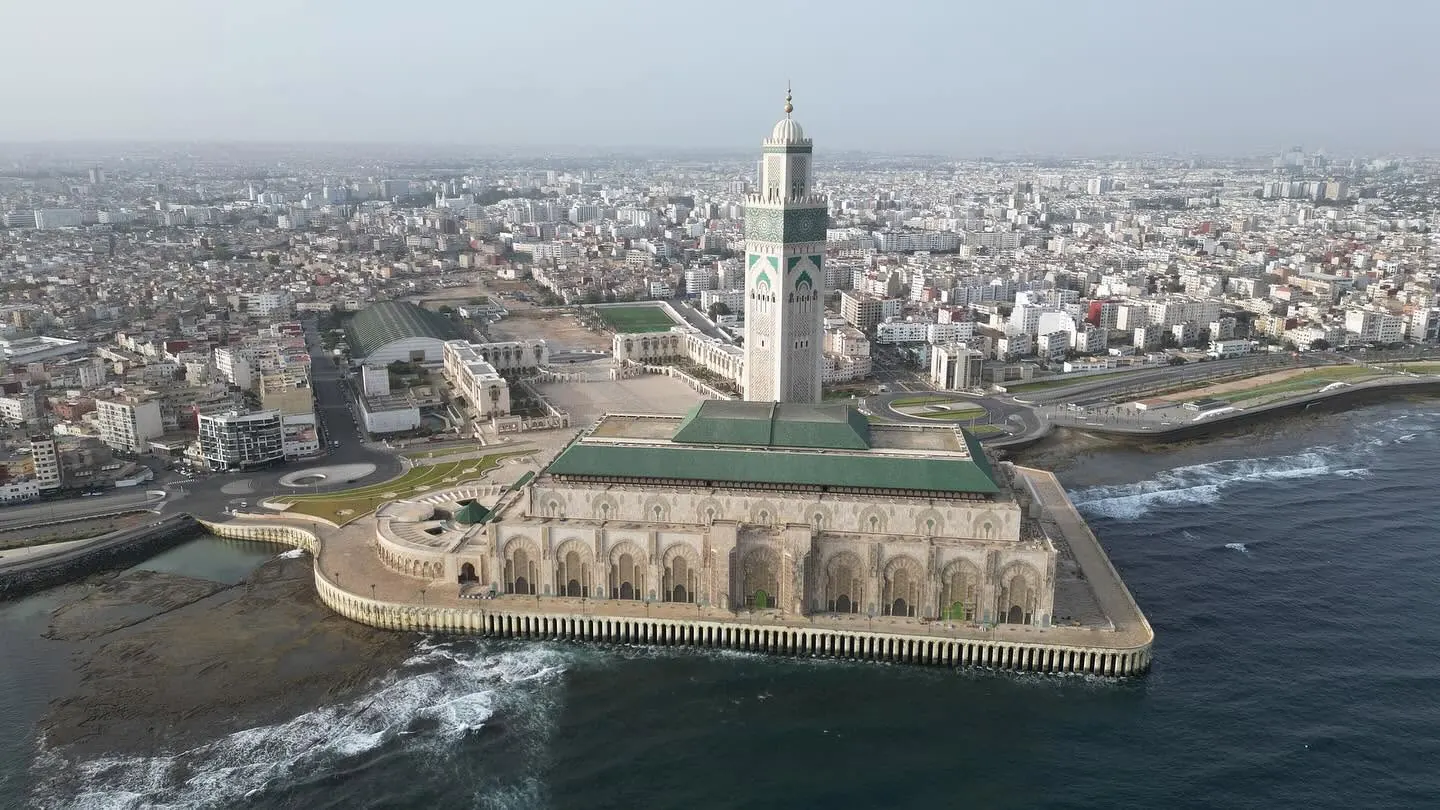
Why build it over the sea? The Foundation links the site to a verse of the Quran: “and His Throne was upon the water”. That is why the mosque was not built inland but right on the Atlantic shore, on Casablanca’s coastline.
Hassan II Mosque facts and figures
The numbers are easier to grasp on a drawing. This cross-section shows the building from the minaret to the sea, with the Foundation’s official figures.
- 1Minaret: 200 m tall on a 625 m² base
- 230 km laser pointing towards Mecca
- 3Central roof that opens to the sky
- 4Prayer hall: 20,000 m² and 25,000 worshippers
- 5Mezzanines for 5,000 women
- 6Ablution hall: lotus-shaped marble fountains and 600 taps
- 7The Atlantic: the building reaches out over the sea
Minaret and hall heights drawn to the same scale (200 and 60 metres); everything else is schematic. Figures from the Hassan II Mosque Foundation. Original drawing by experiumorocco.com/.
The 200-metre minaret
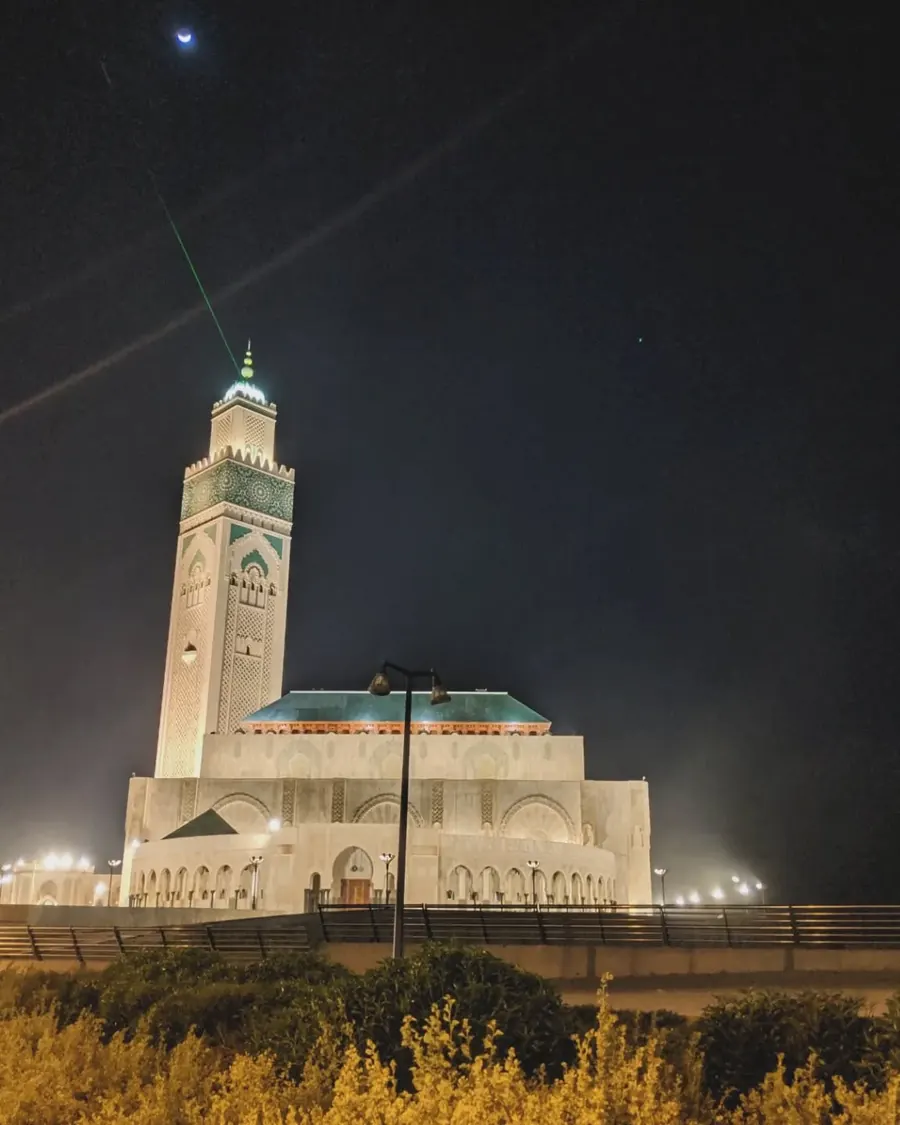
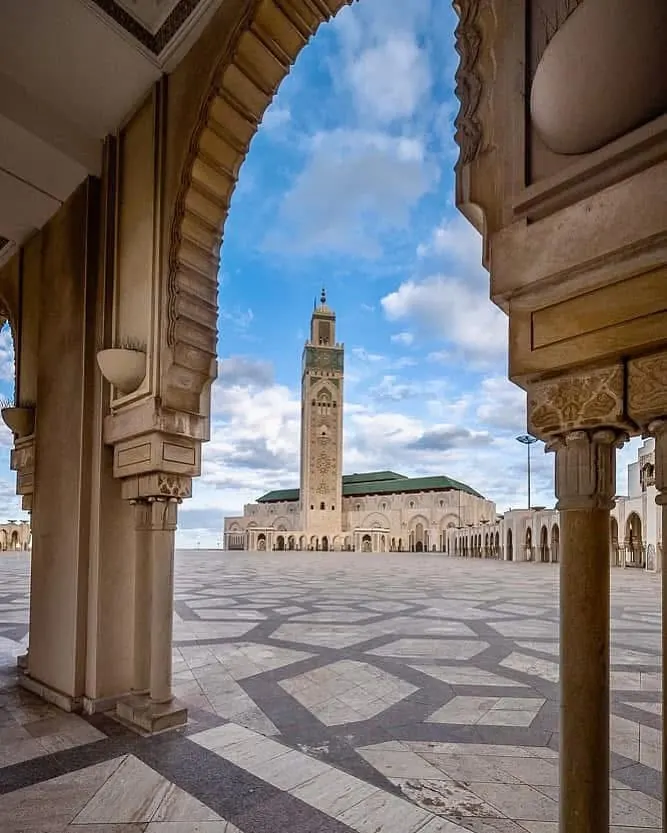
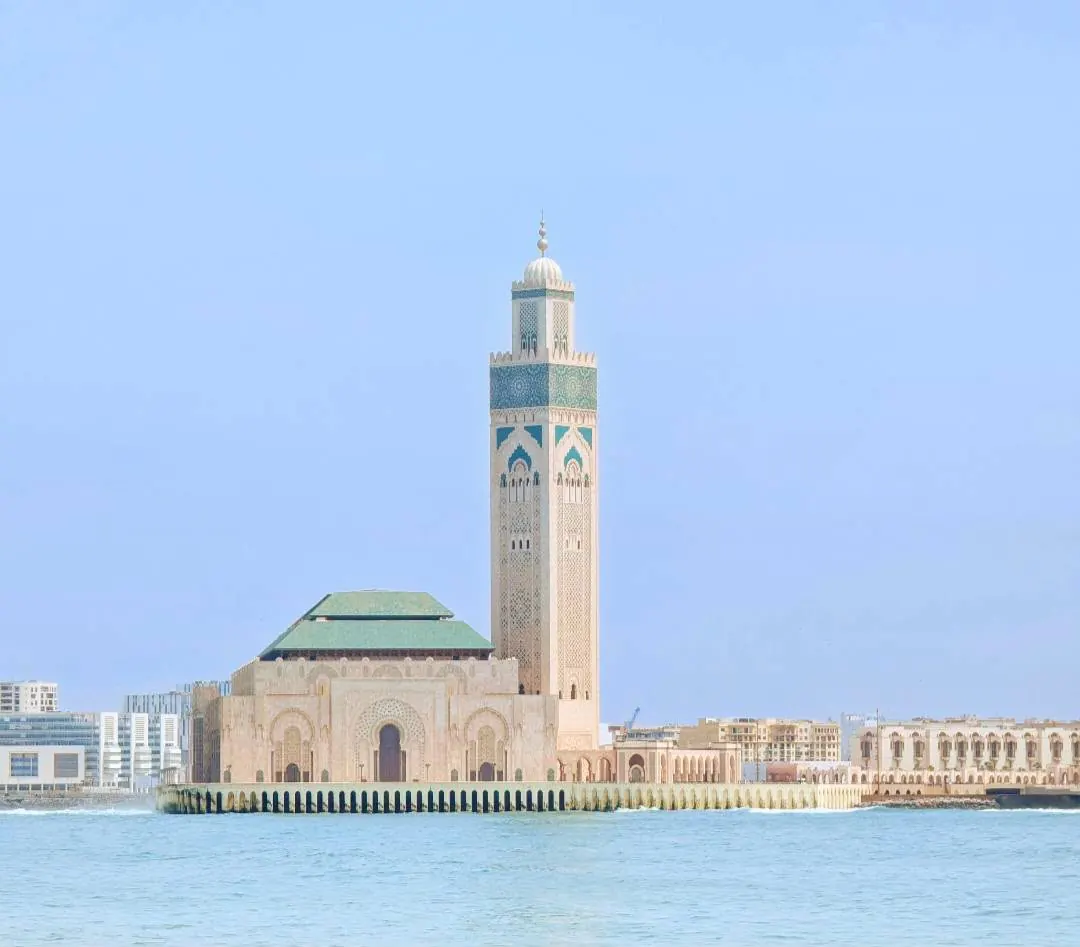
The minaret rises from the middle of the south facade to a height of 200 metres, which makes it one of the tallest in the world. It stands on a 625 m² base, its faces are covered in marble carved like lace and set with zellige panels, and inside a fast lift for 12 people reaches the top in under a minute.
On top sits the jamour, the stack of spheres that crowns minarets across the Maghreb. This one is 15.5 metres tall, weighs 3,700 kg and has three spheres measuring 3.80, 2.50 and 1.60 metres across. The largest sends out a laser beam with a range of 30 km, pointing towards Mecca, the direction of prayer.
The prayer hall
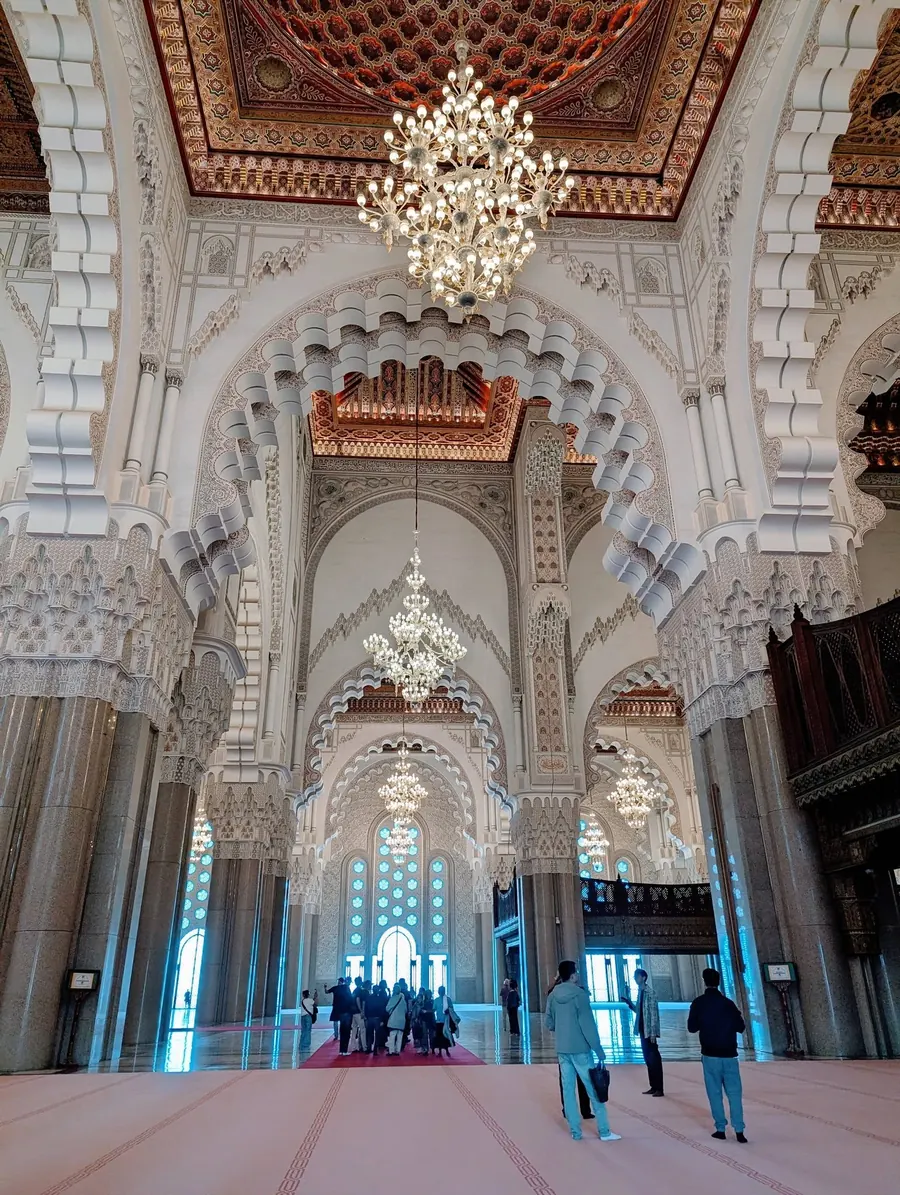
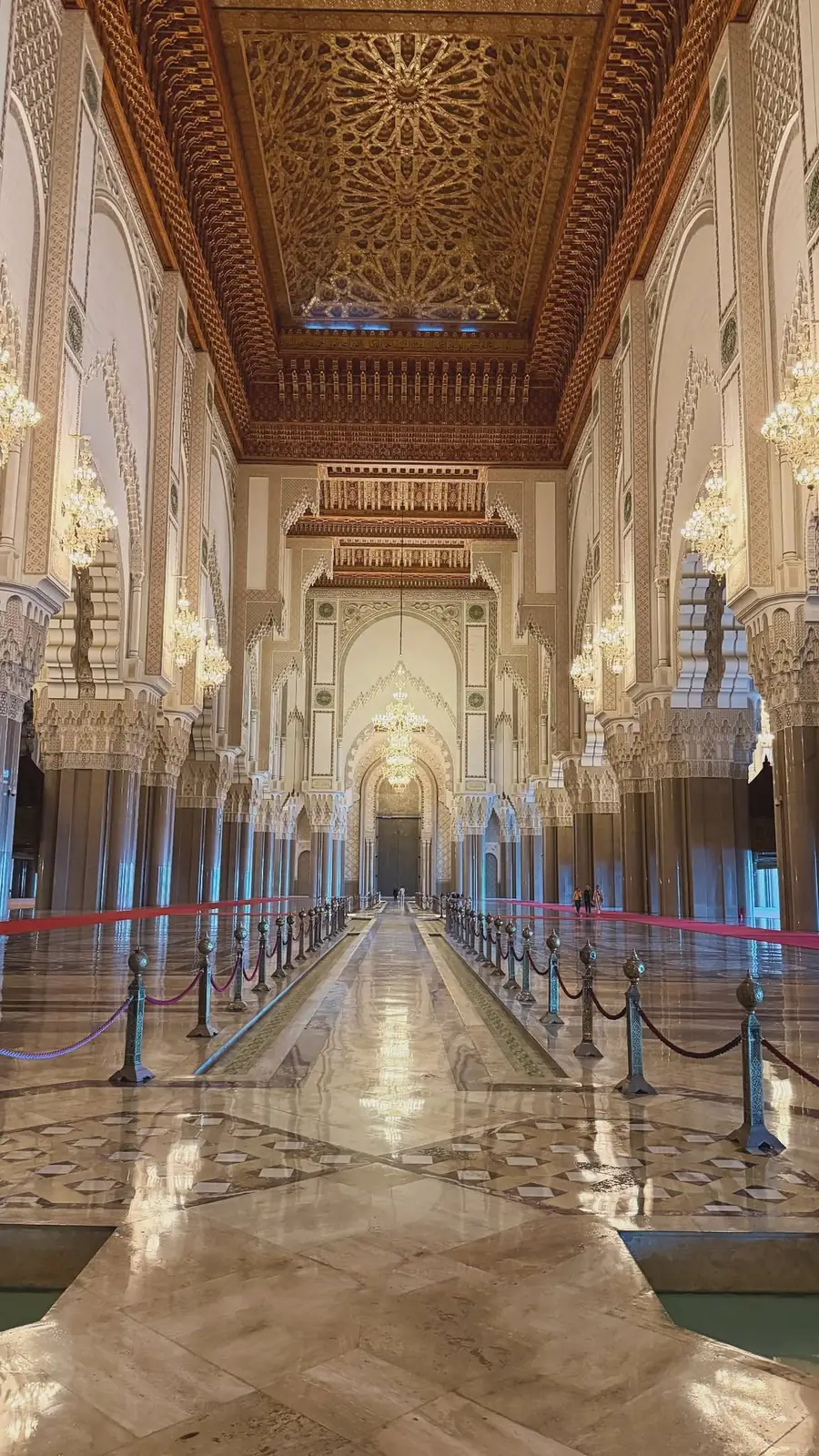
The prayer hall is a rectangle 200 metres long, 100 metres wide and 60 metres high. It covers 20,000 m² and holds around 25,000 worshippers. On either side of the central nave, two suspended mezzanines with a combined 3,550 m² are set aside for women and hold 5,000; four staircases link them to the ablution halls.
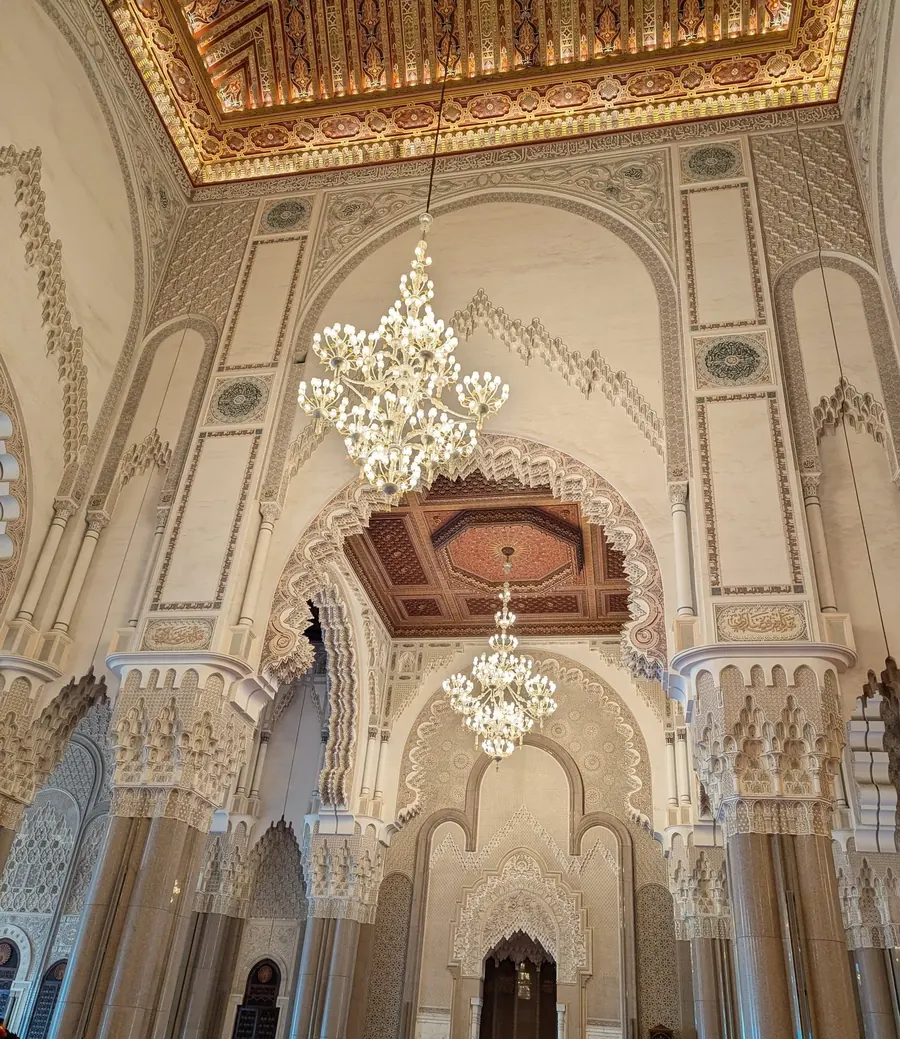
The floor, in marble, granite and travertine, is laid out like a Moroccan carpet and crossed by a water channel, the seguia. It has underfloor heating and glazed openings looking down into the ablution hall below. Light comes from 50 Murano glass chandeliers, each weighing 1,200 kg, and from glass doors facing the Atlantic. The mosque’s great doors are made of titanium and brass.
The roof that opens
The central section of the roof, 3,400 m² in all, is retractable. It opens in five minutes and turns the middle of the hall into an open-air courtyard with the water channel running through it, a scene the Foundation compares to the riads of Muslim Andalusia. The green roof tiles are not clay, by the way: they are 300,000 pieces of cast aluminium made to look like glazed Fez terracotta, and four times lighter.
The ablution hall
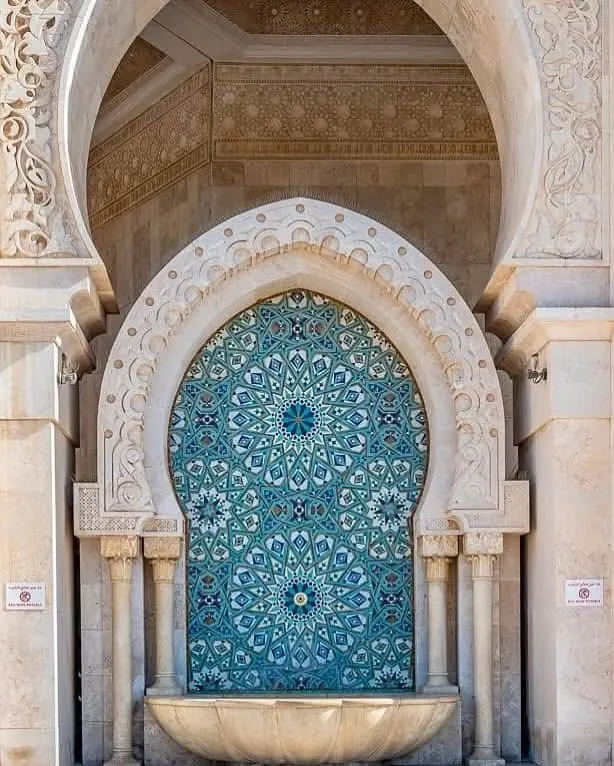
The ablution halls are in the basement beneath the prayer hall, one for men and one for women. Their marble fountains are shaped like lotus flowers, with 600 taps around them. The walls combine zellige with tadelakt, Morocco’s traditional polished lime plaster.
What you see on a Hassan II Mosque tour
Most working mosques in Morocco are open to Muslims only. The Hassan II Mosque is the best-known exception: the Foundation runs paid guided tours in three stages, the prayer hall, the minaret hall and the ablution hall. Along the way, the guide explains the crafts that decorate the building: plaster, carved wood, zellige, marble, tadelakt and copper.
The scale of that craftsmanship is hard to picture: more than 53,000 m² of carved wood and over 10,000 m² of zellige, including 80 new patterns designed for the mosque. Look out for the carved and painted wooden ceilings, the chiselled plaster arches, the geometric zellige panels on the walls and the friezes of calligraphy with verses from the Quran.
The mosque museum
Alongside the mosque, the Foundation runs the Hassan II Mosque Museum, opened by King Mohammed VI in October 2012. Its 3,160 m² display samples of the materials and crafts used on the building, made by Moroccan artisans: carved and painted wood, zellige, marble, copper and plaster. The Foundation presents it as a prelude to the mosque tour.
It has its own ticket: 30 MAD for adults, 15 MAD for Moroccans and residents, and 5 MAD for children over 6 and students. It opens from 9am to 1:30pm and from 2:30pm to 5pm, and from 9am to 3pm during Ramadan.
Hassan II Mosque tickets and tour times
These are the guided tour prices published by the Hassan II Mosque Foundation:
| Visitor | Price |
|---|---|
| Foreign adults | 140 MAD |
| Moroccans, residents of Morocco and foreign students | 70 MAD |
| Children over 6 and Moroccan students | 30 MAD |
| Children under 6 | Free |
Guide prices, subject to change. Private VIP tour for up to 10 people: 2,200 MAD. Groups of 100 or more: 50% off.
You cannot wander in on your own: tours run in groups, at set times that change with the season.
| Period | Saturday to Thursday | Friday |
|---|---|---|
| 16 September to 14 March | 9am, 10am, 11am, noon and 3pm | 9am, 10am and 3pm |
| 15 March to 15 September | 9am, 10am, 11am, noon, 3pm and 4pm | 9am, 10am, 3pm and 4pm |
| Ramadan | 9am, 10am, 11am and 2pm | 9am and 2:15pm |
Times from the Foundation’s official website. They can change, so check fmh2.ma before you go.
Hassan II Mosque dress code and rules
The Foundation sets the rules, and they apply to every visitor:
- Clothing: it must cover your shoulders and torso and come below the knee. Shorts and sleeveless tops are strictly forbidden. If you are still packing, our guide on what to wear in Morocco will help.
- Shoes: take them off before going in and carry them with you. Bags are handed out at the entrance.
- Stay with the group: keep to the schedule, follow your guide and keep your voice down. No smoking or drinking during the tour.
- The water channel: for safety, do not step past the chains around the seguia in the prayer hall.
- Devices: video cameras, radios and other sound devices are not allowed inside the mosque.
If you are dressed for the beach, slip a large scarf or a long-sleeved shirt and a pair of long trousers into your daypack. It saves you missing the tour you wanted.
Tips for visiting the Hassan II Mosque
- Where it is: on Casablanca’s seafront, west of the old medina, between the port and El Hank lighthouse. Casablanca is Morocco’s largest city; our guide to the imperial cities of Morocco puts it in context.
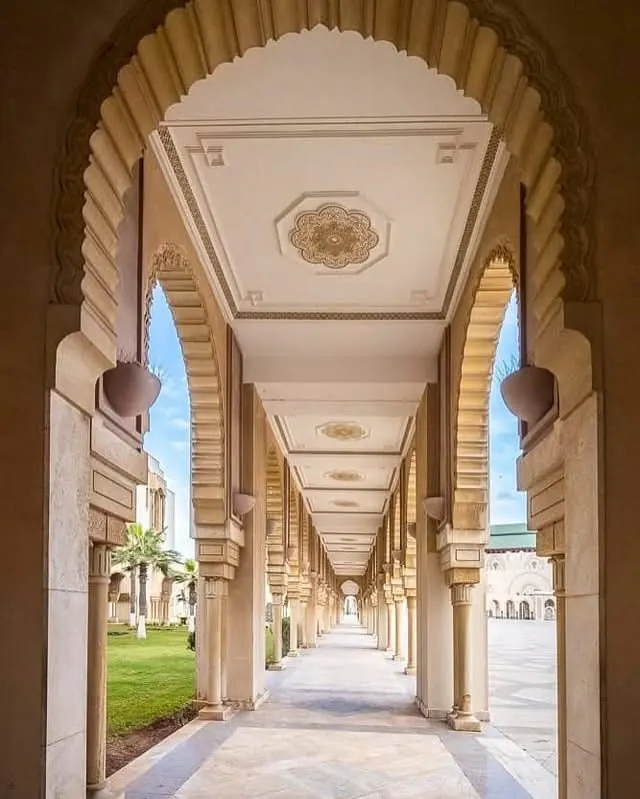
- The esplanade: it surrounds the mosque, covers 30,000 m² and can take up to 80,000 worshippers. Galleries of horseshoe arches in the Andalusian tradition run along its sides, giving shade and good views of the minaret.
- After dark: the building is floodlit and the minaret’s laser can be seen from far away. It is worth coming back to the esplanade or the seafront promenade after your tour.
- Arrive early: tours start on the hour, so get there a little before yours.
- The hammams: beneath the mosque’s courtyard there are traditional baths for men and women, covering 6,000 m², run separately from the guided tour.
Casablanca is where many trips around northern Morocco begin. Our Morocco itinerary for 7, 10 or 14 days shows how to link it with Rabat, Fez and Marrakech, and our 8-day imperial cities and desert tour visits the Hassan II Mosque on day two before heading on to Rabat, Meknes and Fez.
This guide is part of our series on Morocco’s monuments, which also covers the Bahia Palace in Marrakech and the Cherratine Madrasa in Fez.
Hassan II Mosque FAQ
Can non-Muslims visit the Hassan II Mosque?
Yes, on the paid guided tour run by the Hassan II Mosque Foundation, in a group and at set times.
How much is a Hassan II Mosque ticket?
The official price is 140 MAD for foreign adults; 70 MAD for Moroccans, residents and foreign students; 30 MAD for children over 6 and Moroccan students; and free for children under 6. Treat these as guide prices.
What are the tour times?
Saturday to Thursday at 9am, 10am, 11am, noon and 3pm, with an extra 4pm tour from 15 March to 15 September. On Fridays at 9am, 10am and 3pm (plus 4pm in that same season). The schedule changes during Ramadan.
What should I wear to the Hassan II Mosque?
Clothes that cover your shoulders and torso and reach below the knee. Shorts and sleeveless tops are not allowed.
How tall is the Hassan II Mosque minaret?
200 metres. It is topped by a 15.5-metre jamour with three spheres, which sends out a 30 km laser beam towards Mecca.
When was the Hassan II Mosque built?
The foundation stone was laid on 11 July 1986 and the mosque was inaugurated on 30 August 1993. It was funded by the Moroccan people in response to King Hassan II’s call.
Does the roof really open?
Yes. The central part of the prayer hall roof, 3,400 m², opens in five minutes and leaves the hall open to the sky.
Sources
- Hassan II Mosque Foundation: history of the mosque.
- Hassan II Mosque Foundation: prayer hall, minaret, ablution hall and esplanade.
- Hassan II Mosque Foundation: paid guided tours, prices, times and rules.
- Hassan II Mosque Foundation: the mosque’s craftsmen (in French).
- Hassan II Mosque Foundation: museum prices and opening hours and hammams.