


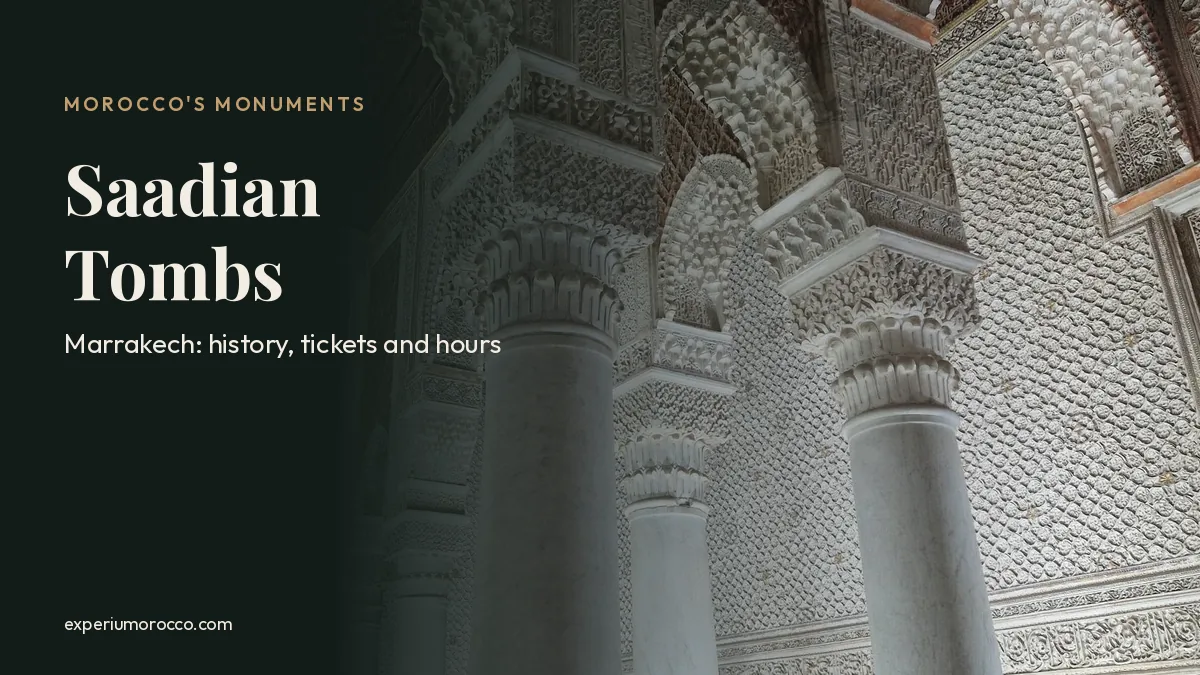
The Saadian Tombs are the royal necropolis of the Saadian dynasty, which ruled Morocco through the 16th century and the first half of the 17th. They sit in the Kasbah quarter of Marrakech, right against its mosque, and hold the graves of Sultan Ahmad al-Mansur and his family beneath cedar ceilings, Carrara marble columns and walls of zellige tilework. This guide covers their history, who is buried in each hall, what to see, the official ticket price and the opening hours.
What it is: the burial ground of the Saadian sultans, from the 16th and 17th centuries, now a monument run by the Ministry of Culture.
Tickets: 100 MAD for foreign adults and 30 MAD for Moroccans and residents (a guide price, which can change).
Opening hours: 9am to 5pm, according to the Ministry’s ticketing website.
Where: in the Kasbah quarter, next to the Kasbah Mosque, about 900 metres as the crow flies from Jemaa el Fna square.
History of the Saadian Tombs
It all began with a single grave. Sultan Mohammed al-Sheikh died in 1557, and his son Abdallah al-Ghalib built a small domed tomb over his burial place, beside the Kasbah Mosque that the Almohads had built in the late 12th century. That first building is known today as the Lalla Mas’uda mausoleum.
The man who turned it into a royal necropolis was Ahmad al-Mansur. He came to the throne in 1578 after the Battle of Wadi al-Makhazin, also called the Battle of the Three Kings, and he is the sultan who built El Badi Palace. During his reign, which lasted until 1603, he enlarged and decorated his father’s mausoleum, where his mother, Lalla Mas’uda, and his brother were also buried. According to Archnet, between 1591 and 1603 he added a second, larger mausoleum with three halls, intended for his own tomb.
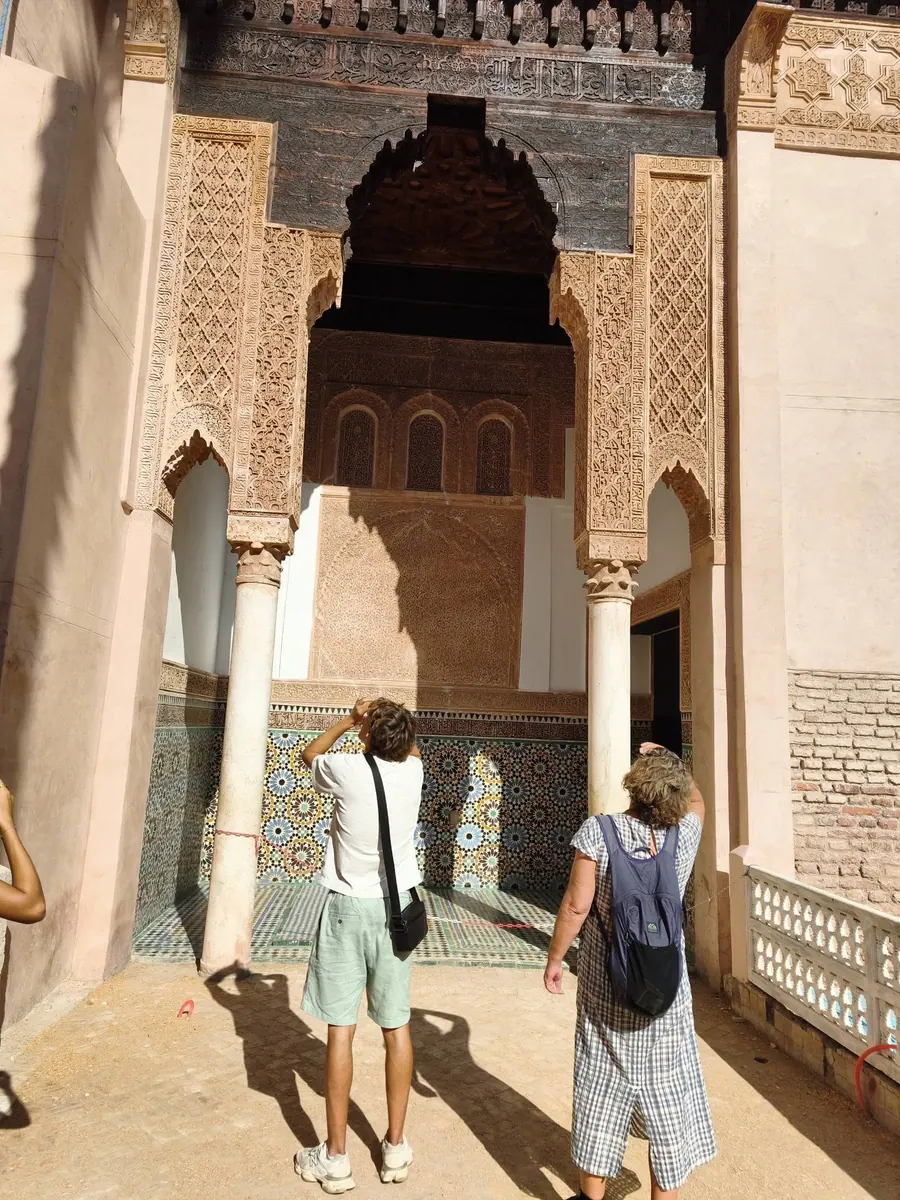
The site stayed in use after the Saadian dynasty ended in the mid-17th century. Archnet dates the sealing of its entrance to 1677, yet the mihrab hall later received Alaouite burials, among them Sultan Mulay al-Yazid, who died in 1792. In 1917 the Fine Arts and Historic Monuments department of the time recorded and restored the site and opened a way in to both buildings, as the Ministry of Culture’s panel at the monument explains.
Who is buried in the Saadian Tombs?
The graves are not all in one place. Each building belongs to a different chapter of the family story, and the timeline makes it clear: the early Saadians in the older mausoleum, al-Mansur and his successors in the Hall of the Twelve Columns, and later an Alaouite sultan in the mihrab hall.
- 11557Mohammed al-Sheikh, father of al-Mansur, whose grave began the necropolis
- 21574Abdallah al-Ghalib, his son, who built the first domed tomb
- 31591Lalla Mas’uda, al-Mansur’s mother
- 41603Ahmad al-Mansur, at the centre of the hall
- 51627Mulay Zaydan, son of al-Mansur
- 61631Abd al-Malik II, son of Zaydan
- 71655Mohammed al-Sheikh al-Saghir, son of Zaydan
- 81792Mulay al-Yazid, Alaouite sultan
Year of death for each person. A partial list: the site holds many more graves, especially in the garden. Sources: the Ministry of Culture panel at the monument, Archnet, Gaston Deverdun (1959) and Xavier Salmon (2016). Original drawing by experiumorocco.com/.
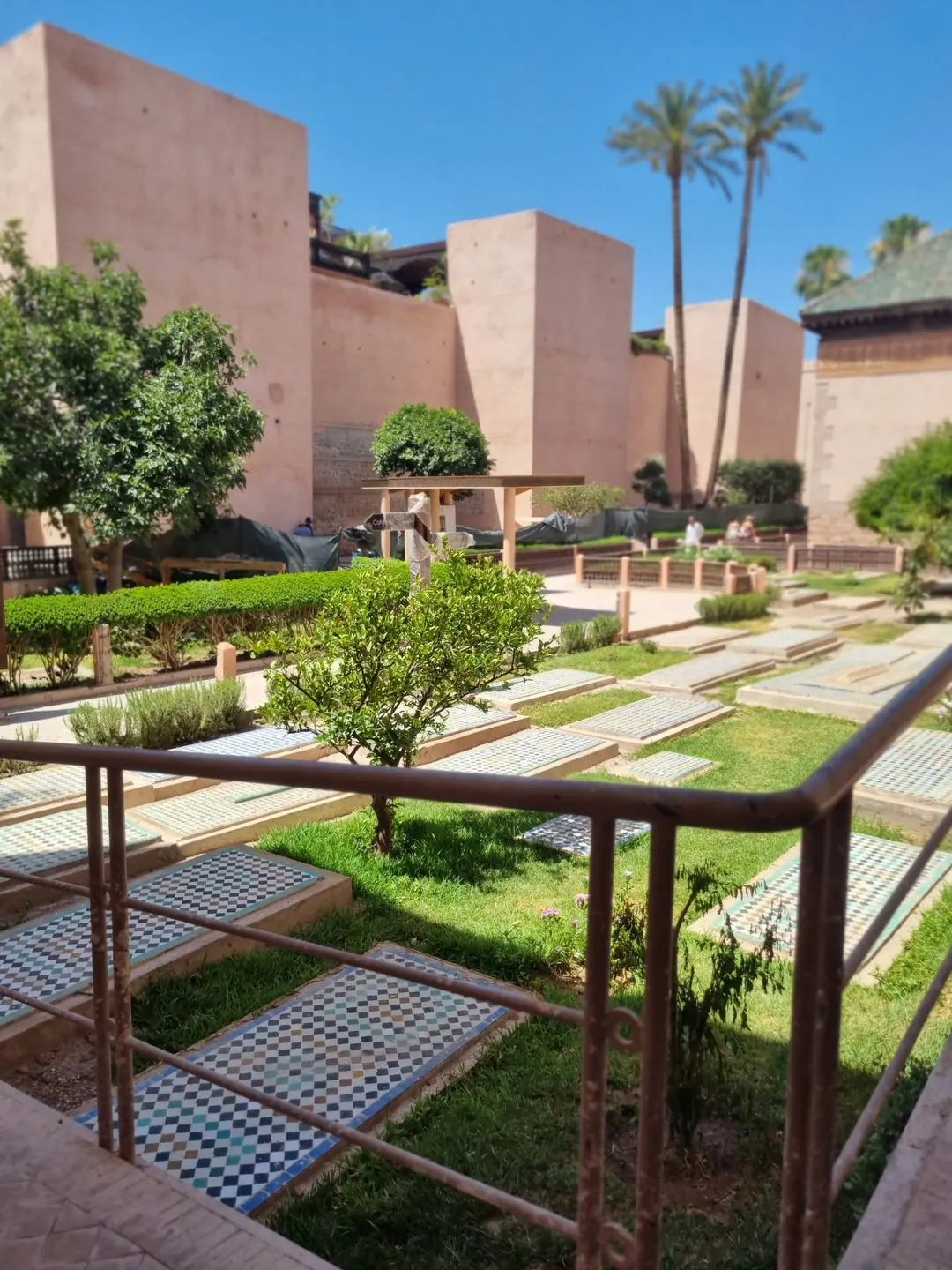
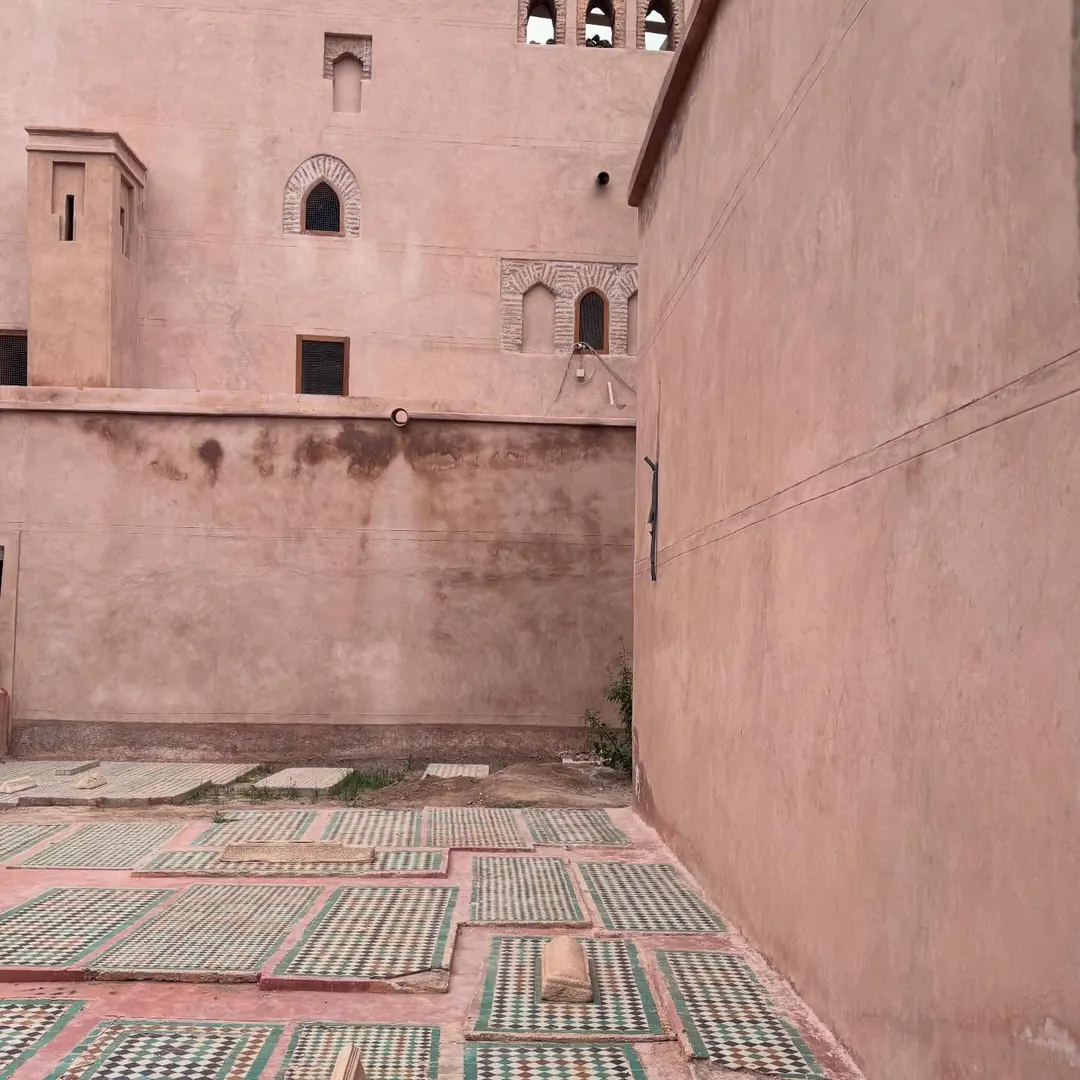
Besides these main tombs, the garden is filled with simpler graves covered in zellige, belonging to members of the court and the royal family.
What to see at the Saadian Tombs
The site is small: Archnet gives the walled garden as roughly 85 by 25 metres. Inside are two buildings, al-Mansur’s mausoleum with its three halls and the Lalla Mas’uda mausoleum.
The Hall of the Twelve Columns
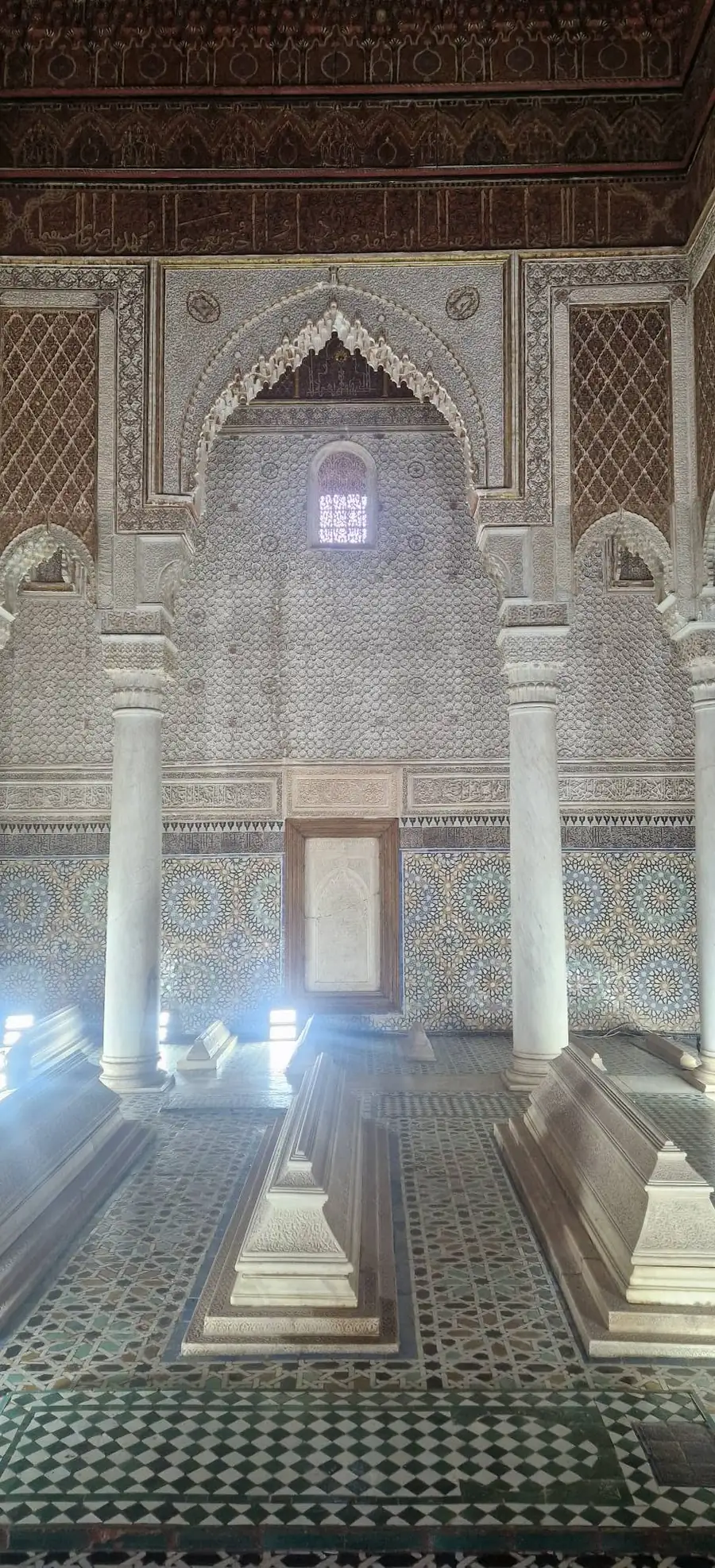
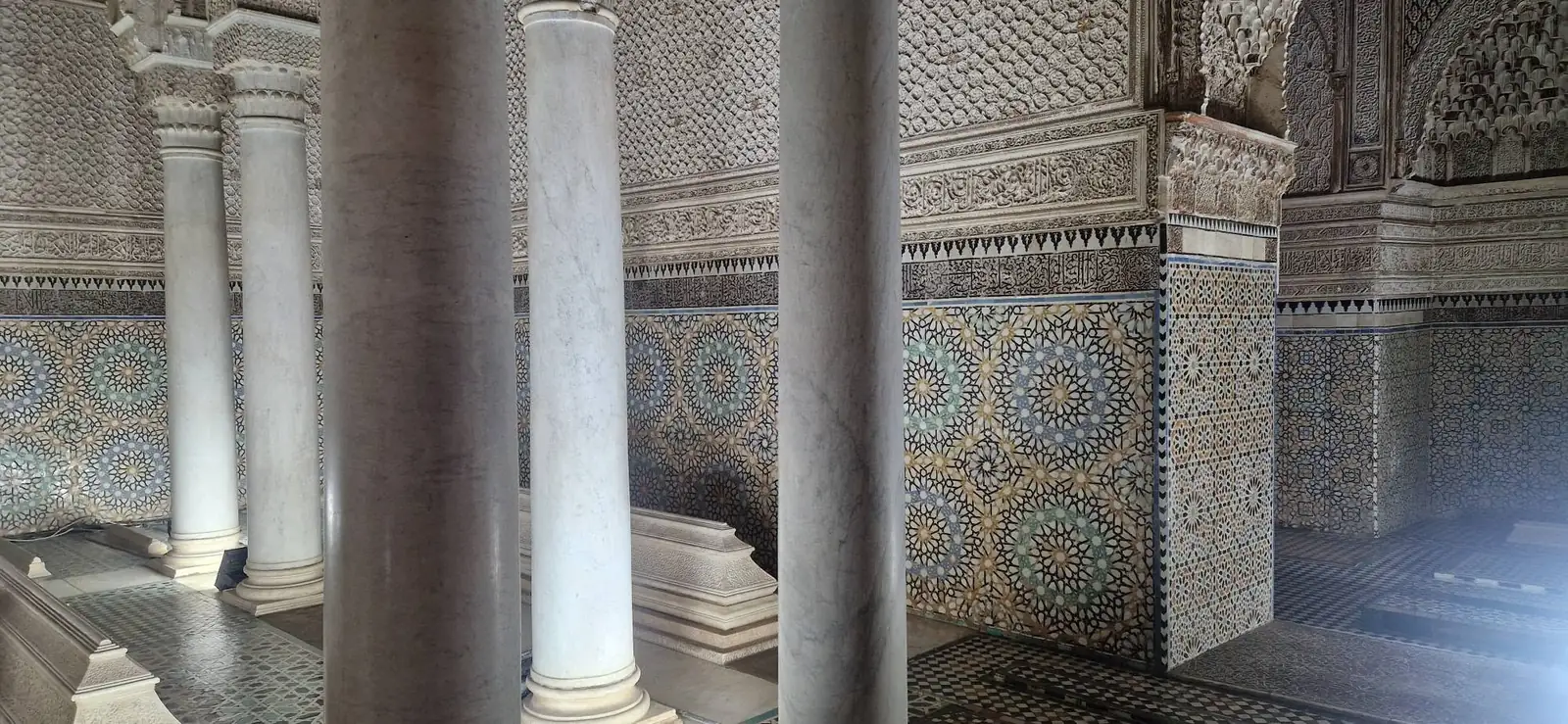
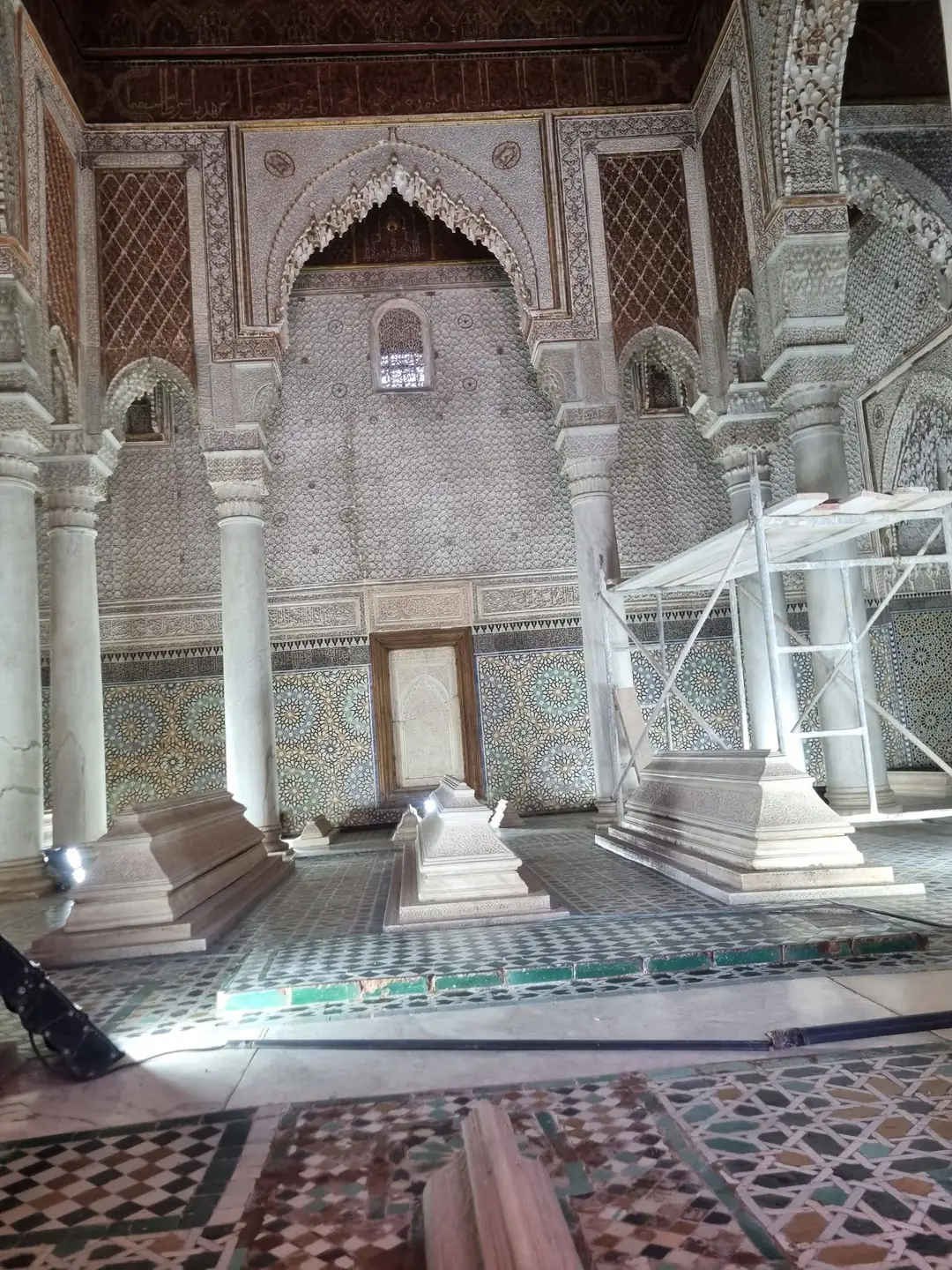
This is the central hall of al-Mansur’s mausoleum and the one everyone comes to see: a room about 10 metres square and 12 metres high, according to Archnet. Sultan Ahmad al-Mansur and three of his successors lie at its centre. A dome rests on twelve Carrara marble columns, and the galleries around the central square are covered with muqarnas vaults and painted, gilded cedar ceilings.
The walls are tiled in zellige with geometric interlace up to about two metres, topped by friezes of Quranic verses, one in carved ceramic and one in plaster. Notice how the three layers stack up: tiles at the bottom, plaster in the middle, cedar at the top.
The mihrab hall
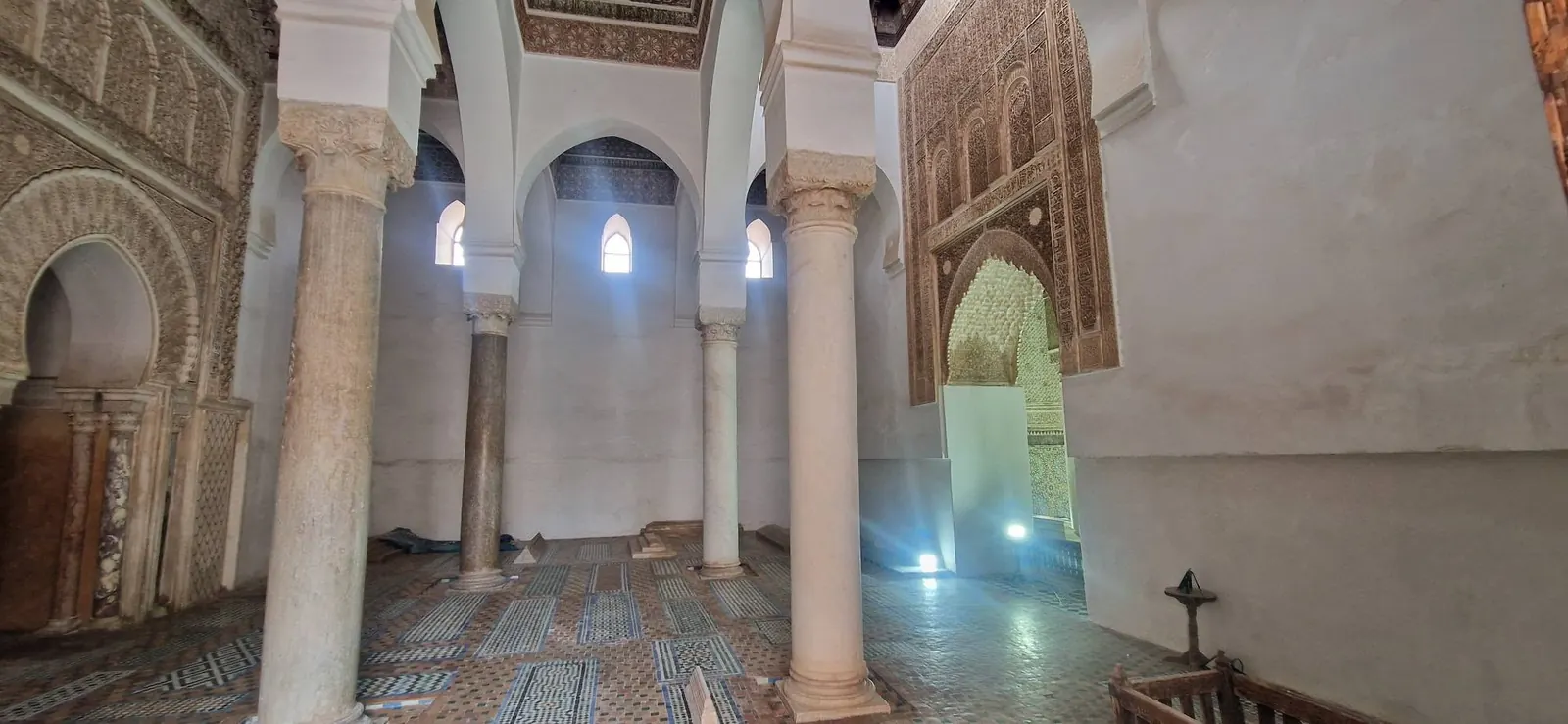
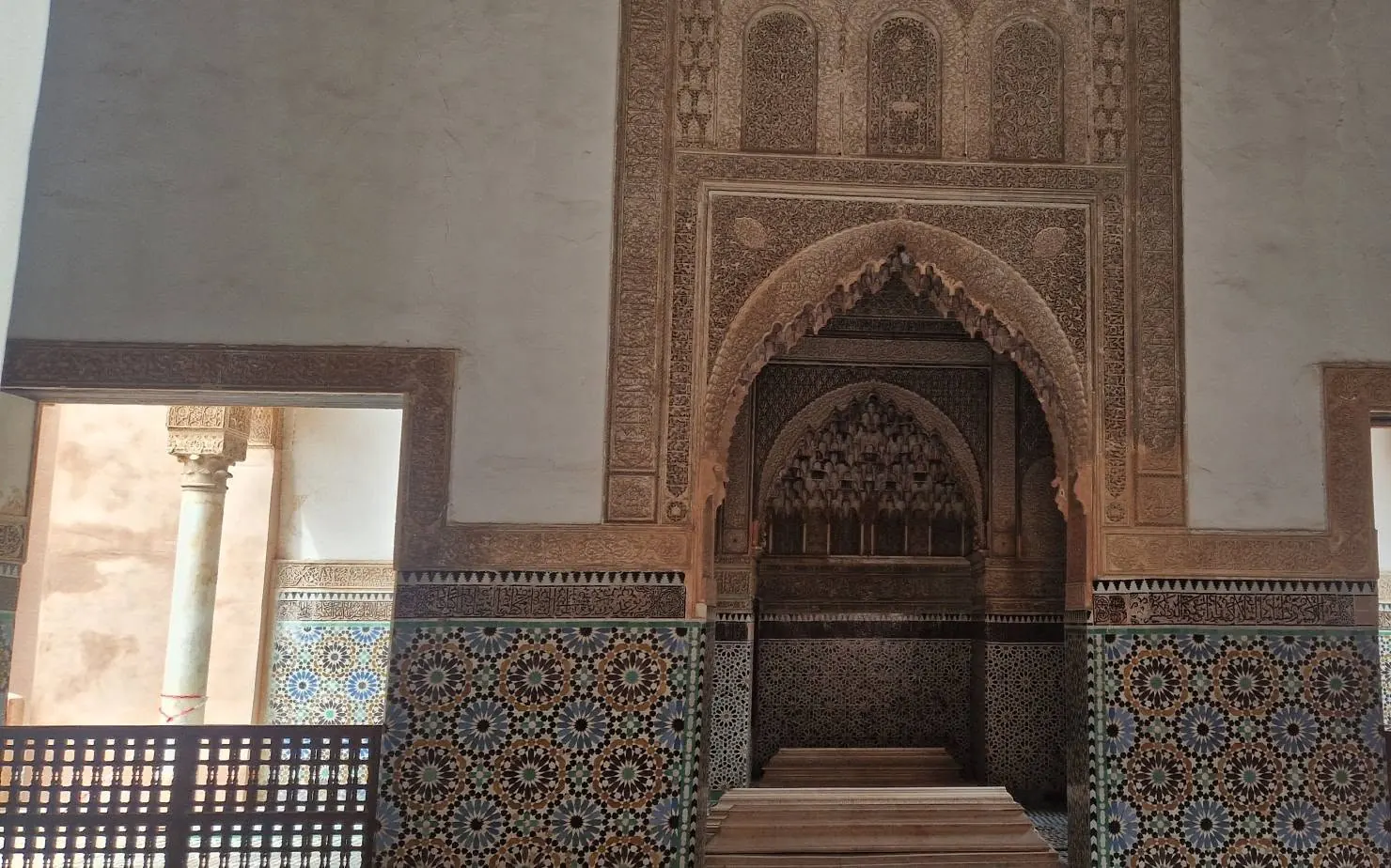
This is the first of the three halls and was used as a prayer room. Its mihrab, the niche that shows the direction of prayer, is covered in muqarnas, and its pointed horseshoe arch rests on four grey marble half-columns framed by four matching colonnettes. No Saadian was buried here: the hall received only Alaouite tombs, including that of Mulay al-Yazid.
The Hall of the Three Niches
The third hall of al-Mansur’s mausoleum lies on the far side of the Hall of the Twelve Columns. The Ministry’s panel singles out its very rich decoration, in the same style as the rest of the building.
The Lalla Mas’uda mausoleum
This is the oldest building: the domed tomb Abdallah al-Ghalib raised over his father’s grave. Al-Mansur enlarged it with a large hall and two loggias, turning it into a square pavilion about 10 metres across with a green-tiled roof, according to Archnet. Mohammed al-Sheikh rests here, along with Lalla Mas’uda, al-Mansur’s mother, who gives the building its name.
How to read the decoration
In a small space, the Saadian Tombs bring together the main crafts of Moroccan architecture: marble for columns and tombs, zellige for floors and dados, carved plaster for arches and walls, and carved, painted cedar for ceilings and canopies. Many art historians see them as one of the high points of Saadian art.
The garden and its tiled graves
Between the two buildings lies the garden, with trees, roses and dozens of ground-level graves covered in zellige. It is the calmest part of the visit and the best place to take in the variety of geometric tile patterns.
Saadian Tombs tickets and opening hours
The Saadian Tombs are run by the Ministry of Culture, and these are the prices listed on its official ticketing website:
| Visitor | Adult | Child (7 to 13) |
|---|---|---|
| Foreign visitor | 100 MAD | 50 MAD |
| Moroccan or resident | 30 MAD | 10 MAD |
Guide prices, subject to change. Moroccans get in free on Fridays and on the first day of national and religious holidays.
You can buy tickets at the ticket office or on the Ministry of Culture’s official platform, which gives opening hours of 9am to 5pm.
Some websites present themselves as “official” and resell tickets at a mark-up. The only public sales platform is the Ministry of Culture’s, on the minculture.gov.ma domain.
Are the Saadian Tombs open after the 2023 earthquake?
Yes. According to the official MAP news agency, the Saadian Tombs withstood the earthquake of 8 September 2023 with partial damage, cracks and small localised collapses, and they are open as usual today. You may still come across scaffolding in one of the halls for conservation work.
Tips for visiting the Saadian Tombs
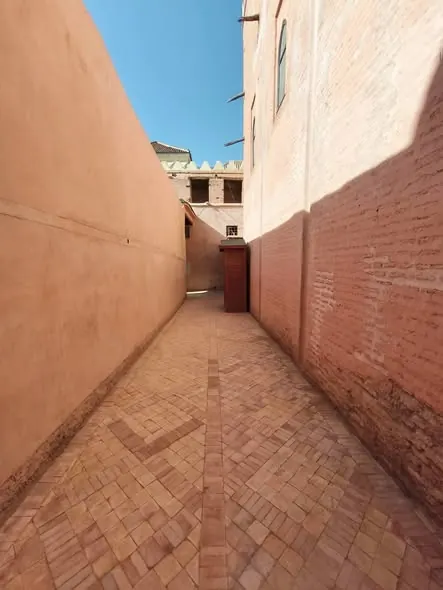
- Getting there: the tombs are in the Kasbah quarter, south of the medina, about 900 metres as the crow flies from Jemaa el Fna square. The way in is through a narrow passage between the walls.
- When to go: first thing in the morning there are usually fewer groups. A queue forms outside the Hall of the Twelve Columns at busy times, because you view the halls from the doorway.
- How long: the site is small, so the visit is short; the main variable is the wait outside the halls.
- Be respectful: this is a royal necropolis, with the graves of sultans and their families. Keep your voice down and stay behind the railings.
- With a guide: in the medina, licensed city guides work under Law 05-12. Our Marrakech guided city tour includes the Saadian Tombs.
The tombs pair well with the other monuments in the south of the medina: El Badi Palace is about 300 metres away and the Bahia Palace less than a kilometre. Our guide to things to do in Marrakech covers the rest of the city. This guide is also part of our series on Morocco’s monuments, alongside the Hassan II Mosque in Casablanca and the Cherratine Madrasa in Fez.
Saadian Tombs FAQ
How much is the Saadian Tombs entrance fee?
The official price is 100 MAD for foreign adults and 50 MAD for children aged 7 to 13; 30 MAD and 10 MAD for Moroccans and residents. Treat these as guide prices.
What are the Saadian Tombs opening hours?
The Ministry of Culture’s ticketing website gives 9am to 5pm. It is worth checking on public holidays and during Ramadan.
Where can I buy Saadian Tombs tickets?
At the ticket office or on the Ministry of Culture’s official platform, e-services.minculture.gov.ma.
Who is buried in the Saadian Tombs?
Sultan Ahmad al-Mansur and three of his successors in the Hall of the Twelve Columns; his father, Mohammed al-Sheikh, and his mother, Lalla Mas’uda, in the older mausoleum; and Alaouite graves such as that of Mulay al-Yazid in the mihrab hall.
How long does the visit take?
Not long, since the site is small. What usually takes the most time is the queue outside the Hall of the Twelve Columns.
Are the Saadian Tombs open after the earthquake?
Yes. They suffered partial damage in 2023, according to MAP, but are open as usual. There may be scaffolding in one of the halls.
Are the Saadian Tombs worth visiting?
Yes, especially if you are interested in Moroccan craftsmanship: the Hall of the Twelve Columns is one of the finest examples of Saadian decoration, with marble, cedar, plaster and zellige in a single room.
Sources
- Ministry of Youth, Culture and Communication: Tombeaux Saadiens, tickets and prices (in French).
- Ministry of Culture: “Tombeaux Saâdiens” information panel at the monument.
- Archnet (MIT and Aga Khan Trust for Culture): Qubur al-Sa’diyyin.
- Morocco’s national portal (MAP): post-earthquake rehabilitation of Marrakech’s historic monuments (September 2025) (in French).
- Gaston Deverdun, Marrakech, des origines à 1912, 1959.
- Xavier Salmon, Marrakech. Splendeurs saadiennes, 1550-1650, 2016.