


The Bahia Palace is the grand residence that two grand viziers, Si Moussa and his son Ba Ahmed, built in the Marrakech medina in the second half of the nineteenth century. Its marble courtyards, painted cedar ceilings and gardens have made it one of the most visited monuments in Morocco. This guide covers its history, what to look for inside, the official ticket price and opening hours, and where the restoration work stands.
What it is: a nineteenth-century palace, built between the 1860s and 1900, now a monument run by the Ministry of Culture.
Official ticket price: 100 MAD for foreign adults and 30 MAD for Moroccans and residents (indicative, subject to change).
Opening hours: 9am to 5pm, according to the Ministry’s ticketing website.
Time needed: about an hour. Restoration has been under way since 2024, but the palace remains open.
Bahia Palace history
The Bahia was not built in one go. Si Moussa, grand vizier to Sultan Sidi Mohammed ben Abderrahmane (1859-1873), started it: his section, known as Dar Si Moussa, has inscriptions dated 1866-1867. His son Ba Ahmed, grand vizier to Sultan Moulay Abdelaziz, enlarged it between 1894 and 1900 by buying and joining neighbouring houses. The great marble courtyard was finished in 1896-1897.
That is why the plan feels like a maze: there is no single axis, just gardens, courtyards and reception rooms added one after another as the plot grew. The extensions were designed by the architect Muhammad al-Mekki al-Misfiwi, with cedar brought from the Middle Atlas, marble from Meknes and tiles from Tetouan. The name comes from the Arabic البهية, meaning “the brilliant” or “the beautiful”.
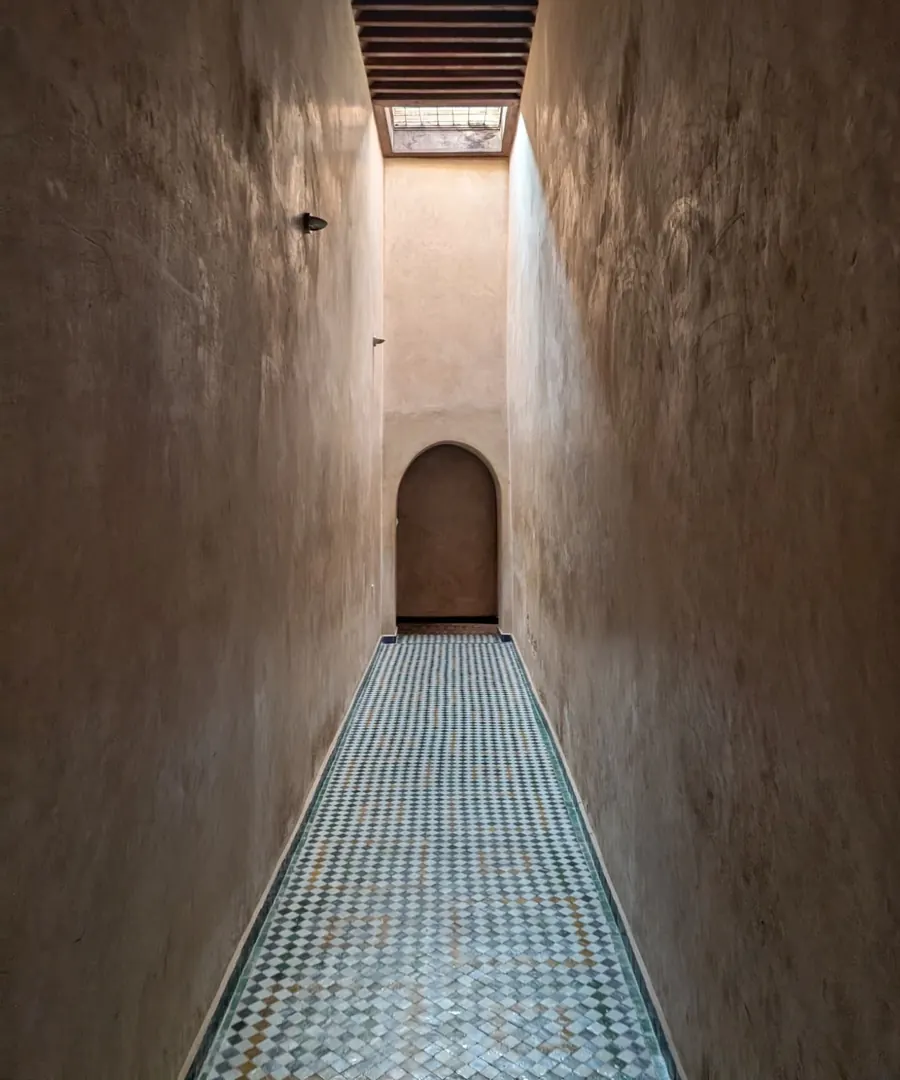
When Ba Ahmed died in 1900, the palace passed to the Makhzen, the sultan’s administration, and its furniture and valuables were removed; the courtyards and fixed decoration survive. In 1912, under the Protectorate, it became the residence of the French resident-general. It later passed to the Moroccan state: the Ministry of Culture manages it and, according to Archnet, it still hosts official receptions from time to time. Between January and April 2019 it welcomed more than 410,000 visitors, according to a Ministry of Culture statement.
What to see at the Bahia Palace
These are the spaces most worth your time.
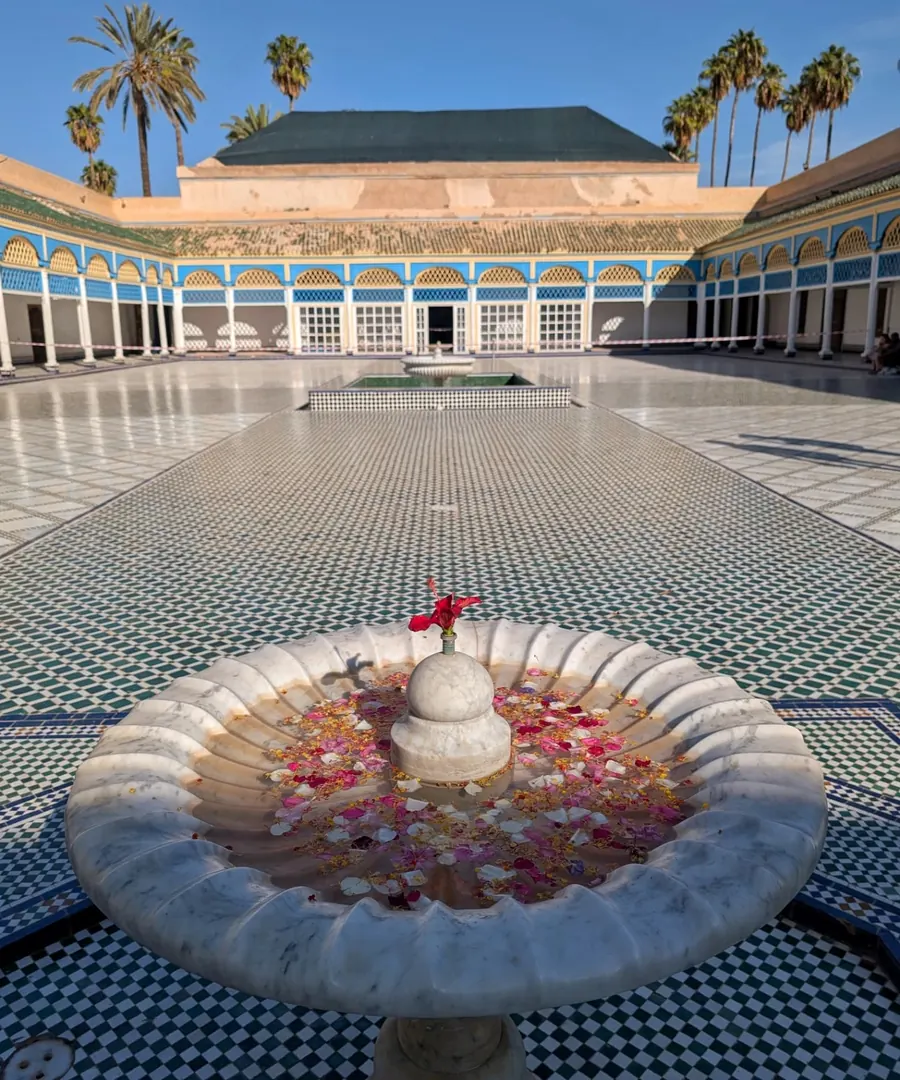
The grand courtyard
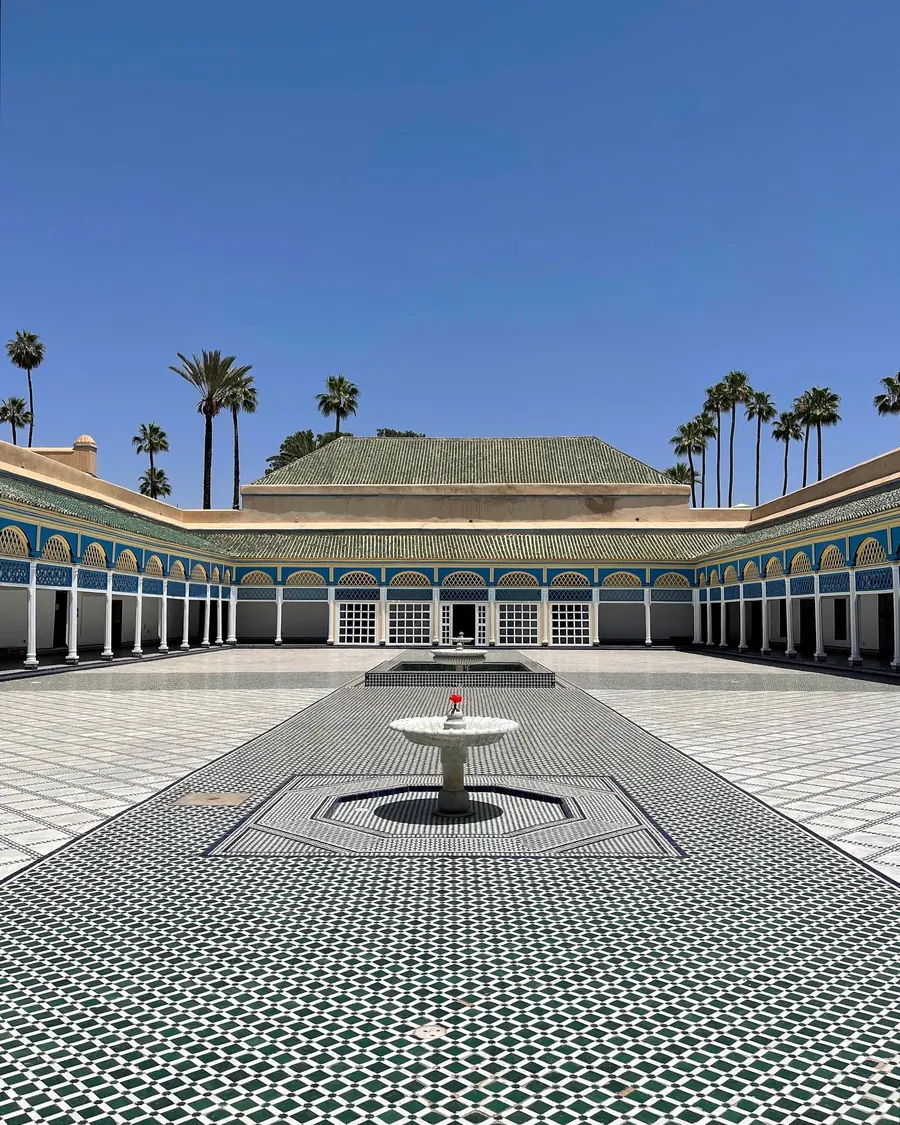
It is the largest space in the palace: roughly 50 by 30 metres (about 165 by 100 feet) of marble paving, split into four by zellige paths, with a fountain in the middle. Galleries with blue and yellow latticework run around it under green tiled roofs. At midday the marble throws back a lot of light, so walk under the galleries if it gets too bright.
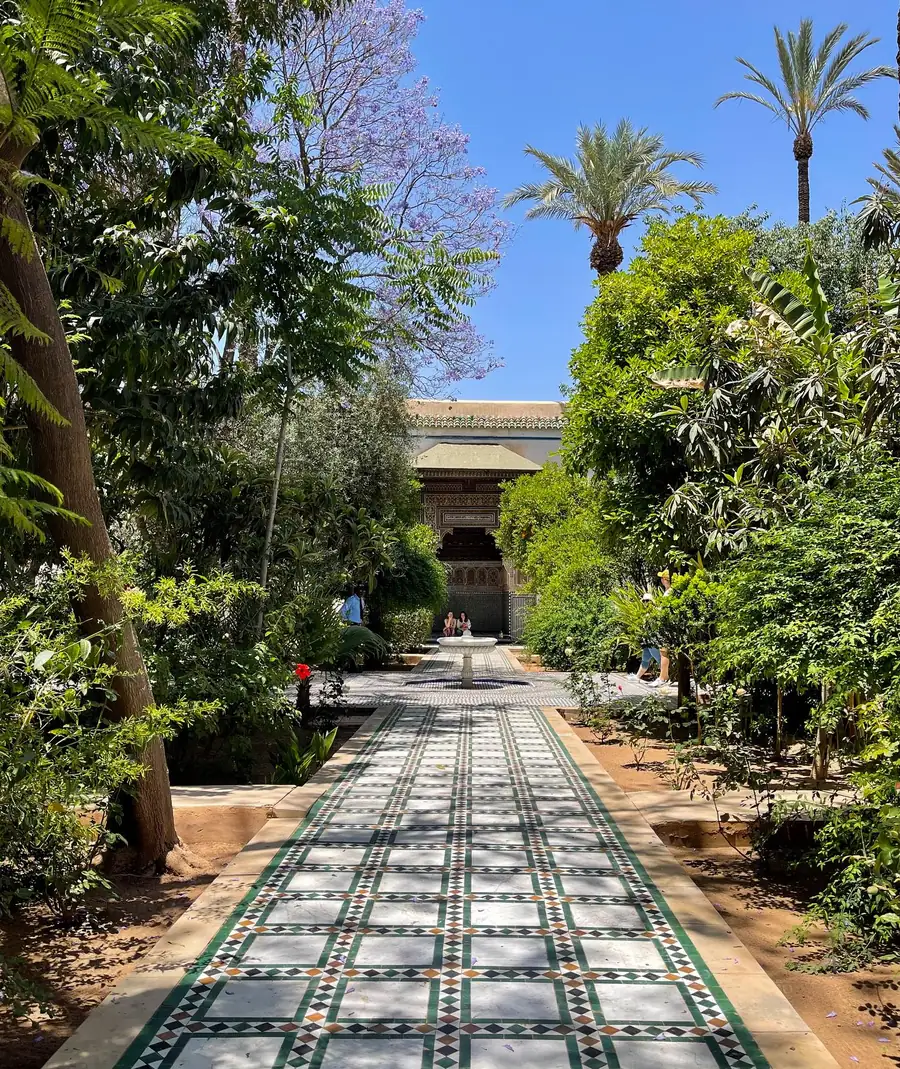
The gardens and riads
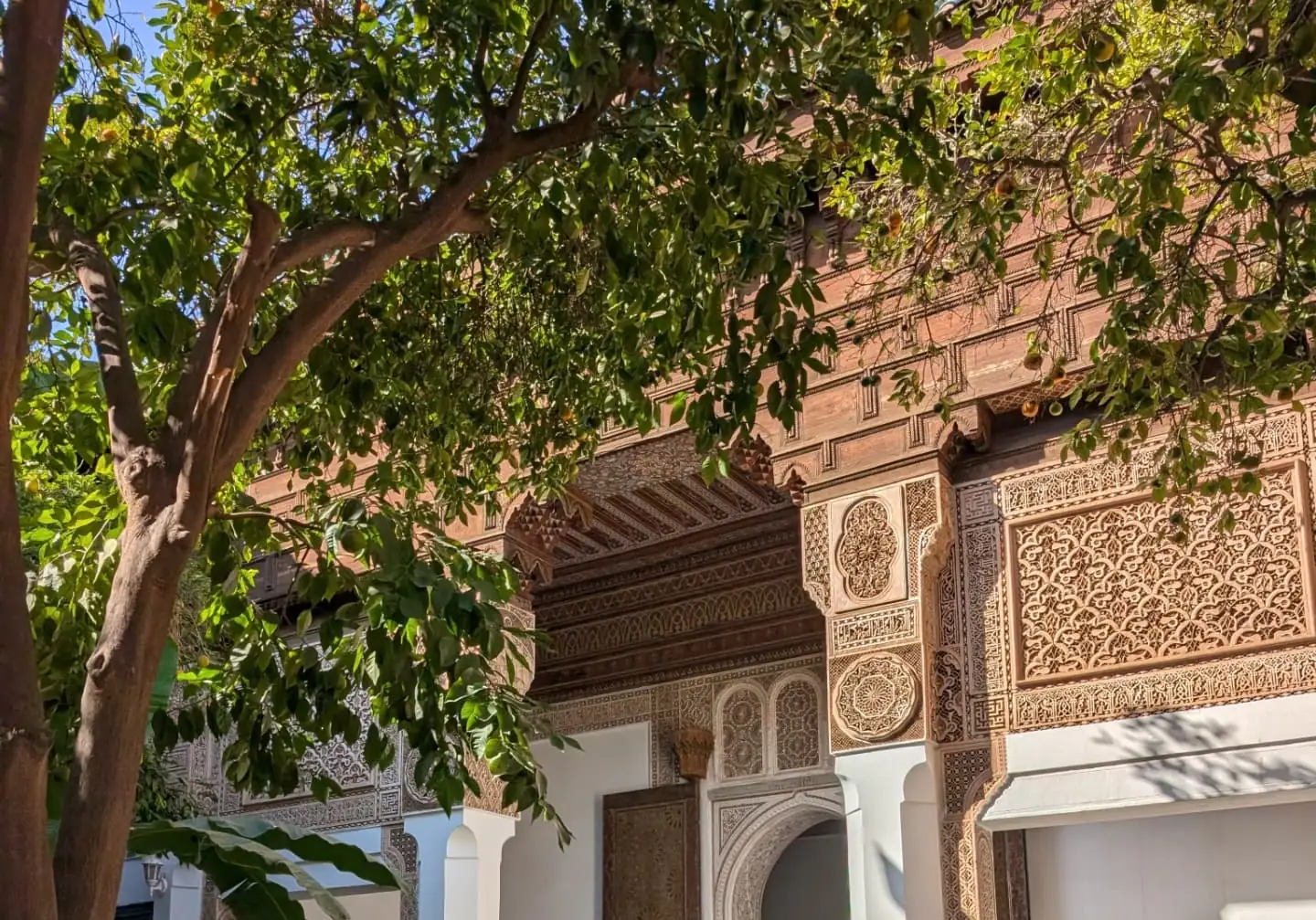
The oldest part, Si Moussa’s, is laid out around a garden with fountains, cypress, orange and jasmine. Other courtyards repeat the idea on a smaller scale: a riad, that is, an inner garden divided into beds with a fountain at its centre.
Ba Ahmed’s reception rooms
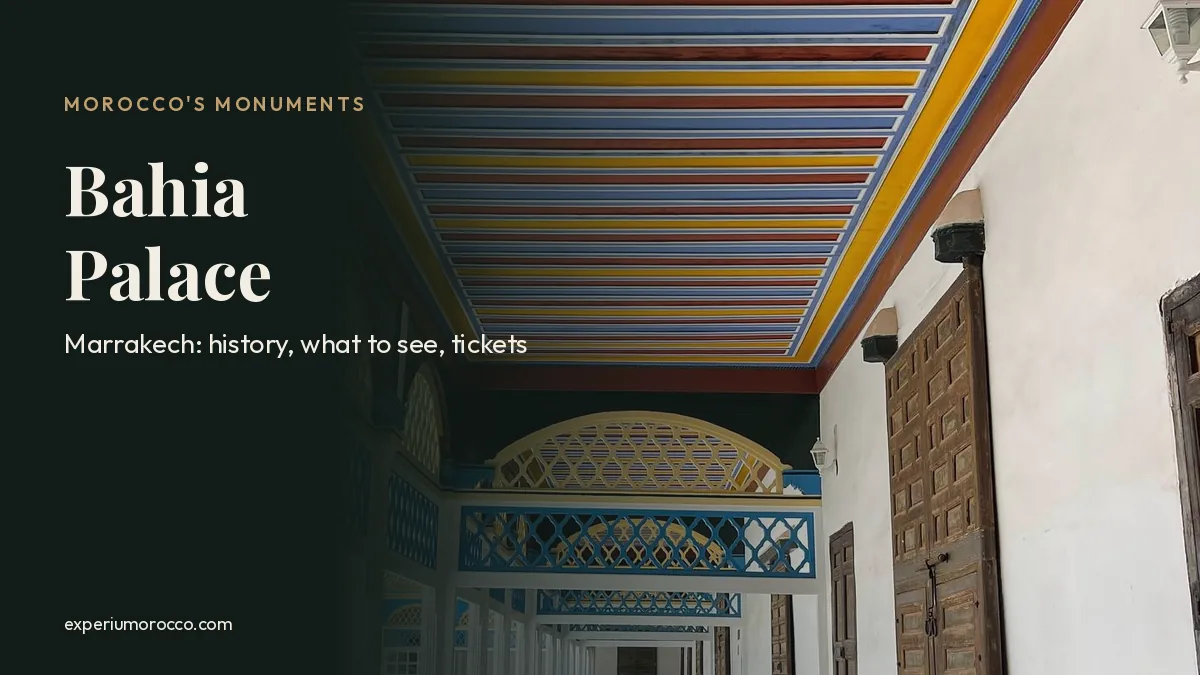
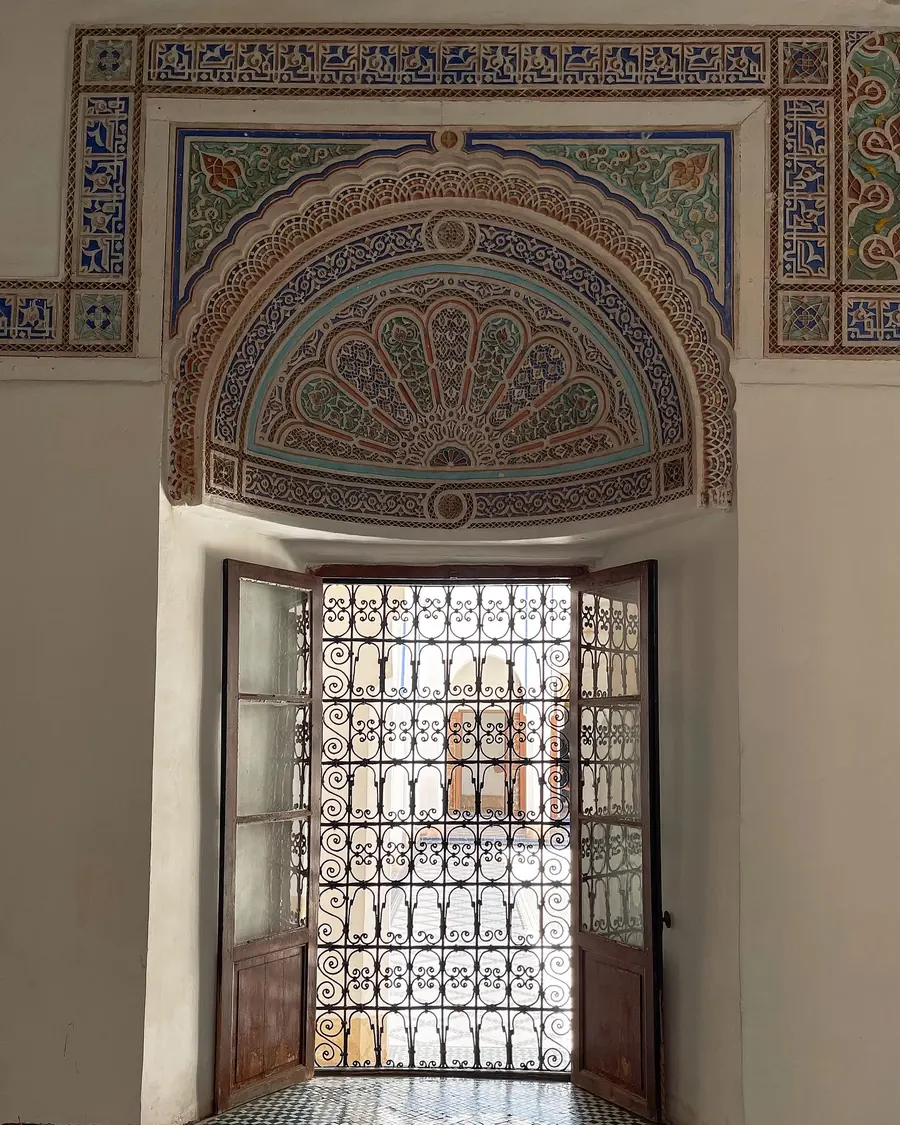
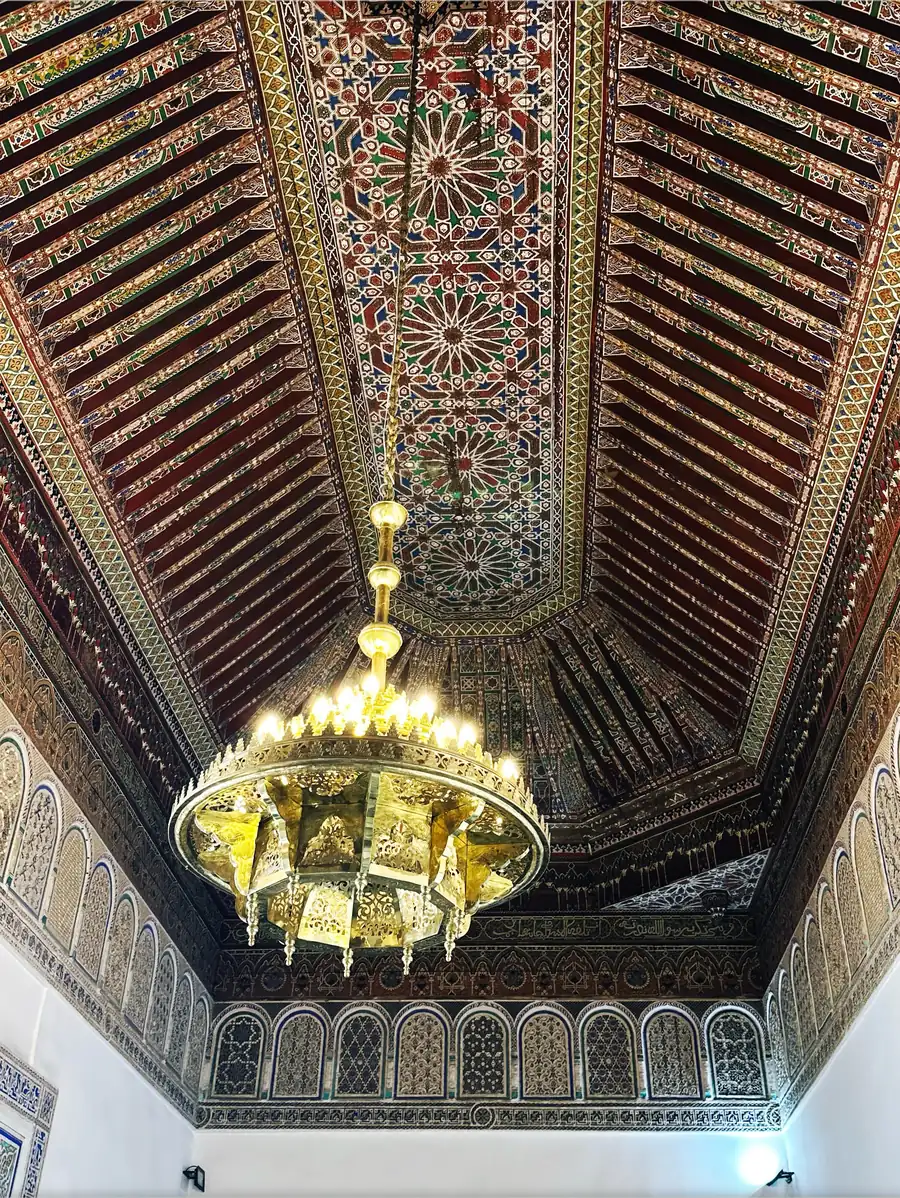
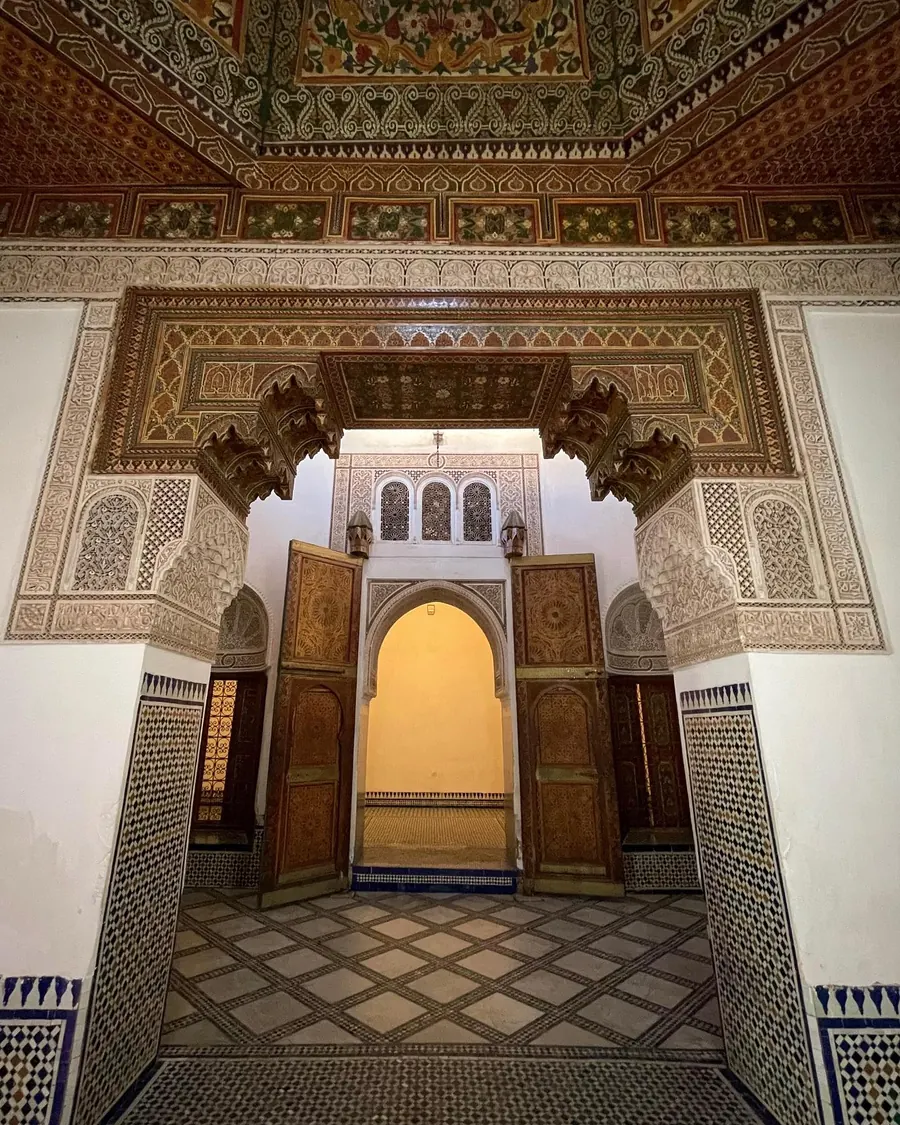
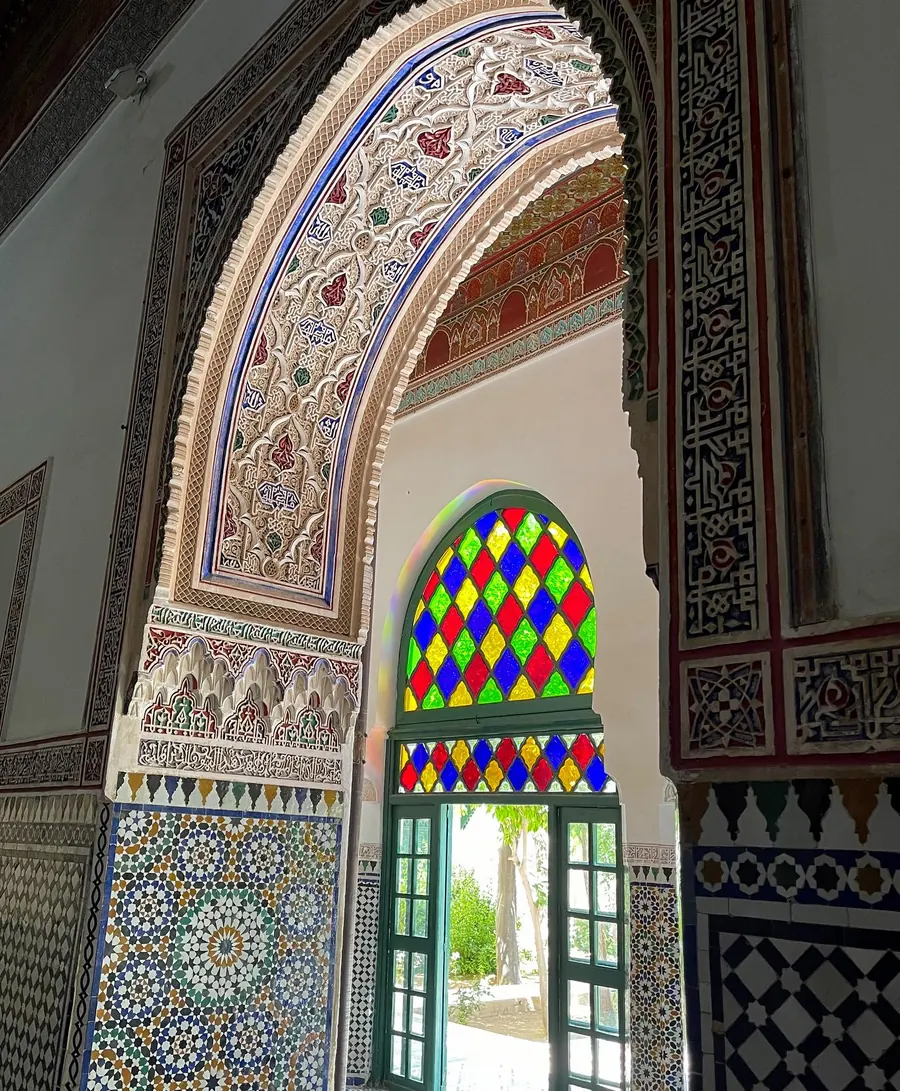
Reception rooms open off the courtyards. Look for three things: the painted cedar ceilings, sometimes with a central dome of muqarnas; the carved stucco door frames with inscriptions; and the high stained-glass windows that change the colour of the room as the day goes on.
How to read the decoration: zellige, stucco and cedar
Almost all of the Bahia’s decoration comes from three crafts that are still practised in Morocco. Zellige, a mosaic of hand-cut glazed tiles, covers floors and the lower walls. Carved stucco fills the middle of the walls with interlacing, plant motifs and calligraphy. Cedar wood, carved and painted, finishes the ceilings, doors and eaves.
Zellige patterns are never improvised: they start from geometric constructions drawn with a compass and a straightedge. The diagram shows how the most common figure, the eight-pointed star, comes to life.
- A circle, drawn with a compass.
- A square set inside the circle.
- A second square, turned 45 degrees.
- Together the two squares form an eight-pointed star.
- An octagon and a smaller star organise the centre.
- Each area is filled with single-colour pieces cut by hand.
Teaching diagram of a classic geometric construction; the palace patterns combine stars like this one with more complex ones. Original drawing by experiumorocco.com/.
Bahia Palace tickets and opening hours
Prices are set by a joint order of the Minister of Youth, Culture and Communication and the Minister Delegate for the Budget, published in Morocco’s Official Bulletin in June 2024. These are the rates shown today on the Ministry’s ticketing website:
| Visitor | Adult | Child (7 to 13) |
|---|---|---|
| Foreign | 100 MAD | 50 MAD |
| Moroccan or resident | 30 MAD | 10 MAD |
Indicative prices, subject to change. Moroccans get in free on Fridays and on the first day of national and religious holidays.
You can buy tickets at the gate or on the Ministry of Culture’s official platform, launched in April 2025, which lists visiting hours of 9am to 5pm.
Several websites pose as an “official site” of the Bahia Palace and resell tickets at a mark-up. The only public sales platform is the Ministry of Culture’s, on the minculture.gov.ma domain.
Is the Bahia Palace under renovation?
Partly, yes. The earthquake of 8 September 2023 cracked walls and caused a partial collapse in the grand riad and an upper-floor pavilion. After emergency work, the palace reopened to visitors on 9 October 2023. The Ministry then commissioned a study and, since 2024, has been restoring the structure, gardens and walls; in September 2025 the work was 30% complete, according to the official news agency MAP.
In practice you can visit, but some rooms may be closed, scaffolded or fenced off. If there is a particular area you want to see, ask at the ticket desk before going in.
Tips for visiting the Bahia Palace
- Getting there: it sits in the medina, in the Riad Zitoun el Jdid area next to the Mellah, about 850 metres (just over half a mile) as the crow flies from Jemaa el Fna square. Allow a good quarter of an hour on foot.
- When to go: first thing in the morning there are usually fewer groups, and the light reaches the courtyards before the marble starts to glare.
- How long: an hour covers the route; add half an hour if you like photographing ceilings.
- What to bring: water and a hat in summer, as the grand courtyard has no shade. Modest clothing is appreciated in the medina; our guide to Moroccan culture and etiquette explains why.
- With a guide: in the medina, tours are led by licensed city and circuit guides under Law 05-12. Our Marrakech guided city tour includes the Bahia.
The Bahia pairs well with the other sights in the south of the medina: El Badi Palace is about 550 metres away as the crow flies and the Saadian Tombs about 850. If it is your first time in the city, our guide to things to do in Marrakech covers the rest and how to fit it into two or three days. And if you enjoy places with a story, this series also covers the Cherratine Madrasa in Fez, built under the same Alaouite dynasty.
Bahia Palace or El Badi?
People mix them up. El Badi is a Saadian palace begun in 1578 by Sultan Ahmad al-Mansur and now in ruins: you visit its walls, pools and views. The Bahia, three centuries younger, still has its ceilings, stucco and zellige. If you only have time for one and care about decoration, choose the Bahia; if ruins and open space appeal more, El Badi.
Bahia Palace FAQ
How much is the Bahia Palace entrance fee?
The official rate is 100 MAD for foreign adults and 50 MAD for children aged 7 to 13, and 30 MAD and 10 MAD for Moroccans and residents. Prices are indicative.
What are the Bahia Palace opening hours?
The Ministry of Culture’s ticketing site gives 9am to 5pm. It is worth checking on public holidays and during Ramadan.
Can I buy Bahia Palace tickets online?
Yes, on the Ministry of Culture’s official platform, e-services.minculture.gov.ma. Tickets are also sold at the gate.
How long does a visit take?
About an hour for the full route, a little longer if you linger in the reception rooms.
Who built the Bahia Palace?
Grand vizier Si Moussa started the residence in the 1860s, and his son Ba Ahmed enlarged it between 1894 and 1900, with the architect Muhammad al-Mekki al-Misfiwi.
What does Bahia mean?
It comes from Arabic and means “the brilliant” or “the beautiful”.
Is the Bahia Palace worth visiting?
Yes, especially if you are interested in Moroccan craftsmanship: few places bring together so much zellige, carved stucco and painted cedar on such a short route.
Sources
- Ministry of Youth, Culture and Communication: Palais El Bahia, tickets and rates.
- Archnet (MIT and Aga Khan Trust for Culture): Bahia Palace.
- Morocco’s national portal (MAP): post-earthquake rehabilitation of Marrakech’s monuments (September 2025, in French).
- Ministry of Culture: statement on visitor numbers at heritage sites, January to April 2019.
- Joint order on entrance fees for historic monuments, Official Bulletin, June 2024.
- UNESCO World Heritage: Medina of Marrakesh.