


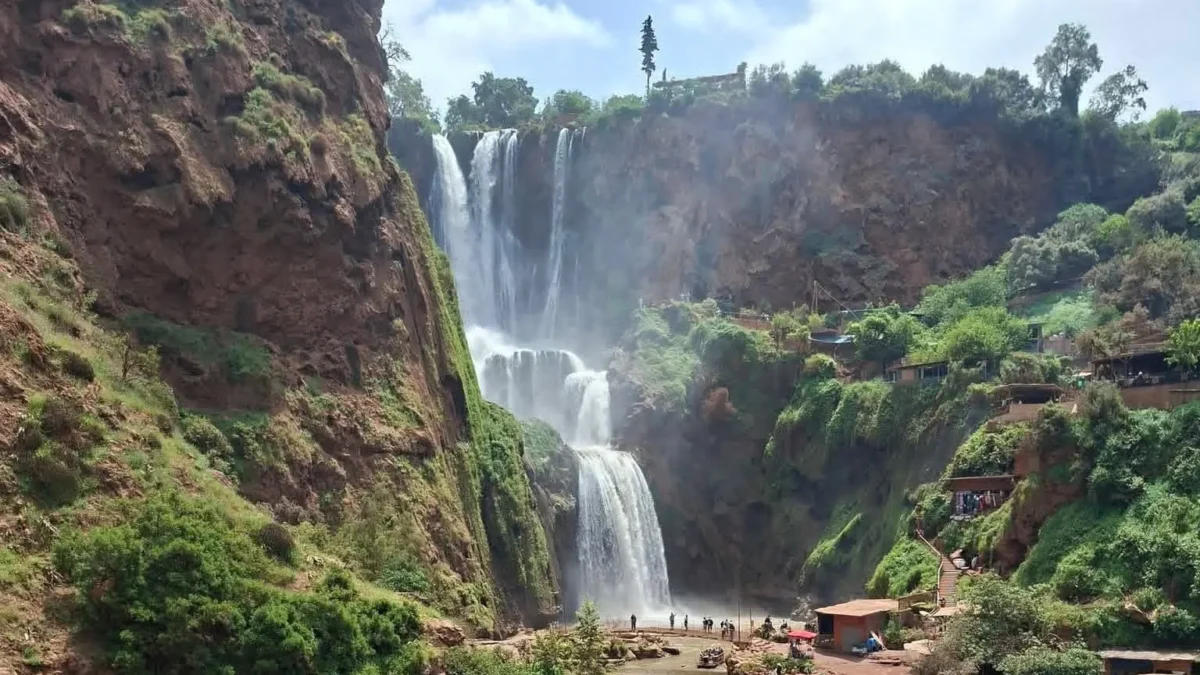
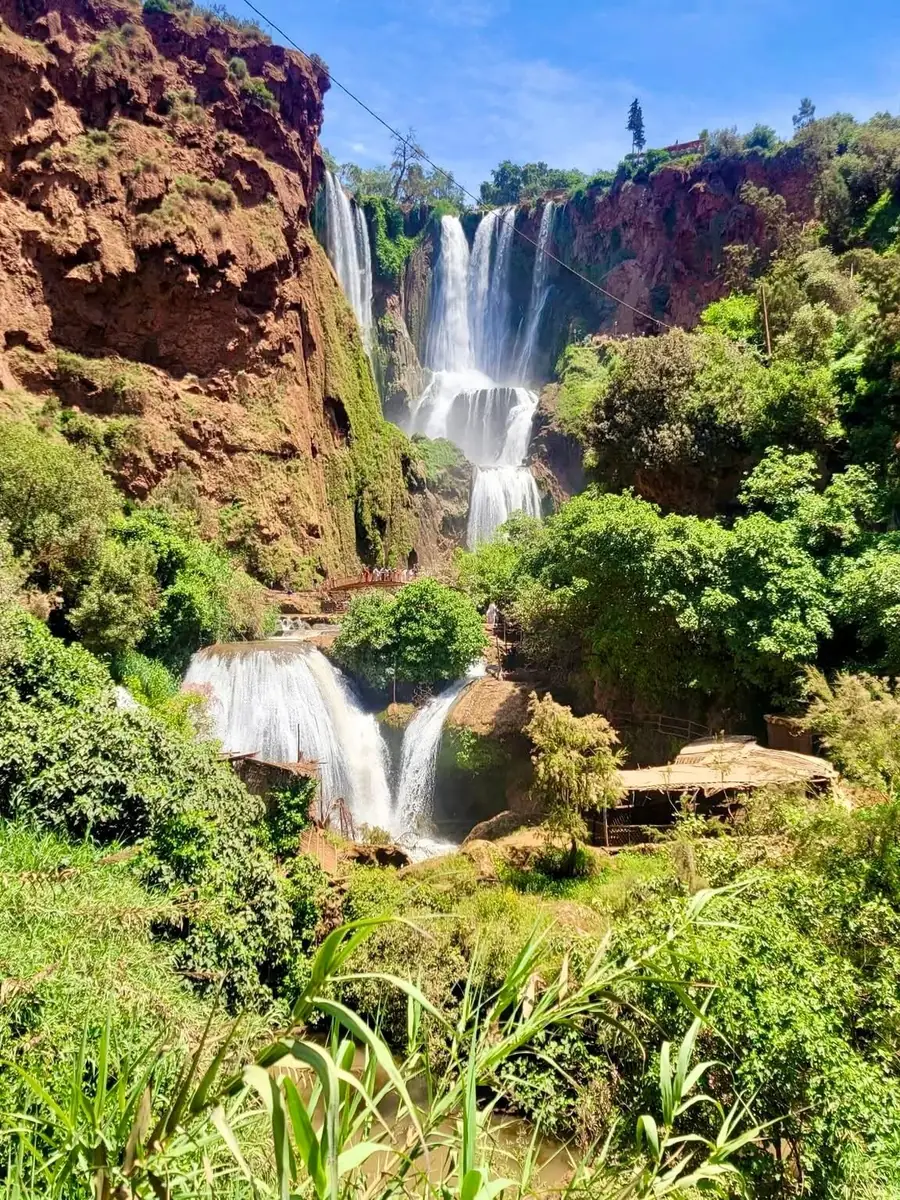
Ouzoud Falls are one of the most popular day trips from Marrakech, and for good reason: the main drop is about 110 metres (roughly 360 feet), tumbling down red cliffs in the central Atlas into green pools, with wild Barbary macaques in the trees around you. This guide explains where the waterfalls are, how they formed, what to do there and whether they beat the Ourika Valley, using scientific and official sources rather than hearsay.
Ouzoud is in Azilal province, about 150 km by road from Marrakech. The highest fall is about 110 metres, and the site is part of the M’Goun UNESCO Global Geopark. Expect pools, stepped paths, old water mills and Barbary macaques, an endangered species you should never feed. Wear shoes with real grip: there are plenty of steps and wet rock.
Where are Ouzoud Falls?
The falls sit in the central High Atlas, in Azilal province, part of the Béni Mellal-Khénifra region. On paper they belong to the rural commune of Ait Taguella, and the visitor area spreads between roughly 700 and 960 metres above sea level. From Marrakech it is about 150 km by road, heading northeast.
The water comes down the Ouzoud river, which geologists also call the Tissakht. Below the big drop it carries on through a red-walled ravine and joins the Oued El Abid, one of the main tributaries of the Oum Er-Rbia. The whole area lies inside the M’Goun Geopark, Morocco’s first UNESCO Global Geopark, designated in 2014, which lists Ouzoud among its geosites.
How high are Ouzoud Falls?
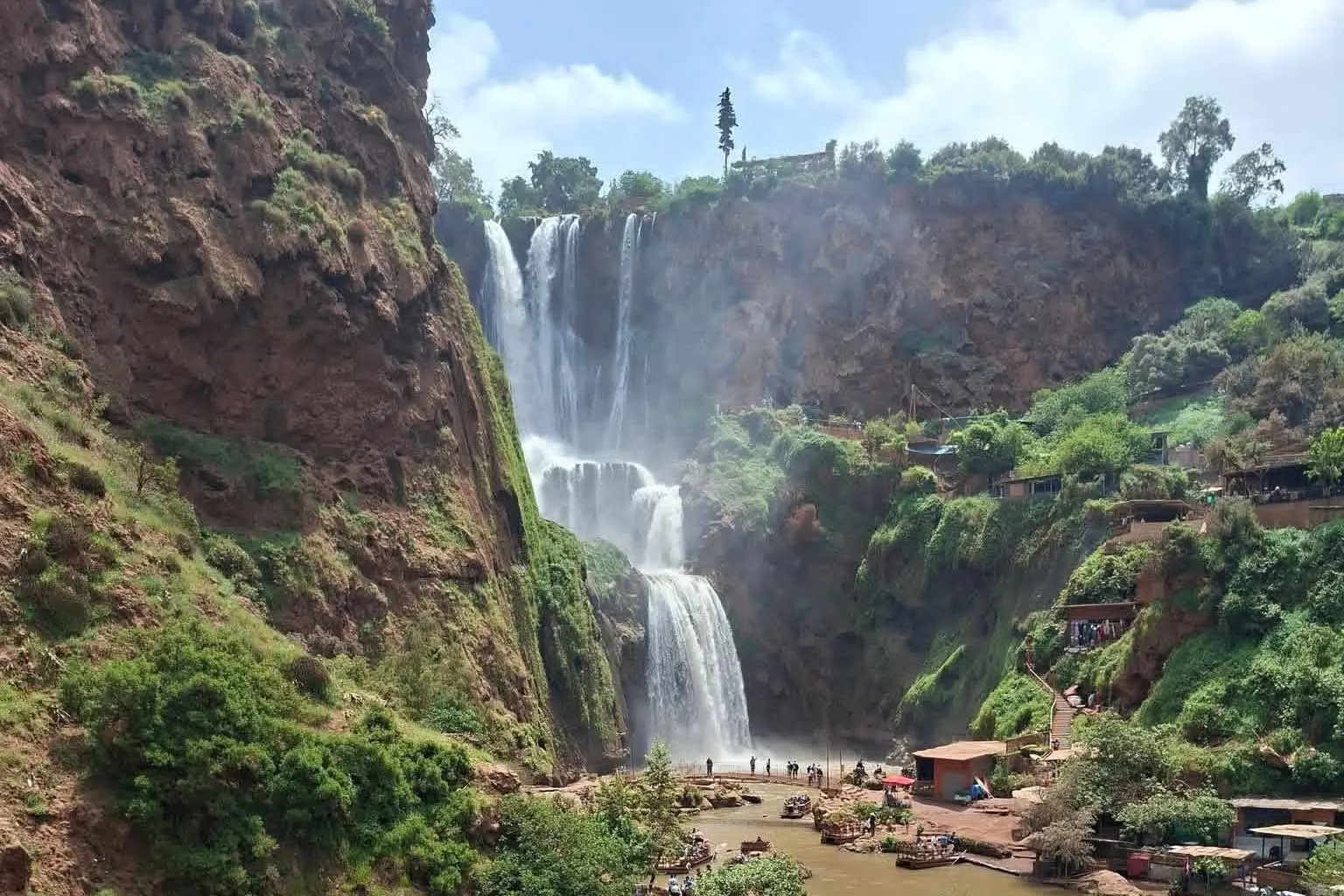
A 2022 study of the site’s geological heritage by researchers from Moroccan universities puts the most spectacular drop at about 110 metres. It is not one single column of water: the river splits into several streams and fills a series of basins that spill into one another, which is why you will see different figures depending on where and when people measure.
To picture 110 metres, set it next to two towers you probably know.
Ouzoud: Louz et al., 2022. Elizabeth Tower: UK Parliament. Koutoubia: Marrakech-Safi Regional Tourism Council. 1 metre is about 3.3 feet.
In other words, the water at Ouzoud drops further than the full height of the tower that holds Big Ben, and a good deal further than the Koutoubia minaret, the 77-metre landmark that rises above Marrakech’s medina.
How the falls formed: springs and travertine
What makes Ouzoud unusual is not only its height but the rock the waterfall builds for itself. The river is fed by karst springs. Rainwater soaks into Lower Jurassic limestone, travels through the mountain and comes back out through 22 separate outlets, loaded with dissolved calcium carbonate.
When that water churns over the edge it loses carbon dioxide, and the carbonate settles on the cliffs. The result is travertine, a porous stone that coats the older limestone layer after layer. In the oldest deposits you can still make out the imprints of leaves, roots and twigs that got trapped in it. So the falls are not just wearing the cliff away; they are also adding to it.
The monkeys of Ouzoud: Barbary macaques
For many visitors the monkeys are the highlight. They are Barbary macaques (Macaca sylvanus), the only wild primate in North Africa. The IUCN has listed them as Endangered since 2008, and in 2016, on a proposal from Morocco and the European Union, they were moved to CITES Appendix I, the highest level of protection in international trade. Catching or selling them is illegal in Morocco.
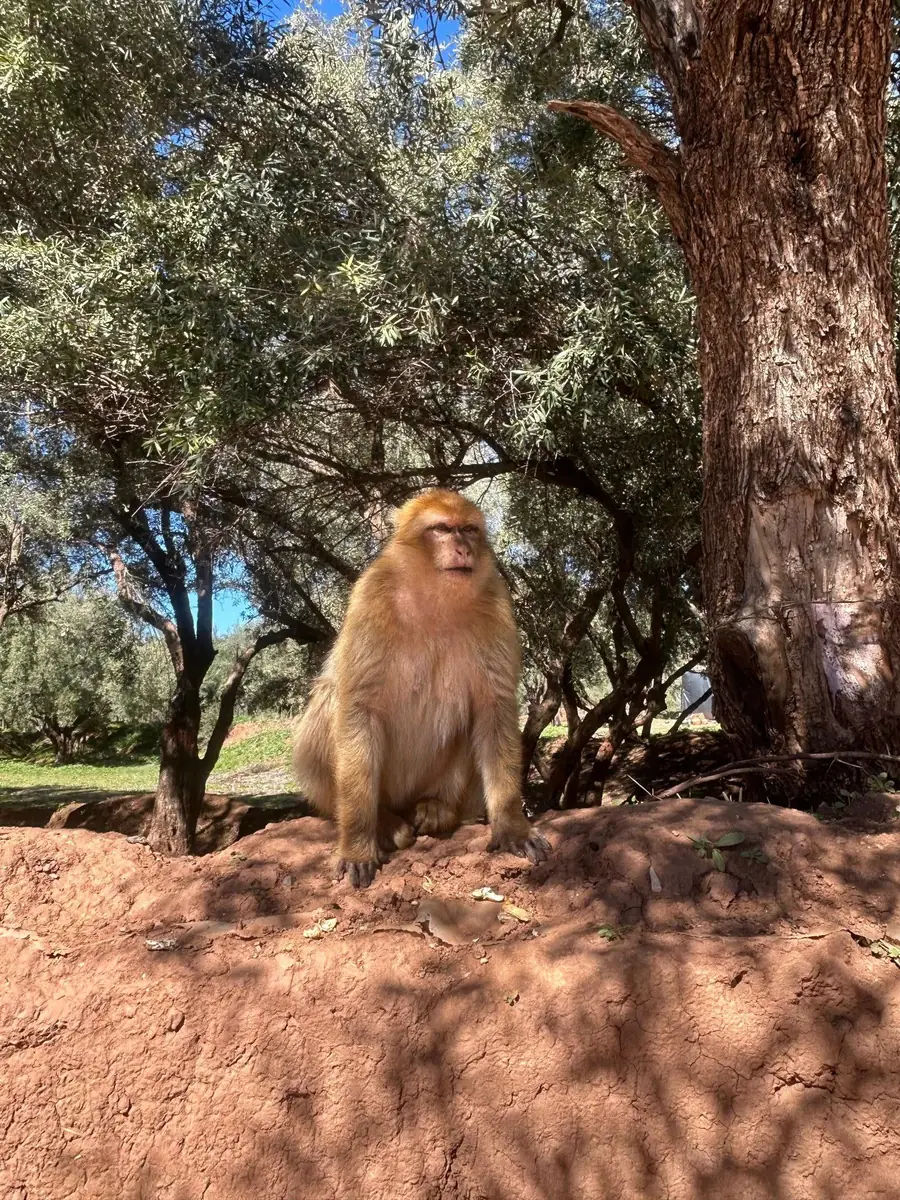
At Ouzoud the macaques are used to people, and that is exactly the problem. A long-term study of one group at the falls, published in the Revue de Primatologie, found that human food accounted for around 21 % of the time they spent feeding. That diet harms their health and makes conflicts with people more likely.
Even if you see other visitors doing it, researchers and conservation bodies advise against feeding the macaques. Watch them from a distance, keep food out of reach and zip up your bags.
The old water mills
Near the top of the falls you will find small traditional mills that use the speed of the water to grind grain. They are simple huts built over channels, and the researchers who catalogued Ouzoud’s heritage count them as part of its cultural value alongside the waterfall itself. Most people walk straight past them, so it is worth slowing down to watch one turn.
Things to do at Ouzoud Falls
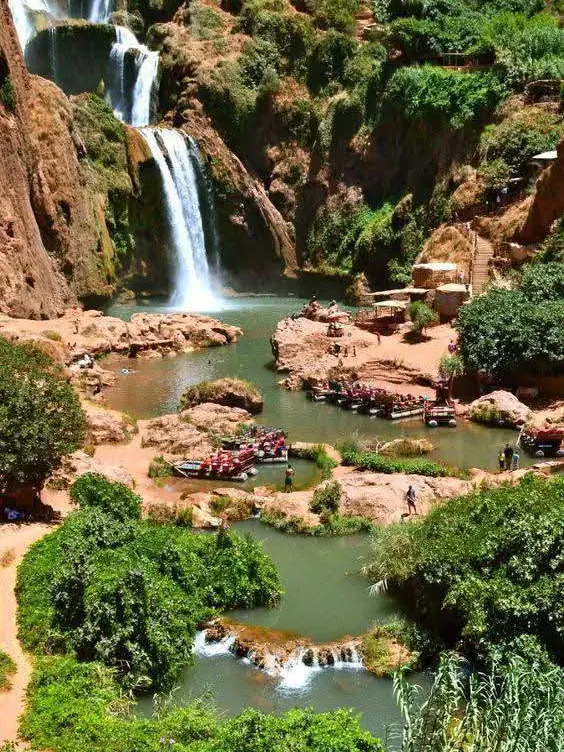
A visit is mostly a walk. From the top, paths and steps lead down to the foot of the falls and around the ravine, with viewpoints along the way.
- Walk down to the base: only from below do you really feel the height, and the spray.
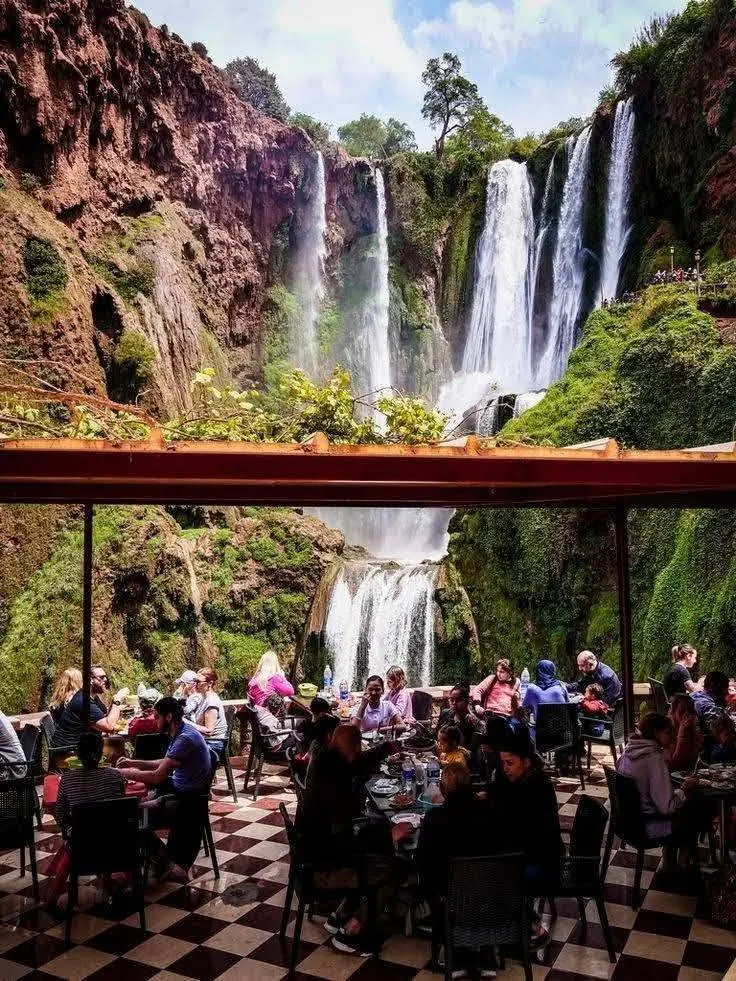
- Find a viewpoint facing the falls: from the opposite side of the ravine you get the full picture, the best one for photos.
- Look for the mills and the travertine: two details most visitors miss.
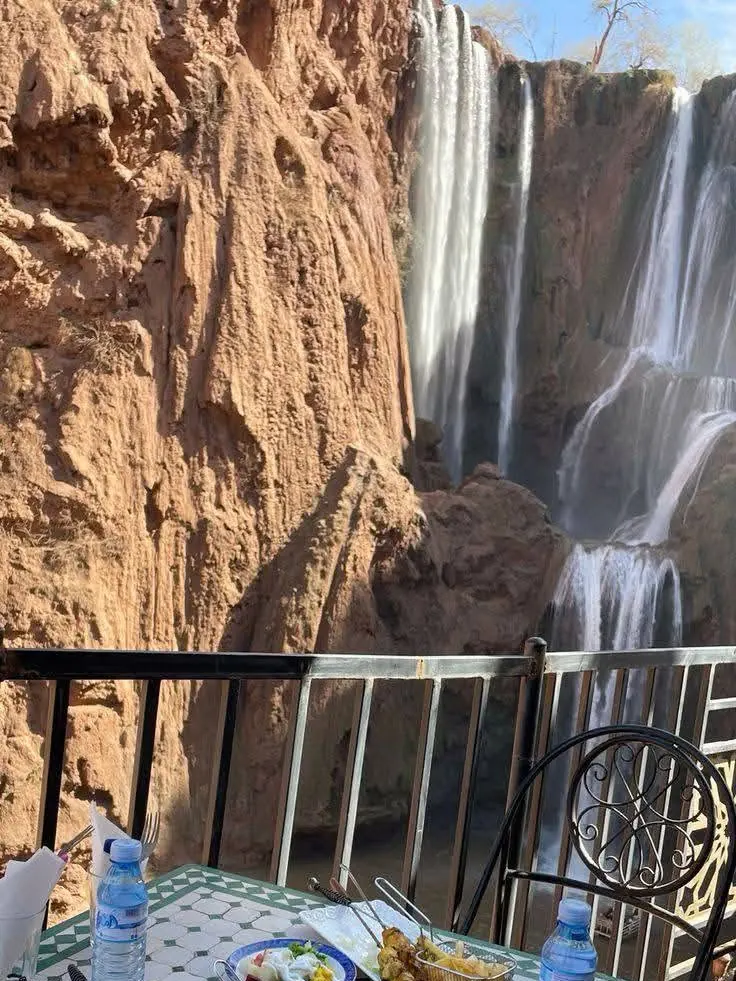
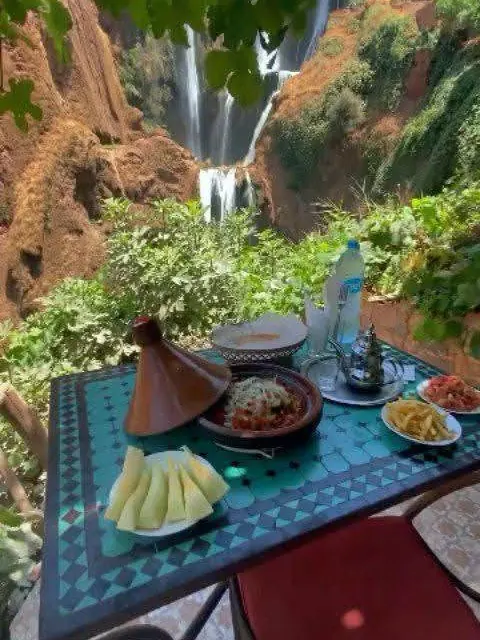
- Have lunch with a view: small restaurants and stalls with terraces overlook the ravine.
- Take a dip: in summer plenty of people swim in the pools. Only go in where the water is calm, and never under the falling water.
On an organised trip you usually explore the site with a local guide first. Our Ouzoud Falls day trip from Marrakech, for example, starts with a 90-minute guided walk before some free time by the water.
Best time to visit Ouzoud Falls
The area has a semi-arid, Mediterranean-type climate: rain comes irregularly in autumn and winter, and summers are dry. That drives the flow. After a wet winter, spring usually brings the fullest falls and the greenest scenery. In summer the water is calmer, yet that is when the site is busiest, because the ravine and the pools are a cool escape from the heat.
- Spring: the best mix of water, temperature and scenery.
- Summer: great for a swim, but arrive early to beat the heat on the road and the midday crowds.
- Autumn and winter: fewer visitors; after heavy rain the water can turn muddy and the paths get slippery.
If you are planning the rest of your stay too, our guide to Marrakech weather by month has the numbers for every season.
Ouzoud Falls or the Ourika Valley?
This is the question most people ask, and the two are quite different. Ourika is a High Atlas valley much closer to Marrakech, with Amazigh villages, terraced fields and a walk up to a series of smaller waterfalls at Setti Fatma. Ouzoud is further away but gives you one big, far higher waterfall.
- Choose Ouzoud if you want the most impressive waterfall, fancy a swim in summer and don’t mind more time on the road.
- Choose Ourika for a shorter day with more village life and a mountain walk. Our Ourika Valley guide covers it in detail.
How to get to Ouzoud Falls from Marrakech
The route leaves Marrakech on the national road towards Béni Mellal and Fes, crosses towns and villages on the plain, then climbs towards Azilal. It is about 150 km each way, so plan on a full day: an early start, a few hours on the road, the visit, and the drive back in the afternoon.
A short packing list:
- Closed shoes with good grip: there are lots of steps and wet sections.
- Swimwear and a towel if you plan to get in the water.
- Water, a hat and sunscreen, especially from May to September.
- Cash for lunch and small expenses. If you don’t have dirhams yet, read our guide to Moroccan currency.
Ouzoud Falls FAQ
How tall are Ouzoud Falls?
The main drop is about 110 metres (around 360 feet), according to a 2022 geological survey of the site. The water splits into several streams and stepped pools.
Where are Ouzoud Falls located?
In the central High Atlas, in Azilal province (Béni Mellal-Khénifra region), about 150 km by road from Marrakech.
Can you swim at Ouzoud Falls?
Many people swim in the river pools, mostly in summer. Stick to calm water away from the falls and currents, and stay out after heavy rain.
Are there monkeys at Ouzoud Falls?
Yes, Barbary macaques, listed as Endangered by the IUCN. You can see them up close, but you should not feed them.
Ouzoud Falls or Ourika Valley: which is better?
Ouzoud has the taller, more dramatic waterfall; Ourika is closer to Marrakech and mixes village life with a mountain walk. It depends on how much time you have and what you are after.
Is Ouzoud worth a day trip from Marrakech?
Yes, it is one of the classic full-day trips. Leave early so you can walk the paths without rushing.
Sources
- Louz E. et al. (2022): Inventory and Enhancement of Geological Heritage in the Ouzoud Syncline (M’Goun UNESCO Geopark), Proceedings 87(1).
- Global Geoparks Network: M’Goun Geopark report.
- CITES: CoP17 Prop. 13 on Macaca sylvanus (Morocco and the European Union, 2016).
- El Alami A. and Chait A.: feeding ecology of Barbary macaques at Ouzoud Falls, Revue de Primatologie.
- UK Parliament: Big Ben facts and figures.
- Marrakech-Safi Regional Tourism Council: Koutoubia Mosque.