


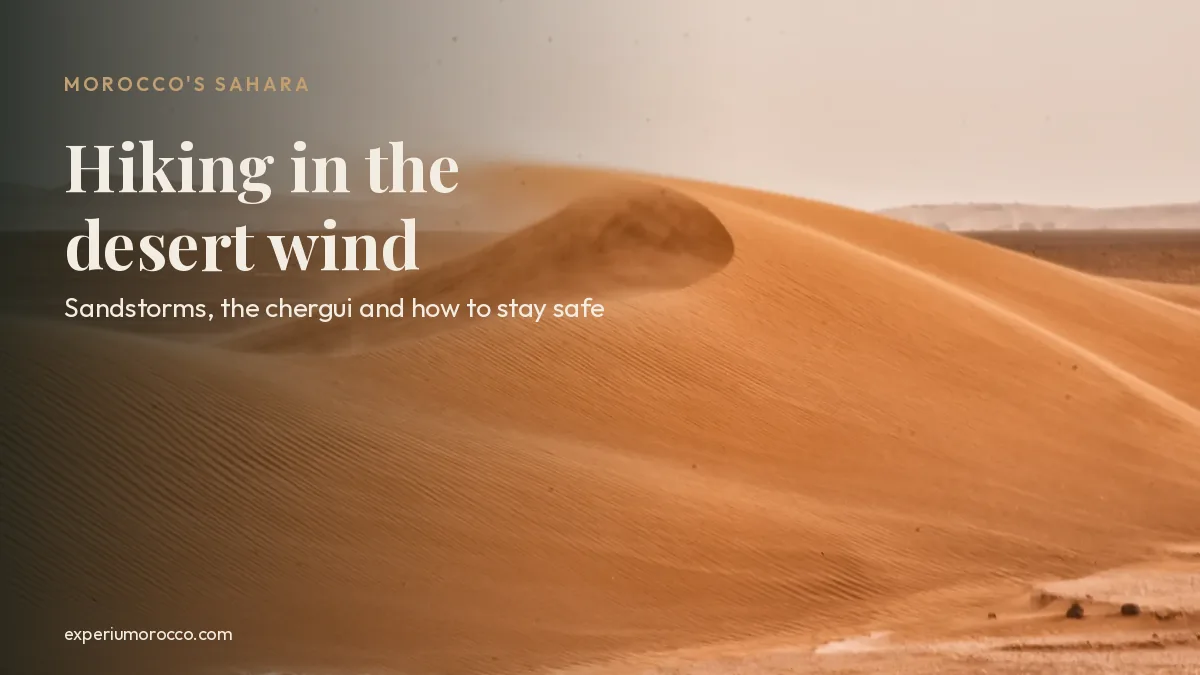
In the desert, the wind is in charge. It can be a gentle breeze drawing ripples in the sand or a sandstorm that wipes out the horizon and stops you in your tracks. If you are hiking across the dunes of the Sahara, knowing when it blows, where it comes from and how to protect yourself is the difference between a rough hour and a story worth telling. This guide brings together official data on the wind in southern Morocco and practical advice for walking, and resting, when the sand starts to fly.
In Morocco’s Sahara the wind is strongest in spring: NASA data show that April and May are the windiest months at Merzouga and M’Hamid, while December and January are the calmest. If a sandstorm catches you on foot, stop, regroup, cover your mouth and nose with a desert scarf, protect your eyes and wait with your back to the wind until you can see again.
PhotosAll the photos in this guide were taken by Mustapha AIT ISHA, licensed tour guide, on our desert routes in Morocco.
What is a sandstorm in the Sahara Desert?
A sandstorm happens when the wind blows hard enough to lift loose sand and fill the air with particles. Sand is heavy, though. According to the US Geological Survey (USGS), grains travel in short hops that normally rise no more than a centimetre above the ground. That is why the first thing you notice when the wind picks up is a river of sand streaming around your ankles and shins. In stronger winds the sand climbs to face height, while the finest dust, far lighter, hangs in the air and dims the light.
That fine dust is what travels long distances. The World Meteorological Organization estimates that around 2 billion tonnes of dust enter the atmosphere every year, and lists the Sahara among the main sources on the planet. According to the World Health Organization, Saharan dust regularly crosses the Atlantic all the way to the Caribbean.
The chergui: Morocco’s desert wind
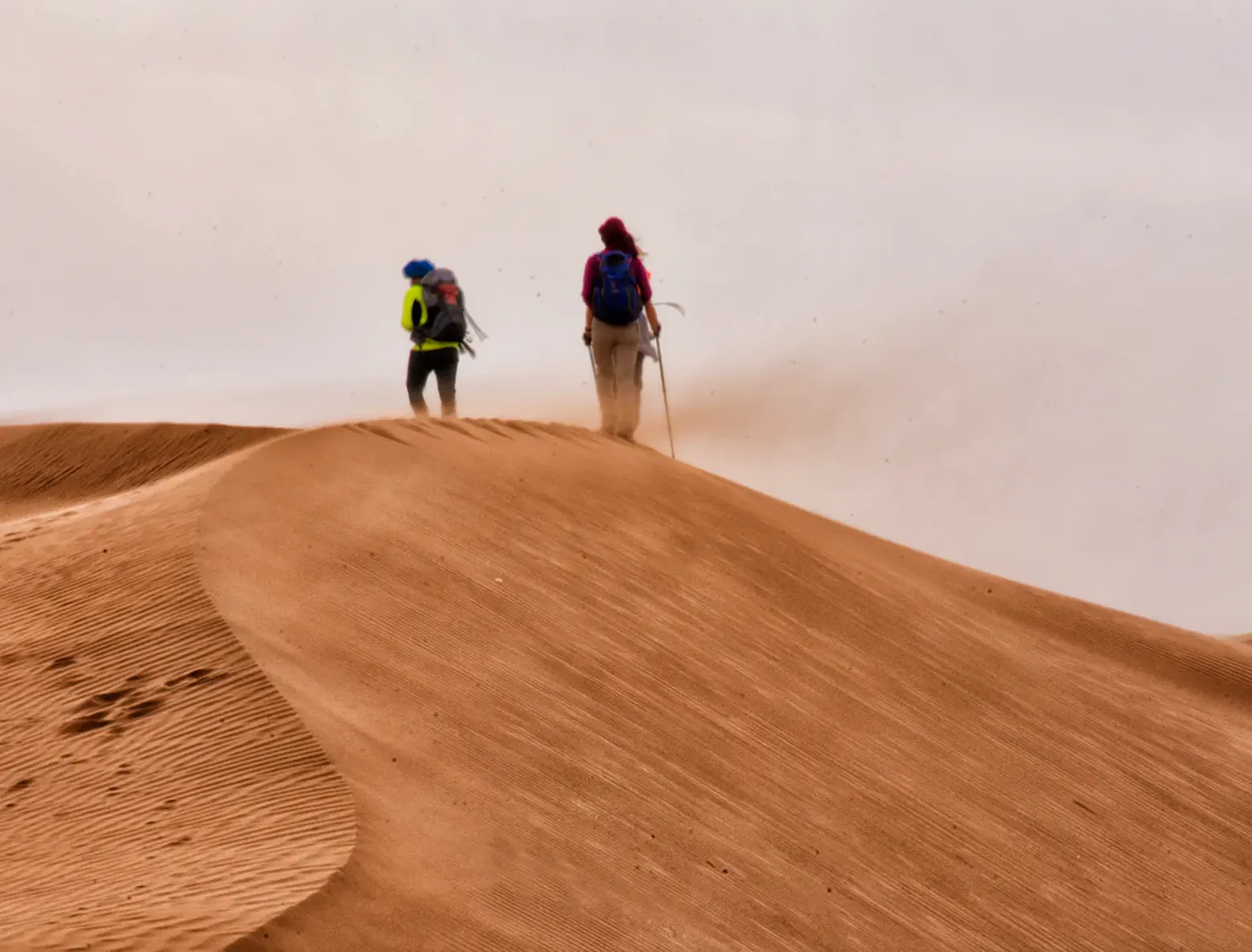
In Morocco, the desert wind has a name of its own: the chergui, from the Arabic for “eastern”. The American Meteorological Society’s glossary describes it as an east or southeast wind that is dry, dusty and persistent, hot in summer and cold in winter. It is most common in the forty days after mid-July, the stretch Moroccans call the smaïm.
- Direction: from the east or southeast.
- Character: dry, dusty and persistent.
- Temperature: hot in summer, cold in winter.
- Most frequent: about 40 days from mid-July, the smaïm.
Source: American Meteorological Society, Glossary of Meteorology.
When is the Sahara windiest? Month-by-month data
To answer with figures rather than impressions, we looked at the climate data from NASA’s POWER project, which calculates the average wind for each month from 25 years of data, 2001 to 2025. These are the values 10 metres above the ground next to Morocco’s two great seas of dunes: Merzouga, at the foot of Erg Chebbi, and M’Hamid, the gateway to Erg Chigaga.
- Merzouga (Erg Chebbi)
- M’Hamid (Erg Chigaga)
Monthly averages for 2001-2025 from reanalysis data (MERRA-2). These are model values, not weather station readings. 1 km/h is about 0.62 mph. Source: NASA POWER project.
See the month-by-month data
| Month | Merzouga | M’Hamid |
|---|---|---|
| January | 12.7 | 12.6 |
| February | 14.2 | 13.7 |
| March | 15.6 | 14.9 |
| April | 17.2 | 16.1 |
| May | 17.7 | 16.5 |
| June | 16.9 | 16.1 |
| July | 15.6 | 15.2 |
| August | 15.0 | 14.7 |
| September | 15.0 | 14.9 |
| October | 13.9 | 13.4 |
| November | 13.4 | 12.9 |
| December | 12.4 | 12.4 |
The pattern is clear and almost identical in both places. The wind starts to rise in February, peaks in April and May at an average of about 17 to 18 km/h (11 mph) in Merzouga, then eases off until December and January, the calmest months, at about 12 to 13 km/h (8 mph). These are averages: any given day can be dead calm or bring gusts far stronger than these figures.
If you want as little wind as possible, autumn and winter work in your favour. If you are travelling in spring, there is no need to change plans; just go prepared and know what to do when the sand starts to move. Still deciding where to go? Our guide to desert trips from Marrakech compares the options.
Hiking the dunes in the wind: what changes
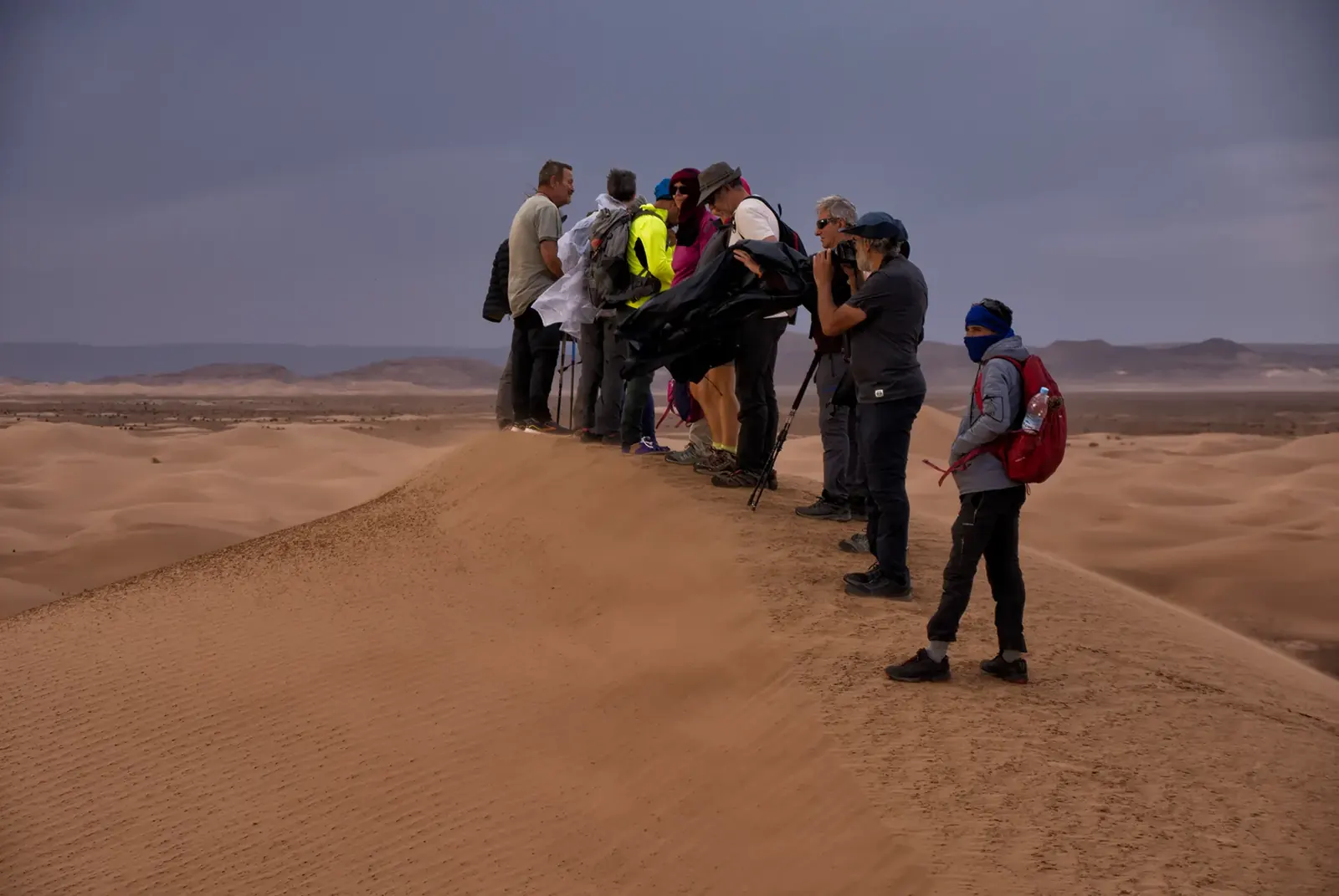
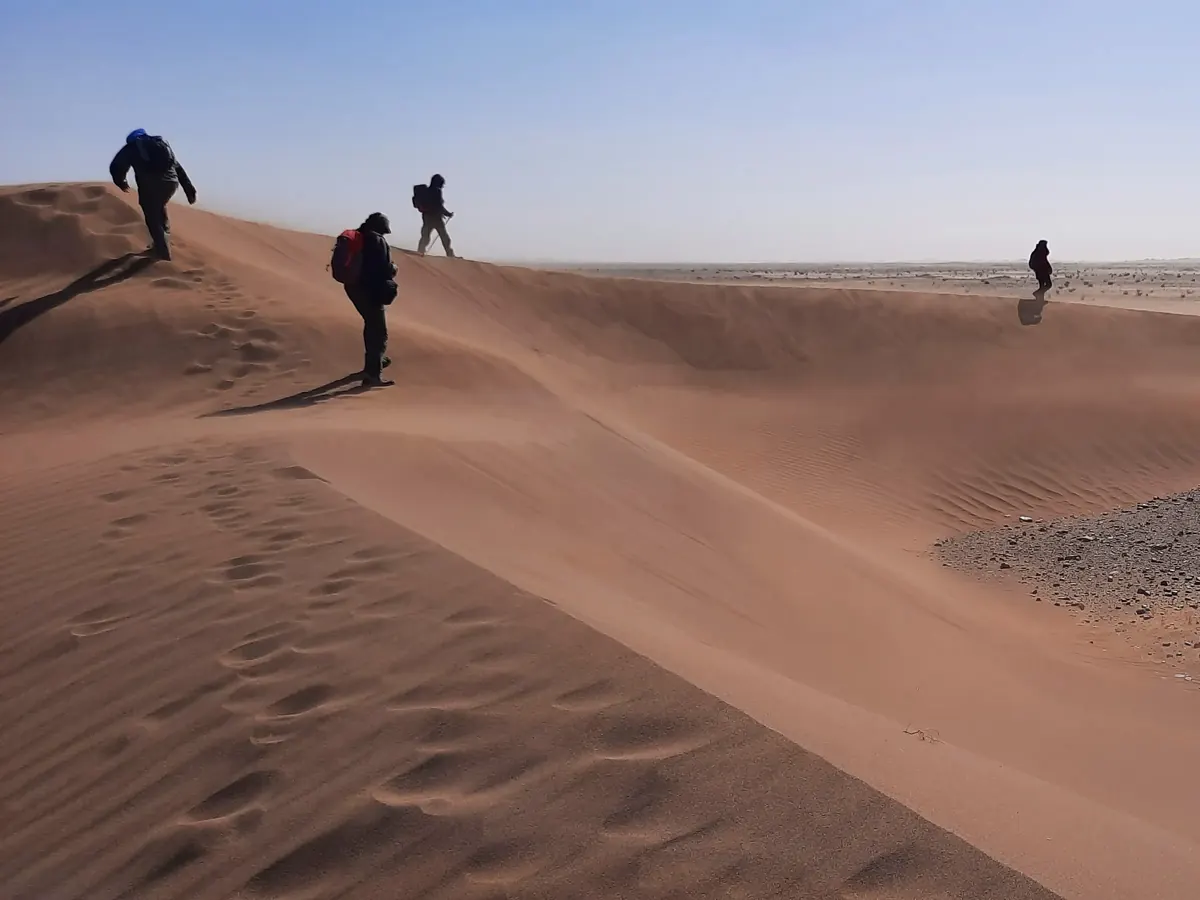
In the wind, a dune becomes a different kind of terrain. Along the crests it blows hardest, tearing sand off in plumes you can see from far away, while the hollows between dunes are usually calmer. Footprints vanish almost at once, so following the tracks of whoever is ahead stops being an option: the group has to walk together and within sight of each other.
Sand streaming along the ground stings your legs and gets into your shoes, and when the wind strengthens it reaches your face. So the best protection is coverage rather than warmth: long trousers, high socks or gaiters, glasses that seal at the sides and something to pull over your mouth and nose. If you want to know how dunes form and why they keep changing shape, our guide to Sahara Desert landscapes explains it.
How to tie a desert scarf (Tuareg-style turban)
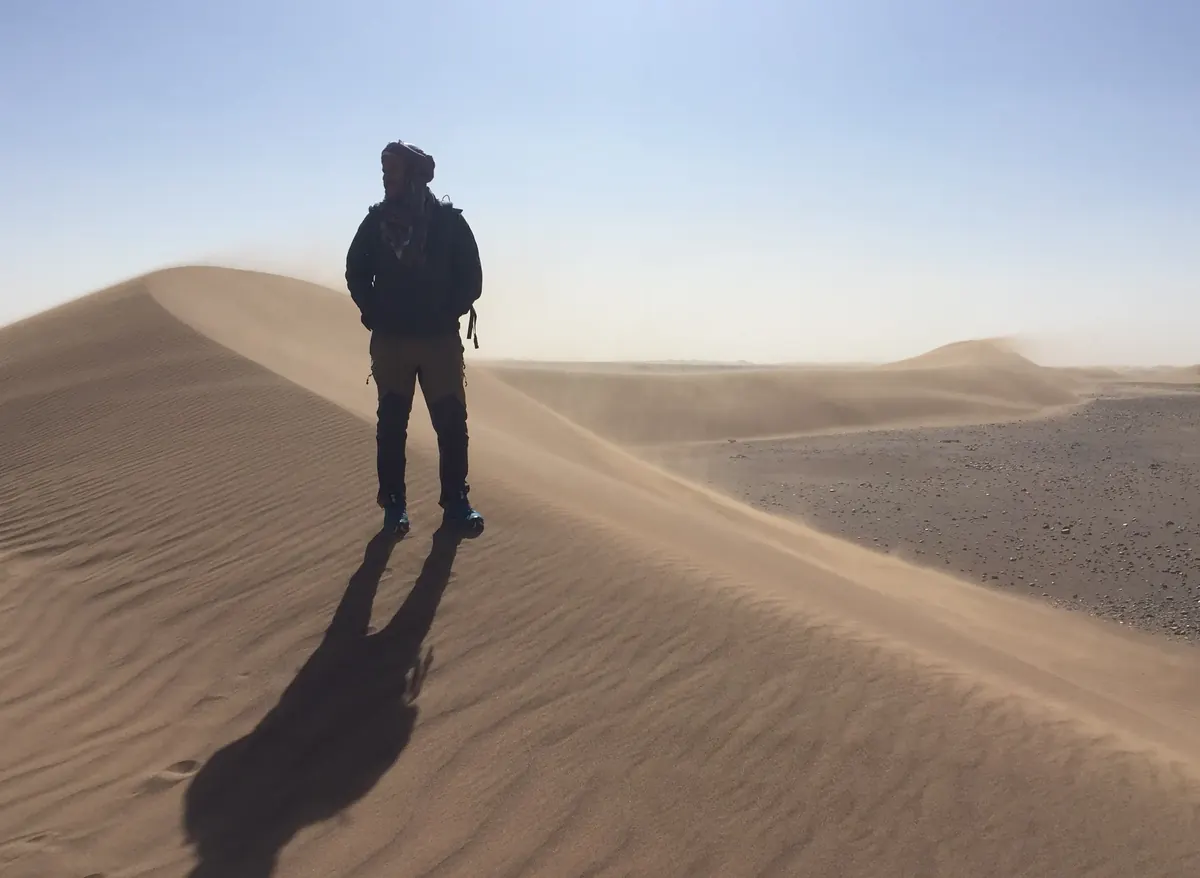
The turban worn by the peoples of the Sahara is not a costume for photos. It is the most practical tool you can have against wind and sun. A long piece of cotton shades your head from the heat and, with one movement, comes up over your mouth and nose when the sand starts flying. There are many ways to tie it; this is one of the simplest.
- Prepare the cloth. Use a long, light cotton cloth. If it is very wide, fold it lengthwise into a band.
- Leave one end hanging. Rest the cloth on your head and let a long section hang down one side to chest height.
- Wrap it. Take the rest around your head, across the forehead and the back of the neck, two or three times, without pulling too tight.
- Tuck it in. Push the loose end under the wraps so it stays in place.
- Cover your face when needed. Bring the hanging section up across your mouth and nose and tuck it under the wraps on the other side. You can drop it again when the wind dies down.
Wraparound sunglasses or ski goggles complete the kit. If you wear contact lenses, bring your glasses too: with sand in the air, contacts can quickly become torture.
What to do in a sandstorm on foot
A sandstorm rarely arrives without warning: the horizon turns yellowish, the wind rises and sand starts running across the ground. If it happens mid-hike, the priority is to stay together and not keep walking blind.
- Stop and regroup. Nobody goes ahead or falls behind. In poor visibility, a few metres are enough to lose sight of the group.
- Get off the crest. The wind is strongest at the top of a dune; a little further down, on the sheltered side, it is easier.
- Cover up. Scarf over your mouth and nose, glasses on, hood up if you have one.
- Sit with your back to the wind. Put your phone, camera and documents in sealed bags.
- Drink and wait. Follow your guide’s instructions and only set off again when you can see clearly.
During dust episodes, Spain’s Ministry of Health advises people with chronic respiratory diseases to avoid long periods outdoors, keep their usual medication close, drink plenty of fluids and avoid strenuous exercise while it lasts. If that applies to you, talk to your doctor before you travel and let your guide know.
What to pack for hiking in desert wind
Tick off what is already in your bag. Nothing is saved; it is just a quick way to check before you set off.
And if you are spending the night in the desert, our guide to a night in a Sahara desert camp tells you what to expect.
Sandstorms in the Sahara: FAQ
Is a sandstorm in the desert dangerous?
For hikers, the main risk is losing visibility, which can split a group up. That is why you stop, regroup and wait. Dust also affects respiratory and cardiovascular health, according to the WHO, so people with asthma or other lung conditions should take extra care.
When do sandstorms happen in Morocco?
They can happen at any time of year, but the wind is strongest in spring. NASA data show that April and May are the windiest months at Merzouga and M’Hamid, and December and January the calmest.
What is the chergui wind?
It is Morocco’s desert wind: it blows from the east or southeast, it is dry and dusty, hot in summer and cold in winter, and it is most frequent in the forty days after mid-July.
How do you tie a desert scarf?
Let one end hang down, wrap the rest around your head two or three times and tuck the loose end in. When the wind blows, bring the hanging end up over your mouth and nose.
What should you do if you are caught in a sandstorm on foot?
Stop, regroup, get off the dune crest, cover your mouth, nose and eyes, sit with your back to the wind and wait until visibility returns before moving on.
What is the best time to visit the Sahara in Morocco to avoid wind?
Autumn and winter. December and January have the lowest average wind speeds of the year at Merzouga and M’Hamid, while April and May have the highest.