


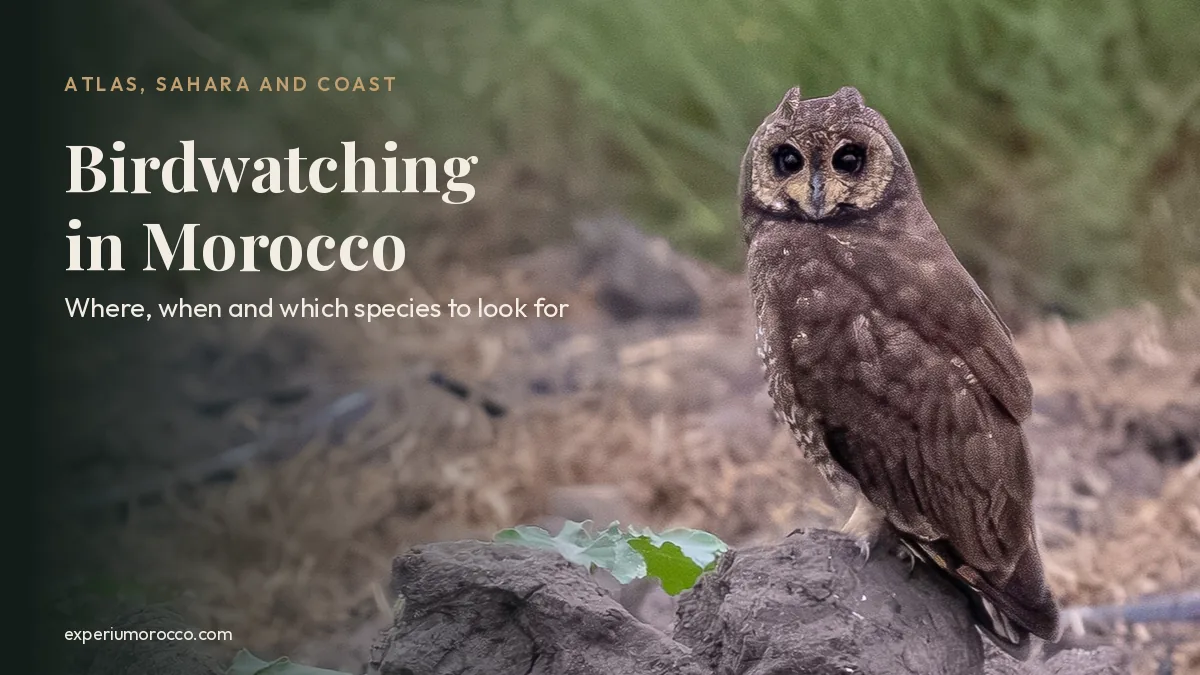
Birdwatching in Morocco packs high mountains, stony desert, Saharan dunes, oases and Atlantic wetlands into a few days’ drive. On a single trip you can go from African Crimson-winged Finches on the High Atlas tops to Thick-billed Larks on the hamada and Desert Sparrows at Merzouga. This guide covers where each target species lives, which months to look for it and how to do it without disturbing anything.
The best birding areas in Morocco are the High Atlas (Oukaïmeden), the hamada around Boumalne Dadès (the Tagdilt track), the desert at Merzouga, Souss-Massa National Park, the last real stronghold of the Northern Bald Ibis, and the wetlands of the north. The best season is February to May, with autumn migration a close second.
Why birdwatching in Morocco is worth the trip
Morocco sits where Europe meets Africa, and its birds show it. Every spring and autumn huge numbers of migrants pass along the Atlantic coast and across the Strait on their way to and from the Sahara. On top of that come species you will not see in Europe: Maghreb specialities found only in northwest Africa, and desert birds at the northern edge of their range.
For a birder from the UK or North America, the word that matters is “lifers”. A first week here can deliver a long list of new species, because the scenery changes every few hours on the road: from Atlas peaks above 4,000 metres to steppe, from steppe to dunes, and from the dry interior to a coast of lagoons and estuaries. That variety, more than a raw species count, is what makes the birds of Morocco so rewarding.
- Maghreb specialities: Moussier’s Redstart, Maghreb Magpie, Levaillant’s Woodpecker, Tristram’s Warbler and the African form of Crimson-winged Finch, restricted to the Atlas.
- Desert specialists: hamada larks, Cream-coloured Courser, sandgrouse, Desert Sparrow and Egyptian Nightjar.
- A conservation story: the Northern Bald Ibis, whose wild population now lives almost entirely on Morocco’s Atlantic coast.
Where to go birding in Morocco
High Atlas: Oukaïmeden and the valleys
Oukaïmeden is a High Atlas ski station reached from Marrakech on a winding mountain road. Up top, on the pastures and scree around the car park and the small reservoir, lives the bird most people come for: the African Crimson-winged Finch, a pinkish finch that feeds in flocks and often lets you get close. It shares the plateau with Red-billed and Alpine Choughs, Rock Sparrows, the Atlas race of Horned Lark and, in spring, Seebohm’s Wheatear.
The drive up is part of the birding. Woods and orchards in the valleys hold Levaillant’s Woodpecker and Moussier’s Redstart, the Atlas bird everyone wants, with its orange breast and white headband. If you want to mix birds with walking, our Atlas Mountains trekking guide helps you pick an area.

In winter, snow can close or slow the road to Oukaïmeden and bury the meadows where the birds feed. Check road conditions the day before.
The Boumalne Dadès hamada: Tagdilt and Imider
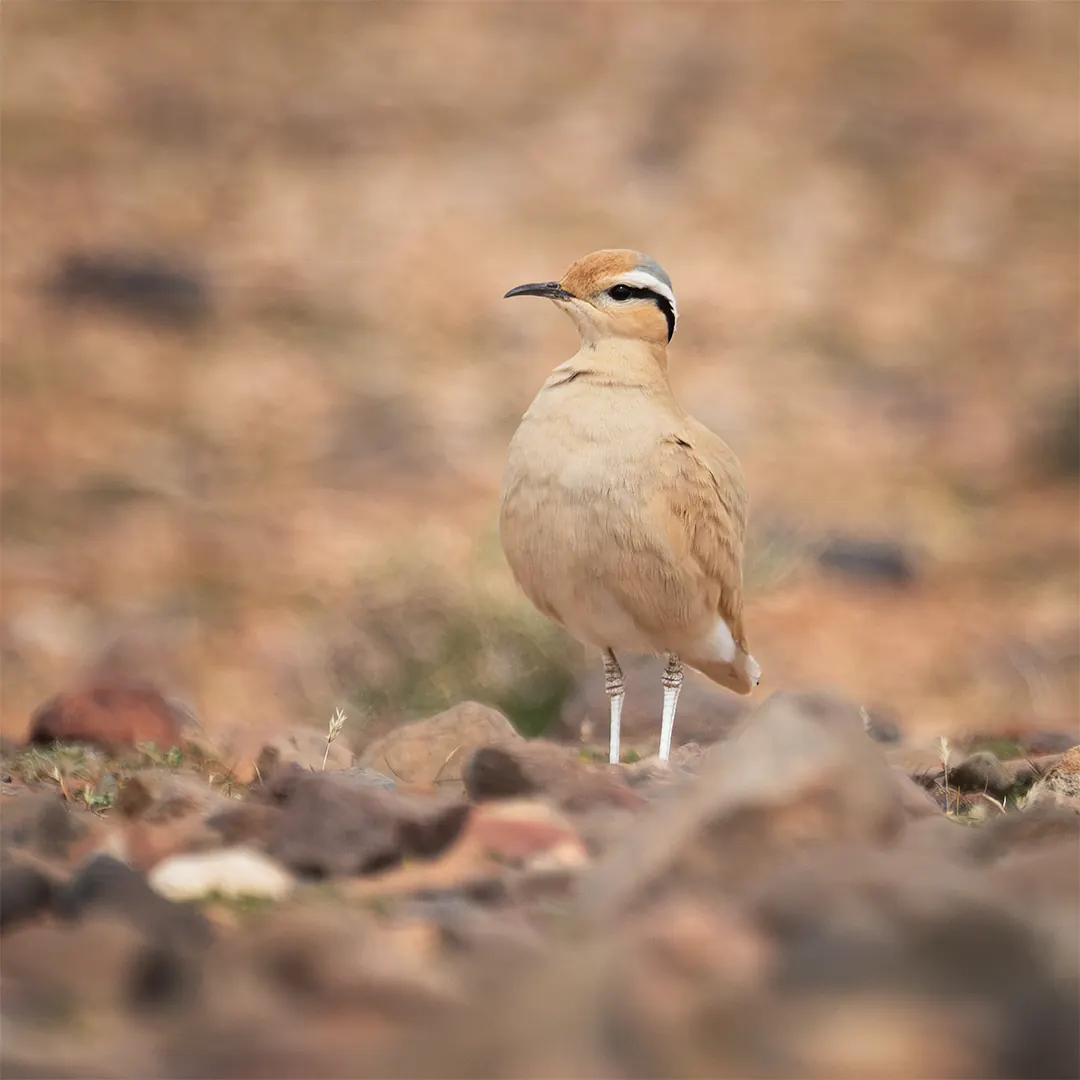
East of Boumalne Dadès lies a plain of stones and low shrubs, the hamada, crossed by the famous Tagdilt track. It is the best place in the country for desert larks: Thick-billed Lark with its outsized bill, Temminck’s Lark with its black “horns”, Greater Hoopoe-Lark with its display flight, and Mediterranean Short-toed Lark. It is also where most birders tick Cream-coloured Courser, a sand-coloured runner that freezes the moment it feels watched.
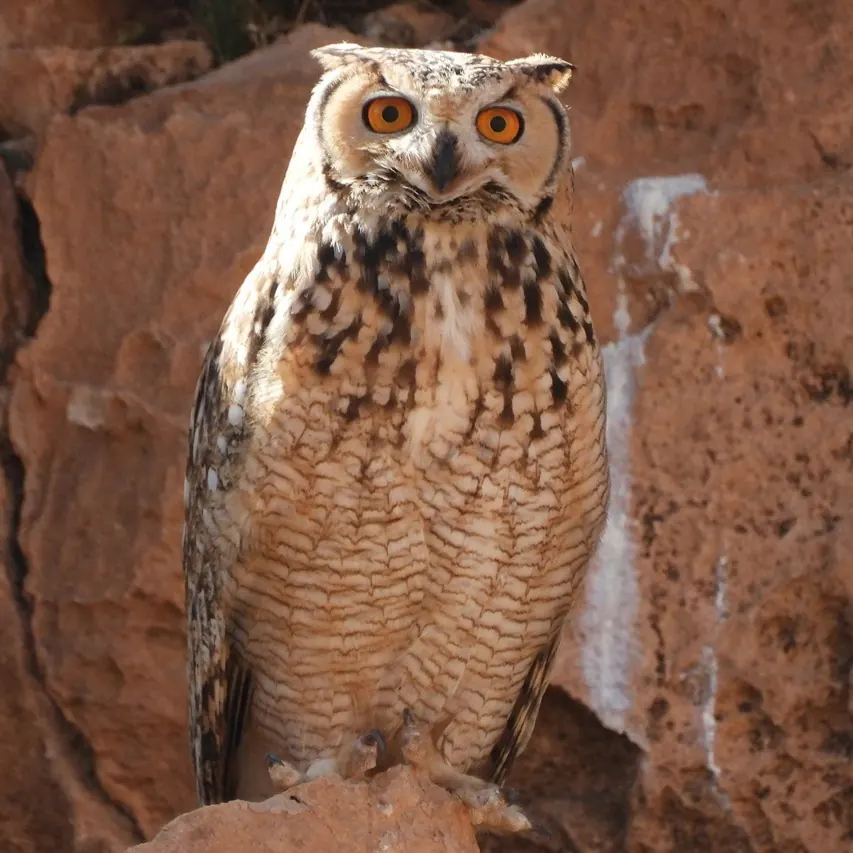
Towards Imider and in the nearby gullies you can add Maghreb Wheatear, White-crowned Wheatear, Trumpeter Finch, Lanner and, with patience, Pharaoh Eagle-Owl on its rock ledge. If you do not know the area, our page on the Todra and Dades gorges puts it on the map.
Merzouga, Erg Chebbi and Dayet Srij lake
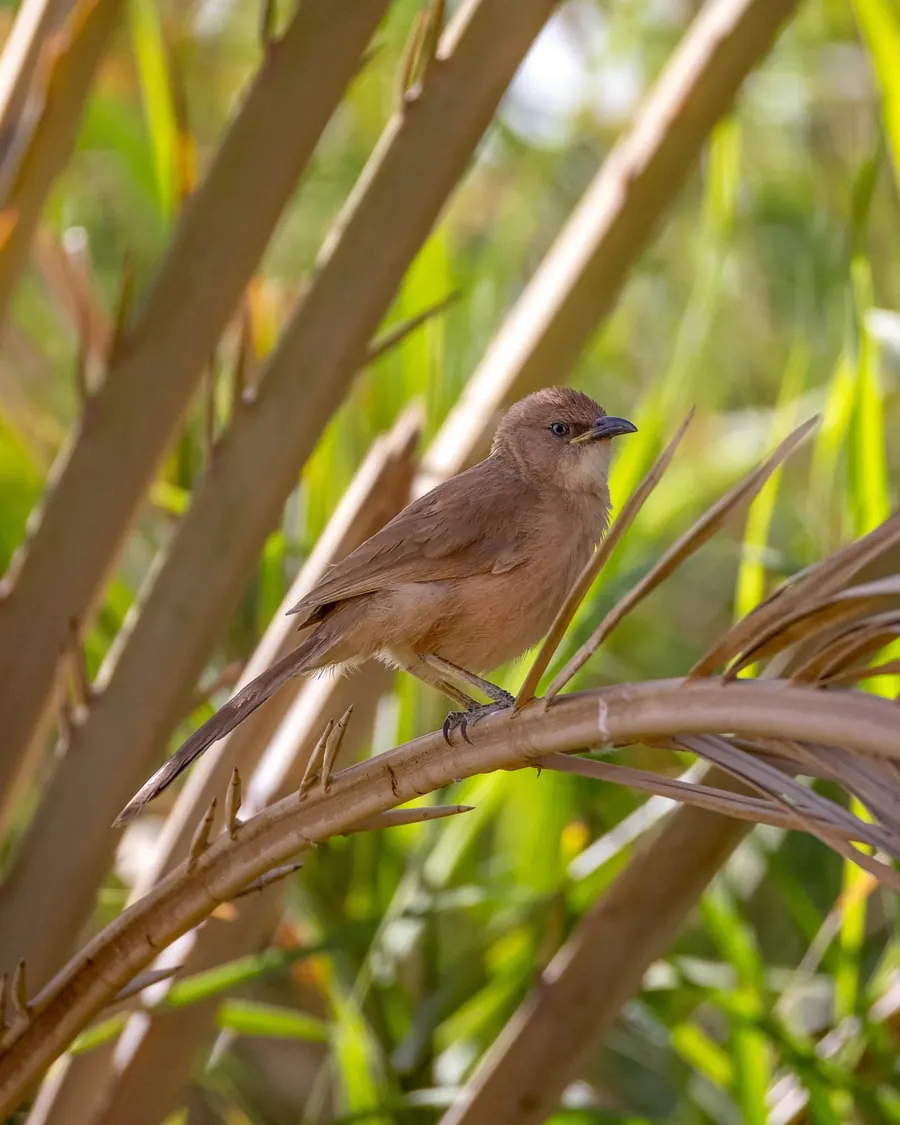
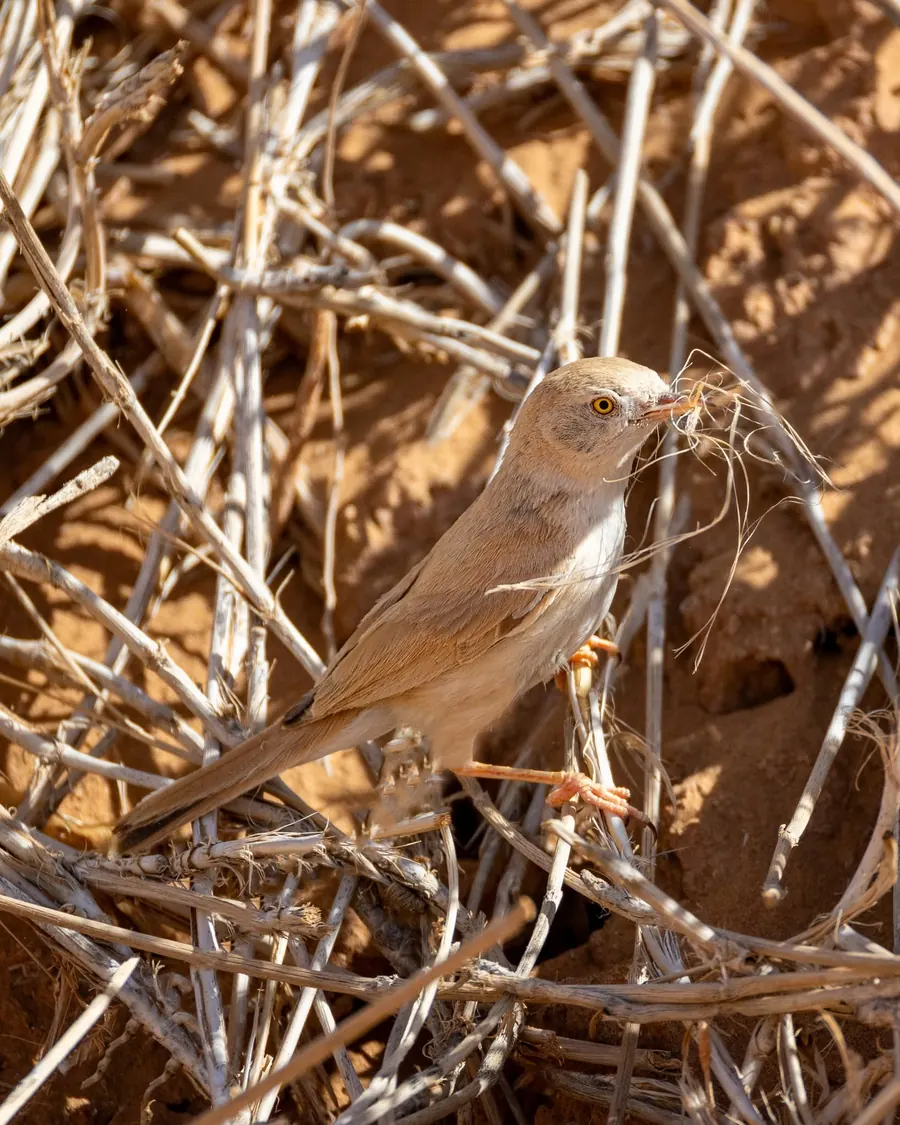
The Erg Chebbi dunes hold Morocco’s most desert-adapted birds. Desert Sparrow, almost white, is looked for near camps and palm groves; Egyptian Nightjar spends the day motionless on the ground and only a trained eye picks it out from the sand; African Desert Warbler, Fulvous Chatterer and Blue-cheeked Bee-eater complete the list, with sandgrouse coming in to drink early in the morning. For the wider picture, see our Merzouga desert guide.
West of the dunes lies Dayet Srij, a seasonal lake. The Key Biodiversity Area factsheet puts the lake at 699 metres and the high dune at 922 metres, and notes that water usually stays from November to May, or until August in wet years. When it is full, expect Greater Flamingos, Ruddy Shelducks and the scarce Marbled Duck; when it is dry, it is a flat bed of mud.
Atlantic coast: Souss-Massa and the Northern Bald Ibis
Souss-Massa National Park, south of Agadir, was created in 1991, covering about 33,800 hectares, to protect the breeding and feeding grounds of the Northern Bald Ibis. According to BirdLife International, over 95% of the world’s truly wild Northern Bald Ibises belong to a single Moroccan population, split between Souss-Massa and Tamri. In 2015, 116 pairs there raised 205 young, and the species was downlisted from Critically Endangered to Endangered on the Red List.
The ibises feed in fields and along the cliff tops, so you can watch them well away from the colonies. The Massa and Souss river mouths add waders, herons, flamingos and seabirds, especially in winter and during migration.
Middle Atlas: the Zaida plain and Ifrane
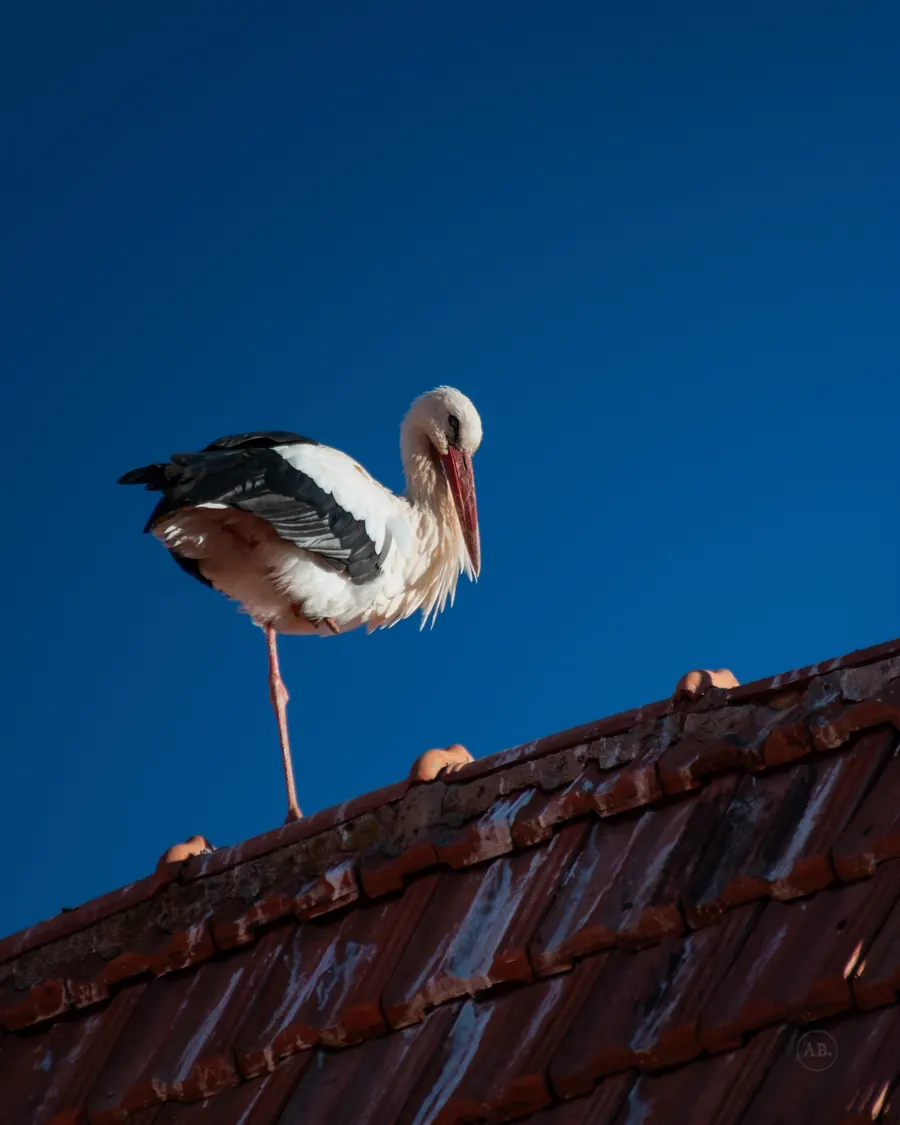
The Zaida plain near Midelt is a classic site for Dupont’s Lark, a bird so secretive that many birders come back several times before they see one. You go before dawn, when it sings, and in winter it is bitterly cold. The same steppe holds Desert Wheatears, which can be surprisingly curious. Further north in Ifrane, White Storks nest on the red-tiled roofs.
Marrakech and the north
You can start without leaving the city: White Storks breed on the walls of El Badi Palace, while gardens and olive groves hold Common Bulbul, Laughing Dove and, with luck, Moussier’s Redstart. In the north, the Merja Zerga lagoon has been a Ramsar site since 20 June 1980 and covers 7,300 hectares; birders go for the winter waders and for Marsh Owl, which hunts at dusk.

Field calendar: when to look for each species
This calendar shows, species by species, the months each bird is usually present and the months it is easiest to find. Residents are here all year but are best when singing and breeding; summer visitors such as Egyptian Nightjar and Blue-cheeked Bee-eater only arrive with the heat.
Indicative: based on each species’ known status (resident or summer visitor) and its song and breeding seasons. It shifts from year to year with rain and snow. For Dayet Srij the calendar shows when the lake usually holds water. Original chart by experiumorocco.com.
Best time for birding in Morocco
February to May is the best time for almost everything: residents are singing, the desert is not yet scorching and spring migration is passing through. In February and March the Atlas may still have snow, and by May the Saharan heat means dawn starts. Autumn, September to November, brings return migration and mild weather in the south.
Winter suits the Atlantic coast and the wetlands, with thousands of waterbirds, but it is cold at Zaida and Oukaïmeden. Summer is the hardest season: only worth it for summer visitors, and only at first light. To fit the birds around the rest of your trip, see the best time to visit Morocco region by region.
Target species and how to find them
| Species | Where | Field tip |
|---|---|---|
| African Crimson-winged Finch | Oukaïmeden | Flocks feeding on the ground by the car park and on the meadows. |
| Moussier’s Redstart | Atlas valleys, olive groves | Perches on bush tops and fences; the male is hard to miss. |
| Thick-billed Lark | Tagdilt track | Work the hamada slowly; it gives itself away when it flies. |
| Cream-coloured Courser | Tagdilt, southern steppes | Runs, then stops dead: watch for stones that move. |
| Pharaoh Eagle-Owl | Gullies and cliffs | Roosts on ledges by day; look for white droppings on the rock. |
| Desert Sparrow | Merzouga | Near camps with water and around palm groves. |
| Egyptian Nightjar | Merzouga | Only with a local guide: it roosts on the ground and must not be flushed. |
| Northern Bald Ibis | Souss-Massa, Tamri | Feeding groups in fields and on slopes near the coast. |
| Dupont’s Lark | Zaida plain | Listen for its song before dawn, without playback. |
Field ethics: birding without disturbance
Many of these birds live in fragile habitats and some are threatened. A few simple rules make all the difference:
- Keep well back from nests, colonies and roosts. If a bird changes behaviour, alarm-calls or flies, you are too close.
- No playback in the breeding season, and never for owls, nightjars or the Northern Bald Ibis.
- With roosting owls and nightjars, keep the visit short and quiet; do not circle the bird for a better angle.
- On the steppe, drive only on existing tracks: fresh tyre marks destroy the plants the larks depend on.
- Some classic sites sit next to rubbish tips with loose dogs; go with someone who knows the place.
- Ask before entering gardens, palm groves or fields, and before photographing people.
What to pack for a Morocco birding trip
- 8×42 or 10×42 binoculars and, ideally, a scope for the steppe and the wetlands.
- A field guide to the birds of North Africa or Morocco, plus an app to log your sightings.
- Layers: dawn is cold in the desert and the Atlas, even in spring.
- Hat, sunscreen, sunglasses and plenty of water for mornings on the hamada.
- Closed shoes for stony ground and a head torch for pre-dawn starts.
How to plan a birding trip to Morocco
One day from Marrakech is enough for Oukaïmeden and the Atlas valleys. For the desert species you need at least five or six days: the Atlas, the Boumalne Dadès hamada and Merzouga fit on one route, with nights at Boumalne and by the dunes. With ten days or more you can add the Souss-Massa coast for the Northern Bald Ibis.
Distances are long and the best birding is early, so stay close to each area rather than driving back and forth. A guide who knows the roosts and the habits of each species saves hours of searching. If you would like a ready-made route, our 7-day Morocco birding tour through the Atlas and Sahara links the three inland areas. For mammals and reptiles too, our guide to Sahara desert animals pairs well with this one.
Birdwatching in Morocco: FAQ
When is the best time for birding in Morocco?
February to May: residents are singing, spring migration is under way and the desert is still pleasant. Autumn, September to November, is the next best option.
Where can you see the Northern Bald Ibis in Morocco?
In Souss-Massa National Park and at Tamri, south and north of Agadir. Almost the whole wild population lives there. Watch them at their feeding areas, never at the colonies.
Can you see African Crimson-winged Finch on a day trip from Marrakech?
Yes. Oukaïmeden is a day trip from Marrakech. Leave early and check beforehand that snow has not closed the road.
What is the Tagdilt track?
An area of hamada, a stony desert plain, on the edge of Boumalne Dadès. It is Morocco’s best-known site for Thick-billed Lark, Temminck’s Lark and Cream-coloured Courser.
How many days do you need for a Morocco birding tour?
One day for the Atlas from Marrakech, around seven for the Atlas and the desert, and ten or more if you add the Atlantic coast for the Northern Bald Ibis.
What birds can you see in Marrakech?
White Storks on El Badi Palace and the city walls, Common Bulbuls and Laughing Doves in the gardens, and Moussier’s Redstart in olive groves on the outskirts.
Sources
- Key Biodiversity Areas Partnership: Merzouga/Tamezguidat site factsheet.
- BirdLife International: Northern Bald Ibis (Geronticus eremita) species factsheet.
- Oryx (Cambridge University Press): Northern bald ibis Geronticus eremita: history, current status and future perspectives.
- Spanish Ministry for the Ecological Transition (OAPN): cooperation report on Souss-Massa National Park (in Spanish).
- Ramsar Convention: Merja Zerga Ramsar site information.